
Arguments for the existence of God are responses to philosophical skepticism. If you have not been deceived by this skepticism to the point of refusing to see when you look, all you have to do is look around yourself for evidence that God is real.
Romans 1:19-20 KJV – 19 Because that which may be known of God is manifest in them; for God hath shewed it unto them. 20 For the invisible things of him from the creation of the world are clearly seen, being understood by the things that are made, even his eternal power and Godhead; so that they are without excuse:
People who are willing to look and see – people whose minds have not been deceived – don’t need a philosophical argument for God. They already know He’s real. They might want to know more about Him, but the fact that He’s real is not a problem.
Furthermore, if they are born again Christians who follow where the Holy Spirit leads, they are sons of God. 1 The skeptic has no hope to convince such people. If you are one these people, you can skip the rest of this post. You are indeed blessed.
For those who are unsure, trust that the answers to any of your questions about God are in the Bible, but beware. Although you have passed the first level of deceivers, the skeptics, there are other wolves (or snakes) who would love to tell you what’s in the Bible like the serpent did to Eve.2
The existence of these wolves3 is as sure as the existence of God. I suspect most of them don’t even know they’re wolves. The Way is narrow4. Don’t let yourself be led astray by blind guides which would be a kind of persecution.5 Forgive them.6 Bless them.7 But move on.8
Skeptics of God’s existence
Philosophical skeptics about God are biblically referred to as fools. They love to run their mouths. If no one listened to them, they would only harm themselves.
Romans 1:21-23 KJV – 21 Because that, when they knew God, they glorified him not as God, neither were thankful; but became vain in their imaginations, and their foolish heart was darkened. 22 Professing themselves to be wise, they became fools, 23 And changed the glory of the uncorruptible God into an image made like to corruptible man, and to birds, and fourfooted beasts, and creeping things.
When skeptics talk they introduce doubt into the minds of their listeners and reinforce it in themselves. When they keep expressing this doubt it becomes a commercial selling speculative lies over and over again.
On the bright side, since skeptics are speaking falsehood, whatever they say will counterproductively spring back on them when people argue against their positions effectively. That defense is the only reason to make these philosophical arguments.
When listeners (including the skeptics themselves) realize that no one in his right mind wants what the skeptics are selling in their commercials, the defense will have succeeded.
Formalized propositional logic
There are many philosophical arguments against skeptics of God’s existence. The kind I am focusing on here is called transcendental arguments. Immanuel Kant began this type of argumentation to address the skepticism of David Hume.9
All I will be doing in this post is formalizing the logical steps that one needs to go through in propositional logic to make a transcendental argument. I will also use an online proof checker10 to validate these steps.
What that will do, hopefully, is make clear what the structure of a transcendental argument is and demonstrate that the structure is valid.
Presuppositions11
To get started I need a proposition, a statement of something obvious that no one would want to reject such as “I think”. Then I need to identify what that proposition presupposes. Following Descartes I might say that “I think” presupposes that “I am”.
Even though I might have to chain these presuppositions to get where I want to go, if I can reach a proposition that some unknown God12 exists, then it is game over for the skeptic. Because of that, I should not expect the skeptic to quietly agree with anything I have to offer. He will claim that I just asserted the presupposition without demonstrating it.13 To make sure that no one agrees with him, I need to make sure that I argue persuasively and clearly.
This is the hardest part of the argument. It is also the part that I’m skipping. All I want to show now is what is going on with such arguments by formalizing them as a propositional proof. I want to make sure that it is clear what these arguments are trying to show.
For an example of a specific transcendental argument, Parker Settecase showed how C.S. Lewis set one up.14
What is a presupposition?
A presupposition is the consequent of two implications where the antecedent of one is the negation of the antecedent of the other. If I say that A presupposes B I mean not only that A implies B but also that not A implies B. If the proposition A and its negation both imply the proposition B, then B is a presupposition of A or A presupposes B.
Although that might sound confusing, presuppositions are easy to find. Here’s an example:
Proposition: There is writing on the paper.
Presupposition: There is a piece of paper.
There is writing on the paper implies that there is a piece of paper.
There is not writing on the paper also implies that there is a piece of paper.
If you accept the proposition or its negation, it makes no sense to reject the presupposition.
Setting up the formalization
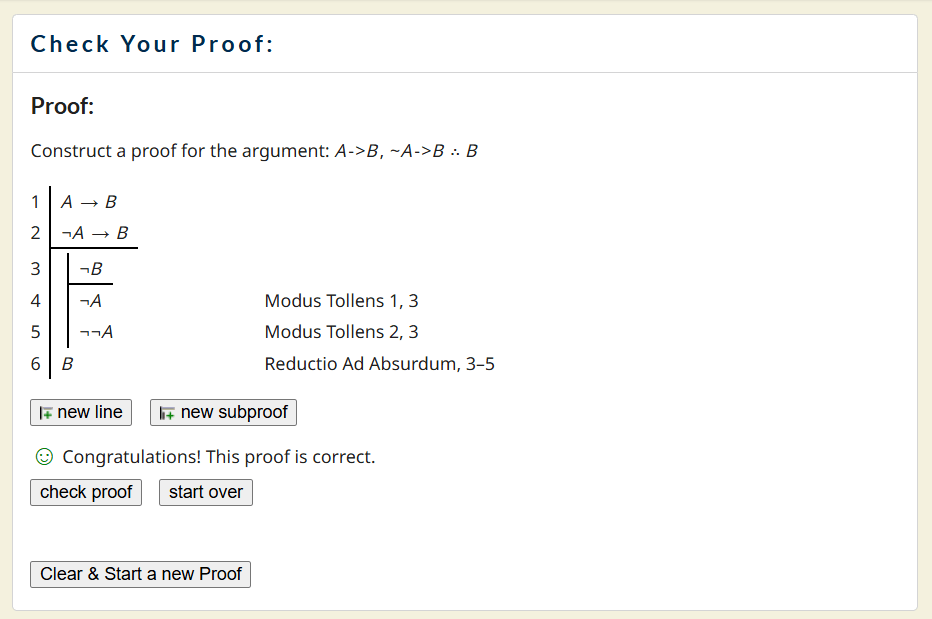
Let A stand for the proposition and let B stand for the presupposition. Next assume the two implications (which I would have to successfully argue for), namely, A implies B and not A implies B.
A → B as the first assumption
¬A → B as the second assumption
What I want to do is show that if I am skeptical and assume not B, then all I get is a contradiction. So, I will assume not B with the intent of deriving a contradiction. That is, I plan to push the skeptic into a corner.
¬B by hypothesis
Since I have assumed not B, I can use modus tollens on A implies B to derive not A. I can do the same to not A implies B to derive not not A. With that I derive the next two lines of the proof.
¬A by modus tollens from the hypothesis and first assumption
¬¬A by modus tollens from the hypothesis and second assumption
Note that those two lines together form a contradiction, not A and not not A. Since I derived a contradiction I can use reductio ad absurdum to reject the hypothesis as absurd. Given a presupposition B, if I hypothesize not B, all I can derive is B.
Proof checker validation15
Moral of the story
If you can show that a true proposition has a presupposition, that presupposition is a necessary condition not only for the proposition but also for its negation.
If the skeptic wants the proposition to be true, he has to accept the presupposition. That is the transcendental argument.
The goal of a transcendental argument for God starts with a proposition even the skeptic can’t reject. It identifies a presupposition of that proposition which leads to some unspecified, unknown God’s existence.
Having that unknown God is all I need. The philosophical step is over. The deception has been broken. The Bible and the Holy Spirit take over (although they have been guiding me all along this philosophical journey which wouldn’t have been necessary if I weren’t deceived in the first place).
______
- Romans 8:14 KJV – 14 For as many as are led by the Spirit of God, they are the sons of God. ↩︎
- Genesis 3:1-5 KJV – 1 Now the serpent was more subtil than any beast of the field which the LORD God had made. And he said unto the woman, Yea, hath God said, Ye shall not eat of every tree of the garden? 2 And the woman said unto the serpent, We may eat of the fruit of the trees of the garden: 3 But of the fruit of the tree which is in the midst of the garden, God hath said, Ye shall not eat of it, neither shall ye touch it, lest ye die. 4 And the serpent said unto the woman, Ye shall not surely die: 5 For God doth know that in the day ye eat thereof, then your eyes shall be opened, and ye shall be as gods, knowing good and evil. ↩︎
- Matthew 7:15-20 KJV – 15 Beware of false prophets, which come to you in sheep’s clothing, but inwardly they are ravening wolves. 16 Ye shall know them by their fruits. Do men gather grapes of thorns, or figs of thistles? 17 Even so every good tree bringeth forth good fruit; but a corrupt tree bringeth forth evil fruit. 18 A good tree cannot bring forth evil fruit, neither can a corrupt tree bring forth good fruit. 19 Every tree that bringeth not forth good fruit is hewn down, and cast into the fire. 20 Wherefore by their fruits ye shall know them. ↩︎
- Matthew 7:13-14 KJV – 13 Enter ye in at the strait gate: for wide is the gate, and broad is the way, that leadeth to destruction, and many there be which go in thereat: 14 Because strait is the gate, and narrow is the way, which leadeth unto life, and few there be that find it. ↩︎
- Mark 10:29-30 KJV – 29 And Jesus answered and said, Verily I say unto you, There is no man that hath left house, or brethren, or sisters, or father, or mother, or wife, or children, or lands, for my sake, and the gospel’s, 30 But he shall receive an hundredfold now in this time, houses, and brethren, and sisters, and mothers, and children, and lands, with persecutions; and in the world to come eternal life. ↩︎
- Matthew 5:43-45 KJV – 43 Ye have heard that it hath been said, Thou shalt love thy neighbour, and hate thine enemy. 44 But I say unto you, Love your enemies, bless them that curse you, do good to them that hate you, and pray for them which despitefully use you, and persecute you; 45 That ye may be the children of your Father which is in heaven: for he maketh his sun to rise on the evil and on the good, and sendeth rain on the just and on the unjust. ↩︎
- Luke 6:27-28 KJV – 27 But I say unto you which hear, Love your enemies, do good to them which hate you, 28 Bless them that curse you, and pray for them which despitefully use you. ↩︎
- 1 Timothy 6:3-5 KJV – 3 If any man teach otherwise, and consent not to wholesome words, even the words of our Lord Jesus Christ, and to the doctrine which is according to godliness; 4 He is proud, knowing nothing, but doting about questions and strifes of words, whereof cometh envy, strife, railings, evil surmisings, 5 Perverse disputings of men of corrupt minds, and destitute of the truth, supposing that gain is godliness: from such withdraw thyself. ↩︎
- Bardon, Adrian, “Transcendental Arguments”, Internet Encyclopedia of Philosophy, https://iep.utm.edu/trans-ar/ ↩︎
- Open Logic Project: https://openlogicproject.org/ ↩︎
- Beaver, David I., Bart Geurts, and Kristie Denlinger, “Presupposition”, The Stanford Encyclopedia of Philosophy (Fall 2024 Edition), Edward N. Zalta & Uri Nodelman (eds.), URL = <https://plato.stanford.edu/archives/fall2024/entries/presupposition/> ↩︎
- Acts 17:22-23 KJV – 22 Then Paul stood in the midst of Mars’ hill, and said, Ye men of Athens, I perceive that in all things ye are too superstitious. 23 For as I passed by, and beheld your devotions, I found an altar with this inscription, TO THE UNKNOWN GOD. Whom therefore ye ignorantly worship, him declare I unto you. ↩︎
- Sheng-Ta Tsai, Deconstructing Christianity, Transcendental Argument for God’s Existence Debunked, 9/20/2023 ↩︎
- Parker Settecase provided a detailed presentation of this proof in his blog post of 11/13/2017, C.S.Lewis’s Transcendental Argument for God. ↩︎
- https://proof-checker.org/ ↩︎

 Poetry, Short Prose and Walking
I’m happy I didn’t have to read all that!! I’m a son of God!
LikeLiked by 1 person
You are indeed! There was no need to read further. Blessings and thank you, Mary!
LikeLike
Wow you spent some time writing this! You have really thought about TAG
LikeLiked by 1 person
There is another part to this. I want to go into the details of C.S. Lewis’s specific transcendental argument formalizing it as well. I may have that finished in a couple of weeks. Blessings and thank you, Jim!
LikeLiked by 1 person
Wow
LikeLiked by 1 person
The mitzva of observing Torah commandments לשמה within the borders of the oath sworn brit lands, the inheritance of the Chosen Cohen people.
[[[ Within the covenantal framework that you so powerfully defend, how do you see the role of individual conscience? Not as a competing system, but as a faculty formed by oath remembrance and living Torah? I[[[ Within the covenantal framework that you so powerfully defend, how do you see the role of individual conscience? Not as a competing system, but as a faculty formed by oath remembrance and living Torah? In a world saturated with propaganda and revisionism, what disciplines shape that conscience to remain true to Sinai? ]]]
The Books of שמות וויקרא concentrate on the avodat HaShem of dedicating korbanot. This “service” does not exist as offering up a barbeque unto Heaven. The mitzva of the פרט case of Moshiach learns from the כלל of korbanot services of the House of Aaron.
Another בנין אב-precedent, the כלל for faith: צדק צדק תרדוף. Still another פרט-בנין אב precedent: the court case of Hebrew slaves vs. the State of Par’o – beating slaves for their rebellion to meet their brick production quota consequent to Par’o withholding the required straw.
One other בנין אב-precedent learns from the כלל that all ברכות require שם ומלכות.
Just as a korban requires a dedication to achieve a specific specified purpose, so too the mitzva of Moshiach. Specifically in the mitzva case dedication of Moshiach, this dedicated “king” sanctified לשמה to rule the land with Judicial justice, working through the common law lateral Sanhedrin courtrooms. Based upon the Torah Constitutional mandate that the Sanhedrin courts operate through משנה תורה-Legislative Review of any and all statute laws or bureaucratic regulations imposed by the Monarchy and/or his government.
The often repeated rebuke which the Book of Shmuel makes upon the House of David as Moshiach, the injustice shown to the husband of Bat Sheva. This פרט-specific defines the כלל dedication of the mitzva dedication of Moshiach. No such dedication for the mitzva of Moshiach to become a substitute theology which has some mythical theologically based messiah to replace the chosen Cohen People.
The opening word of the Torah בראשית, through the aggadic stories of the Creation, teaches the k’vanna of tohor time-oriented commandments; as the Av of the תולדות secondary source positive and negative commandments located specifically in the Books of שמות ויקרא ובמדבר. Hence just as the Book of בראשית introduces the Avot Avraham Yitzak and Yaacov, this opening first Book of the Torah introduces Av tohor time-oriented commandments which the rest of the Books of the Torah come to clarify.
For example: what separates tohor spirits from tumah spirits? Avodat HaShem in the Mishkan, only served in the state of tohor middot. For a Cohen to serve within the Mishkan in a condition of tumah middot – this Av transgression carries the din of כרת. Cutting off that person and his children from the oath brit wherein HaShem and the Avot mutually swore to create the chosen Cohen people יש מאין. This latter בראשית most essential idea shares nothing with tuma middot which promote racial or genetic inheritance of the Jewish race – as the Xtian church and Nazis promote – examples of tumah middot.
Hence to swear a Torah oath requires שם ומלכות like as do all ברכות from the Torah. The sin of the Golden Calf – a substitute theology which replaces the revelation of the 1st Sinai commandment revelation of the Spirit Divine Presence Name unto other word-Gods. Avoda zara by definition worships other Word-gods. The sin of the Golden Calf serves as the defining פרט for the 2nd Sinai Commandment כלל not to worship other Gods.
Therefore all Torah oath britot require שם ומלכות. The Name clearly directly links to the Spirit Divine Presence Name revealed in the first Sinai commandment. The term מלך refers to the כלל mitzva of the dedication of the spirit of משיח as expressed through all tohor time oriented Av commandments … the righteous pursuit of justice to achieve shalom among the chosen Cohen people throughout the generations in all Ages and times while Jews rule our ancient homelands.
מלכות understood as the dedication of defined tohor middot. אל remembrance of the Sin of the Golden Calf. רחום the inference which turns pity upon its head. Obliterating the Canaanites, the killing of the minor stubborn and rebellious child, the war against Amalek (Jewish assimilation to foreign cultures and customs of peoples who do not accept the revelation of the Torah at Sinai. And intermarriage with such Goyim). The middah of רחום a Jew dedicates how he shall socially interact with both his people and Goyim in the future; specifically through the dedication of defined tohor middot. חנון the general dedication to dedicate all future behavioral patterns with family friends, people, and even Goyim by and through the future born tohor middot that a person dedicates whenever that Jews does Torah or Talmudic mitzvot/halachot.
Both Xtianity and Islam worship other Word-gods. Therefore both religions do not define faith as the pursuit of justice, but rather belief in the theologies about these Word-gods.
[[[ Also, when you speak of the erasure of Jewish self-determination through revisionist Palestinian narratives, I hear both an intellectual rebuttal and a deep historical wound. Is your critique aimed primarily at the political manipulation of language and borders—or also at the erasure of Jewish covenantal memory from the land itself? ]]]
Unlike the Xtian and Muslims theologies which promote some pie in the sky Universal Monotheism God, the revelation of the Torah at Sinai revealed the local tribal God of Israel. When David fled from king Shaul he declared as he entered g’lut lands: “I have been forced to abandon God”. Just as the Great and Small Sanhedrin courts only have jurisdiction within the borders of the Jewish state so too the local God of Israel. Herein the answer given to the Holocaust survivor who said to me: “I was in Auschwitz, Where was God?” When I lived in the US and Xtian people asked me if I was a religious Jew? I responded with: I am an atheist praise God. But even living within the borders of the oath sworn brit alliance lands I habitually respond to Goyim with “I am an atheist – praise God”. Meaning, I do not believe in any theological/creed construct of Word-gods – praise God. LOL Torah, its deep and requires a sense of humor.
The curse of g’lut-exile of my people almost immediately caused Jews to lose the wisdom how to do mitzvot לשמה. G’lut Jewry does not understand how to employ and work our Yatrir HaTov within our hearts. The בנין אב-precedent of blowing the shofer serves as a פרט to define the כלל of Yatzir HaTov. Meaning, to blow a shofar requires air from the lungs. But to blow a spirit from the Yatzir HaTov within the heart requires the k’vanna, (all time-oriented commandments require k’vanna) the dedication of defined tohor middot spirits. This כללי-general idea of tohor middot, it defines the dedication of the middah of חנון.
Herein a definition of 3 of the 13 tohor middot which a person dedicates through Yatzir Tov k’vannot from within their hearts. Jews uprooted from our homelands by both the Babylonians and Romans caused the g’lut cursed survivors to lose this kabbalah wisdom which defines how to do mitzvot לשמה.
LikeLike