Formalizing the Transcendental Argument Against Skepticism

Arguments for the existence of God are responses to philosophical skepticism. If you have not been deceived by this skepticism to the point of refusing to see when you look, all you have to do is look around yourself for evidence that God is real.

Romans 1:19-20 KJV19 Because that which may be known of God is manifest in them; for God hath shewed it unto them. 20 For the invisible things of him from the creation of the world are clearly seen, being understood by the things that are made, even his eternal power and Godhead; so that they are without excuse:

People who are willing to look and see – people whose minds have not been deceived – don’t need a philosophical argument for God. They already know He’s real. They might want to know more about Him, but the fact that He’s real is not a problem.

Furthermore, if they are born again Christians who follow where the Holy Spirit leads, they are sons of God. 1 The skeptic has no hope to convince such people. If you are one these people, you can skip the rest of this post. You are indeed blessed.

For those who are unsure, trust that the answers to any of your questions about God are in the Bible, but beware. Although you have passed the first level of deceivers, the skeptics, there are other wolves (or snakes) who would love to tell you what’s in the Bible like the serpent did to Eve.2

The existence of these wolves3 is as sure as the existence of God. I suspect most of them don’t even know they’re wolves. The Way is narrow4. Don’t let yourself be led astray by blind guides which would be a kind of persecution.5 Forgive them.6 Bless them.7 But move on.8

Skeptics of God’s existence

Philosophical skeptics about God are biblically referred to as fools. They love to run their mouths. If no one listened to them, they would only harm themselves.

Romans 1:21-23 KJV21 Because that, when they knew God, they glorified him not as God, neither were thankful; but became vain in their imaginations, and their foolish heart was darkened. 22 Professing themselves to be wise, they became fools, 23 And changed the glory of the uncorruptible God into an image made like to corruptible man, and to birds, and fourfooted beasts, and creeping things.

When skeptics talk they introduce doubt into the minds of their listeners and reinforce it in themselves. When they keep expressing this doubt it becomes a commercial selling speculative lies over and over again.

On the bright side, since skeptics are speaking falsehood, whatever they say will counterproductively spring back on them when people argue against their positions effectively. That defense is the only reason to make these philosophical arguments.

When listeners (including the skeptics themselves) realize that no one in his right mind wants what the skeptics are selling in their commercials, the defense will have succeeded.

Formalized propositional logic

There are many philosophical arguments against skeptics of God’s existence. The kind I am focusing on here is called transcendental arguments. Immanuel Kant began this type of argumentation to address the skepticism of David Hume.9

All I will be doing in this post is formalizing the logical steps that one needs to go through in propositional logic to make a transcendental argument. I will also use an online proof checker10 to validate these steps.

What that will do, hopefully, is make clear what the structure of a transcendental argument is and demonstrate that the structure is valid.

Presuppositions11

To get started I need a proposition, a statement of something obvious that no one would want to reject such as “I think”. Then I need to identify what that proposition presupposes. Following Descartes I might say that “I think” presupposes that “I am”.

Even though I might have to chain these presuppositions to get where I want to go, if I can reach a proposition that some unknown God12 exists, then it is game over for the skeptic. Because of that, I should not expect the skeptic to quietly agree with anything I have to offer. He will claim that I just asserted the presupposition without demonstrating it.13 To make sure that no one agrees with him, I need to make sure that I argue persuasively and clearly.

This is the hardest part of the argument. It is also the part that I’m skipping. All I want to show now is what is going on with such arguments by formalizing them as a propositional proof. I want to make sure that it is clear what these arguments are trying to show.

For an example of a specific transcendental argument, Parker Settecase showed how C.S. Lewis set one up.14

What is a presupposition?

A presupposition is the consequent of two implications where the antecedent of one is the negation of the antecedent of the other. If I say that A presupposes B I mean not only that A implies B but also that not A implies B. If the proposition A and its negation both imply the proposition B, then B is a presupposition of A or A presupposes B.

Although that might sound confusing, presuppositions are easy to find. Here’s an example:

Proposition: There is writing on the paper.
Presupposition: There is a piece of paper.
There is writing on the paper implies that there is a piece of paper.
There is not writing on the paper also implies that there is a piece of paper.
If you accept the proposition or its negation, it makes no sense to reject the presupposition.

Setting up the formalization

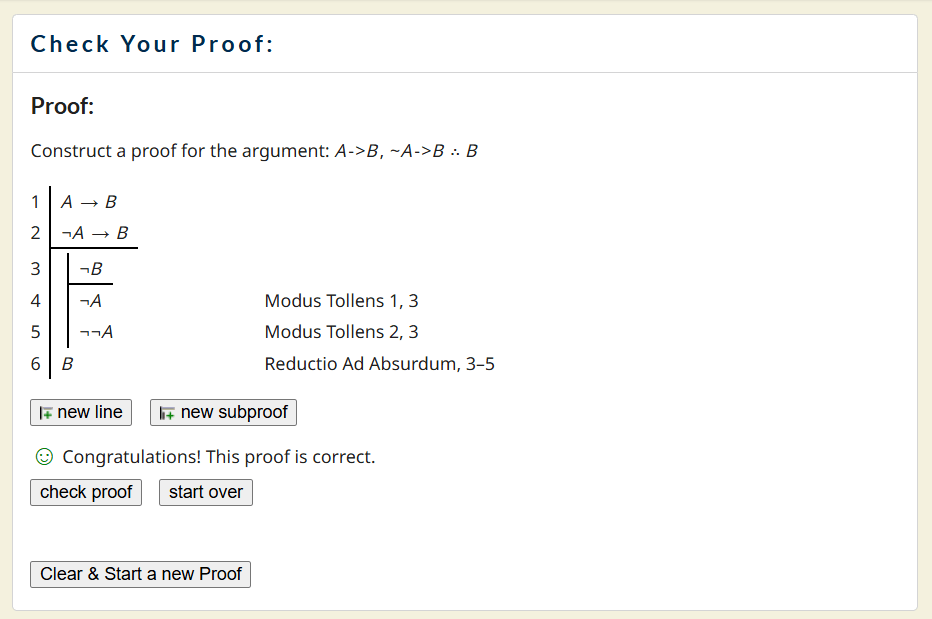
Let A stand for the proposition and let B stand for the presupposition. Next assume the two implications (which I would have to successfully argue for), namely, A implies B and not A implies B.

What I want to do is show that if I am skeptical and assume not B, then all I get is a contradiction. So, I will assume not B with the intent of deriving a contradiction. That is, I plan to push the skeptic into a corner.

Since I have assumed not B, I can use modus tollens on A implies B to derive not A. I can do the same to not A implies B to derive not not A. With that I derive the next two lines of the proof.

Note that those two lines together form a contradiction, not A and not not A. Since I derived a contradiction I can use reductio ad absurdum to reject the hypothesis as absurd. Given a presupposition B, if I hypothesize not B, all I can derive is B.

Proof checker validation15

Moral of the story

If you can show that a true proposition has a presupposition, that presupposition is a necessary condition not only for the proposition but also for its negation.

If the skeptic wants the proposition to be true, he has to accept the presupposition. That is the transcendental argument.

The goal of a transcendental argument for God starts with a proposition even the skeptic can’t reject. It identifies a presupposition of that proposition which leads to some unspecified, unknown God’s existence.

Having that unknown God is all I need. The philosophical step is over. The deception has been broken. The Bible and the Holy Spirit take over (although they have been guiding me all along this philosophical journey which wouldn’t have been necessary if I weren’t deceived in the first place).

______

  1. Romans 8:14 KJV14 For as many as are led by the Spirit of God, they are the sons of God. ↩︎
  2. Genesis 3:1-5 KJV1 Now the serpent was more subtil than any beast of the field which the LORD God had made. And he said unto the woman, Yea, hath God said, Ye shall not eat of every tree of the garden? 2 And the woman said unto the serpent, We may eat of the fruit of the trees of the garden: 3 But of the fruit of the tree which is in the midst of the garden, God hath said, Ye shall not eat of it, neither shall ye touch it, lest ye die. 4 And the serpent said unto the woman, Ye shall not surely die: 5 For God doth know that in the day ye eat thereof, then your eyes shall be opened, and ye shall be as gods, knowing good and evil. ↩︎
  3. Matthew 7:15-20 KJV15 Beware of false prophets, which come to you in sheep’s clothing, but inwardly they are ravening wolves. 16 Ye shall know them by their fruits. Do men gather grapes of thorns, or figs of thistles? 17 Even so every good tree bringeth forth good fruit; but a corrupt tree bringeth forth evil fruit. 18 A good tree cannot bring forth evil fruit, neither can a corrupt tree bring forth good fruit. 19 Every tree that bringeth not forth good fruit is hewn down, and cast into the fire. 20 Wherefore by their fruits ye shall know them. ↩︎
  4. Matthew 7:13-14 KJV13 Enter ye in at the strait gate: for wide is the gate, and broad is the way, that leadeth to destruction, and many there be which go in thereat: 14 Because strait is the gate, and narrow is the way, which leadeth unto life, and few there be that find it. ↩︎
  5. Mark 10:29-30 KJV29 And Jesus answered and said, Verily I say unto you, There is no man that hath left house, or brethren, or sisters, or father, or mother, or wife, or children, or lands, for my sake, and the gospel’s, 30 But he shall receive an hundredfold now in this time, houses, and brethren, and sisters, and mothers, and children, and lands, with persecutions; and in the world to come eternal life. ↩︎
  6. Matthew 5:43-45 KJV43 Ye have heard that it hath been said, Thou shalt love thy neighbour, and hate thine enemy. 44 But I say unto you, Love your enemies, bless them that curse you, do good to them that hate you, and pray for them which despitefully use you, and persecute you; 45 That ye may be the children of your Father which is in heaven: for he maketh his sun to rise on the evil and on the good, and sendeth rain on the just and on the unjust. ↩︎
  7. Luke 6:27-28 KJV27 But I say unto you which hear, Love your enemies, do good to them which hate you, 28 Bless them that curse you, and pray for them which despitefully use you. ↩︎
  8. 1 Timothy 6:3-5 KJV3 If any man teach otherwise, and consent not to wholesome words, even the words of our Lord Jesus Christ, and to the doctrine which is according to godliness; 4 He is proud, knowing nothing, but doting about questions and strifes of words, whereof cometh envy, strife, railings, evil surmisings, 5 Perverse disputings of men of corrupt minds, and destitute of the truth, supposing that gain is godliness: from such withdraw thyself. ↩︎
  9. Bardon, Adrian, “Transcendental Arguments”, Internet Encyclopedia of Philosophy, https://iep.utm.edu/trans-ar/ ↩︎
  10. Open Logic Project: https://openlogicproject.org/ ↩︎
  11. Beaver, David I., Bart Geurts, and Kristie Denlinger, “Presupposition”, The Stanford Encyclopedia of Philosophy (Fall 2024 Edition), Edward N. Zalta & Uri Nodelman (eds.), URL = <https://plato.stanford.edu/archives/fall2024/entries/presupposition/&gt; ↩︎
  12. Acts 17:22-23 KJV22 Then Paul stood in the midst of Mars’ hill, and said, Ye men of Athens, I perceive that in all things ye are too superstitious. 23 For as I passed by, and beheld your devotions, I found an altar with this inscription, TO THE UNKNOWN GOD. Whom therefore ye ignorantly worship, him declare I unto you. ↩︎
  13. Sheng-Ta Tsai, Deconstructing Christianity, Transcendental Argument for God’s Existence Debunked, 9/20/2023 ↩︎
  14. Parker Settecase provided a detailed presentation of this proof in his blog post of 11/13/2017, C.S.Lewis’s Transcendental Argument for God. ↩︎
  15. https://proof-checker.org/ ↩︎

Thursday Doors: President James K. Polk’s Birthplace

Since the James K. Polk Site near Charlotte, North Carolina, is only four miles away and offers easy bike access to the Little Sugar Creek Greenway, I go there often.

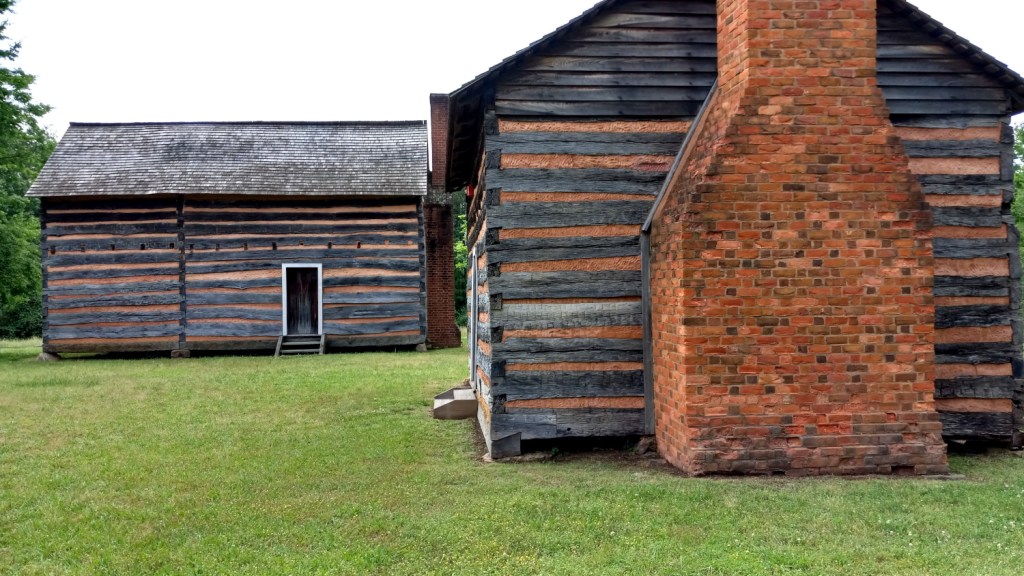
Here are photos of the doors on the early 1800s style buildings. These aren’t the original Polk family buildings, but they are representative buildings from the area.

There are also guided tours through the buildings and a museum.

______

The red stuff would have been clay from the Little Sugar Creek a few hundred feet away, but is now reinforced with a cement of some sort.
A view of the cabin with the main hearth.
A view from the garden.

______

Linked to Thursday Doors.

Ritva at Ritva Sillanmäki Photography

Six Sentence Story: Pop

“After all these years of searching I’ve found nothing – nada – zip – that would explain how there could be life of any sort in any universe,” Brian told his grandchildren, “which makes me wonder what lit the fuse that got us here.”

But didn’t it all just pop out of nothing?

By itself!?

Yeah, we heard it went pippity-pop like pop corn, grandpops.

What in the world do they teach you kids in school these days? Nothing like that could ever happen.

______

Denise offers the prompt word “fuse” to be used in this week’s Six Sentence Stories.

Diotrephes and Demetrius

The short epistle of 3 John contrasts two leaders in the early church: Diotrephes and Demetrius.

Diotrephes

3 John 1:9-10 KJV9 I wrote unto the church: but Diotrephes, who loveth to have the preeminence among them, receiveth us not.
10 Wherefore, if I come, I will remember his deeds which he doeth, prating against us with malicious words: and not content therewith, neither doth he himself receive the brethren, and forbiddeth them that would, and casteth them out of the church.

Demetrius

3 John 1:11-12 KJV11 Beloved, follow not that which is evil, but that which is good. He that doeth good is of God: but he that doeth evil hath not seen God.
12 Demetrius hath good report of all men, and of the truth itself: yea, and we also bear record; and ye know that our record is true.

Leadership in Church History

When Paul described the qualities that a bishop must have, he indirectly warned about the kind of men who should not be followed if given leadership positions in the church.

1 Timothy 3:2-7 KJV2 A bishop then must be blameless, the husband of one wife, vigilant, sober, of good behaviour, given to hospitality, apt to teach;
3 Not given to wine, no striker, not greedy of filthy lucre; but patient, not a brawler, not covetous;
4 One that ruleth well his own house, having his children in subjection with all gravity;
5 (For if a man know not how to rule his own house, how shall he take care of the church of God?)
6 Not a novice, lest being lifted up with pride he fall into the condemnation of the devil.
7 Moreover he must have a good report of them which are without; lest he fall into reproach and the snare of the devil.

Before the church gained political power, it was persecuted. After it gained political power, it began persecuting others itself. This was the result of people who should have never received leadership roles.

Justo L. Gonzalez1 commented on the persecution of the Anabaptists (and I have read far enough into that book to highly suspect that it applies to any Christian group that suffered persecution at the hands of other Christians):

The martyrs were many—probably more than those who died during the three centuries of persecution before the time of Constantine.

Paul tells us what could have happened from the very beginning of church history if people chose to follow the lead of the Spirit of God rather than their own lusts.

What could have happened is almost beyond imagining:

Romans 8:14 KJVFor as many as are led by the Spirit of God, they are the sons of God.

The Point

None of the faulty leadership in the church had to happen. It could have all been avoided.

God did not will it. Don’t blame Him.

It was not caused by Augustinian total depravity nor was it caused by materialistic determinism, the atheistic rehashing of that Augustinian teaching.

Those responsible cannot hide behind any of these lame excuses for their own choices, their own defiant refusals to become the sons of God.

  1. Justo L. Gonzalez, The Story of Christianity: The Reformation to the Present Day, page 56. ↩︎

Six Sentence Story: God Wills That All Be Saved

After listening to the song, Saint Augustine in Hell, Gregory asked John, his father confessor, how anyone could imagine that Saint Augustine might be in hell.

Well, Father John explained, Saint Augustine was a saint and God wills all to be saved, so there’s a very good chance that he’s in heaven. But he did teach that only some, not all, of us were predestined to go to heaven – predestined before we were even born so we could not boast that we had anything to do with it, so – if he’s right – he might be one of those unfortunate ones the Lord never knew.

Unable to lace his doubts into a secure knot of preservation with these vague words, Gregory cried, Please, Father John, I’ve got to know!

You, my son, I trust will be in heaven, Father John assured him, because you love God with your whole heart, because you follow where He leads and because God wills that all be saved just as you do, so when you get there ask for Saint Augustine and rejoice when he greets you. If it turns out that you can’t remember his name, then rejoice nonetheless in the Lord.

______

Denise offers the prompt word “lace” to be used in this week’s Six Sentence Stories.

1 Timothy 2:1-4 KJV1 I exhort therefore, that, first of all, supplications, prayers, intercessions, and giving of thanks, be made for all men;
2 For kings, and for all that are in authority; that we may lead a quiet and peaceable life in all godliness and honesty.
3 For this is good and acceptable in the sight of God our Saviour;
4 Who will have all men to be saved, and to come unto the knowledge of the truth.

2 Peter 3:9 KJV9 The Lord is not slack concerning his promise, as some men count slackness; but is longsuffering to us-ward, not willing that any should perish, but that all should come to repentance.

Romans 10:9-13 KJV9 That if thou shalt confess with thy mouth the Lord Jesus, and shalt believe in thine heart that God hath raised him from the dead, thou shalt be saved.
10 For with the heart man believeth unto righteousness; and with the mouth confession is made unto salvation.
11 For the scripture saith, Whosoever believeth on him shall not be ashamed.
12 For there is no difference between the Jew and the Greek: for the same Lord over all is rich unto all that call upon him.
13 For whosoever shall call upon the name of the Lord shall be saved.

Saint Augustine, On the Predestination of the Saints, Chapter 16: Faith, then, as well in its beginning as in its completion, is God’s gift; and let no one have any doubt whatever, unless he desires to resist the plainest sacred writings, that this gift is given to some, while to some it is not given. But why it is not given to all ought not to disturb the believer, who believes that from one all have gone into a condemnation, which undoubtedly is most righteous; so that even if none were delivered therefrom, there would be no just cause for finding fault with God. Whence it is plain that it is a great grace for many to be delivered, and to acknowledge in those that are not delivered what would be due to themselves; so that he that glories may glory not in his own merits, which he sees to be equalled in those that are condemned, but in the Lord. But why He delivers one rather than another —His judgments are unsearchable, and His ways past finding out. Romans 11:33 For it is better in this case for us to hear or to say, O man, who are you that repliest against God? Romans 9:20 than to dare to speak as if we could know what He has chosen to be kept secret. Since, moreover, He could not will anything unrighteous.

Six Sentence Story: Pretty Pink and Baby Blue

The devils planted Pamela wearing her pretty pink petunias next to Billy with his baby blue blossoms in a flower bed.

That’ll teach um, one of the devils said.

Teach um what? the other asked.

Teach um . . . hmmm, yeah, teach um what? . . . ah! teach um that now they can weep and moan and gnash their teeth at each other for all eternity. The dumbest thing they ever did was to find their way down here.

Just then another truckload of flowering wretches arrived.

______

Denise offers the prompt word “bed” to be used in this week’s Six Sentence Stories.

Luke 13:28-30 KJV28 There shall be weeping and gnashing of teeth, when ye shall see Abraham, and Isaac, and Jacob, and all the prophets, in the kingdom of God, and you yourselves thrust out.
29 And they shall come from the east, and from the west, and from the north, and from the south, and shall sit down in the kingdom of God.
30 And, behold, there are last which shall be first, and there are first which shall be last.

I don’t think this photo has anything to do with the story, but you are welcome to let your imagination run wild.

The Church of the Holy Sepulchre and the Shroud of Turin

This morning I followed an email link from the Associates for Biblical Research to one of their Digging for Truth episodes on the tomb of Jesus.

The tour we took when in Israel scheduled us to see the Garden Tomb, but neglected the Church of the Holy Sepulchre. This episode, however, convinces me that we should have gone to the Church of the Holy Sepulchre instead.

In the above video they mentioned the Shroud of Turin. I realized that I knew little to nothing about this shroud except that it was claimed to have covered the body of Jesus.

The following is a 8 minute summary of the evidence that favors the view that this was, indeed, the actual shroud that covered Jesus.

Six Sentence Story: How I Learned to Confuse Chickens With Dinosaurs

Although less than ten years old the boys were old enough to read a children’s weekly their parents purchased for them. One of the stories reported that chickens evolved from dinosaurs (or perhaps it was the other way around).

Regardless, the boys decided they would find a dinosaur and become famous like the guy who wrote that story. One of the boys thought that a slight rise in the normally flat Indiana farm land was enough of a warrant to proclaim that ground as the perfect burial ground for a dinosaur, but their father told them they could not dig there while the corn was growing.

So they shifted their plans and began a dig behind the chicken house going about a foot down before reaching the water table and finding – ! ! ! – BONES! – though admittedly only chicken bones, but bones nonetheless worth showing to their mother. After giving her the bones they went back outside imagining now that they were Flash Gordons saving Dale Ardens from Ming the Merciless and their mother put the bones in the garbage.

______

Denise offers the prompt word “warrant” to be used in this week’s Six Sentence Stories.

This is a true story. I was the boy who wanted to dig up the corn field. My brother liked digging up stuff as well. Only many, many decades later did I realize that this chicken-dinosaur nonsense was indeed nonsense.

If you haven’t yet realized that it’s nonsense, but are still going on snipe hunts or are wondering how reindeer could possibly fly, have a look at Michael Earl Riemer’s Reindeer Don’t Fly: Exploring the Evidence-Lacking Realm of Evolutionary Philosophy.

If you don’t know who Flash, Dale, Ming, Princess Aura and Dr. Zarkov are, you are either missing out or you are very fortunate.

Matthew 18:2-6 KJV2 And Jesus called a little child unto him, and set him in the midst of them,
3 And said, Verily I say unto you, Except ye be converted, and become as little children, ye shall not enter into the kingdom of heaven.
4 Whosoever therefore shall humble himself as this little child, the same is greatest in the kingdom of heaven.
5 And whoso shall receive one such little child in my name receiveth me.
6 But whoso shall offend one of these little ones which believe in me, it were better for him that a millstone were hanged about his neck, and that he were drowned in the depth of the sea.

Fossils

We are back in South Carolina. As I was putting mulch around some bushes I noticed the fossils in a bit of mudrock we brought back from a property we once owned on Green Bay in Wisconsin. That rock (along with the mulch) are shown in the photo above.

Ten years ago when I found the stone I tried to identify the fossils1 in it using a field guide. The field guide said that they were between 300 to 400 million years old (assuming I remember what it said correctly and matched what was in the book with what was in my hand).

I was impressed, but I was also disappointed that they weren’t 600 million years old, or older. I kept looking for more of those stones.

Over the past ten years I smartened up. I realized that given erosion rates all of the stuff I had in my hand would have eroded away2 long before it reached anywhere near 300 million years.

Today, I can tell you how old that stone is to within about 10 years, but you need to understand something about fossils first.

Fossils don’t form from dead stuff falling to the ground and being slowly buried over millennia. Dead stuff falling to the ground quickly decays. They have to die rapidly with a heavy weight pressing them down so they do not decompose. That occurs when heavy sediment carried by flooding waters provides the weight to press the plants and animals to the ground.

You would apply the same process to a leaf you wanted to preserve. You would pick it fresh and place it between paper with many books piled on top of it. When it dried out, you would have a nice, flat leaf, not a curled up piece of decaying leaf mold.

So, when in the history of humanity did such a flooding occur so that you could expect to find fossils all over the world? Think. The only time such flooding occurred on a global scale was the flood recorded in Genesis 6-9 and echoed through many legends.

That allows me to date the stone that I now have in my garden.

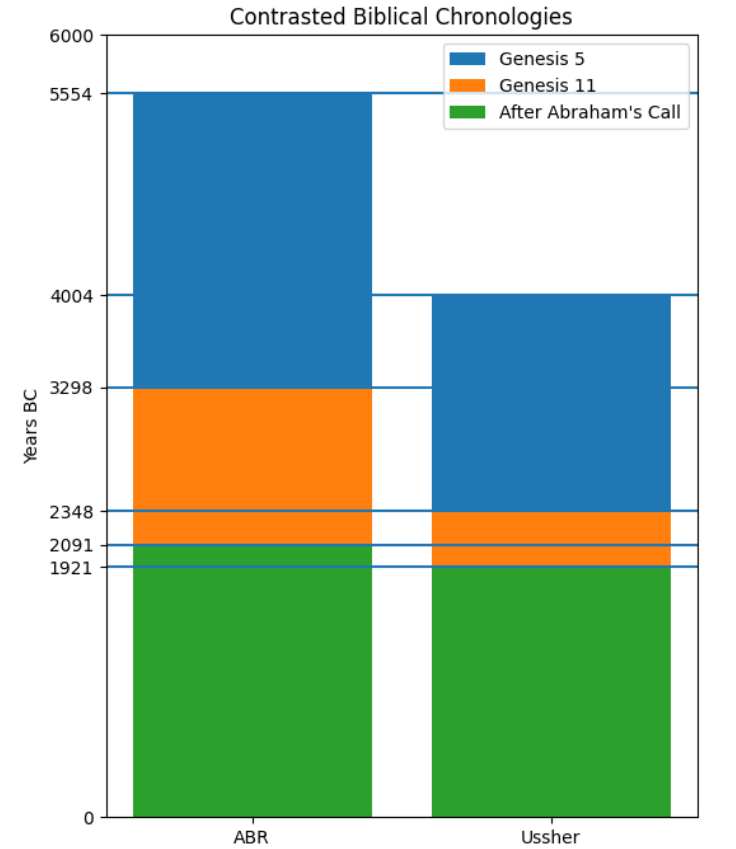
Given the biblical chronology that Henry B. Smith, Jr from Associates for Biblical Research provided3, the flood could be dated to 3298 BC. Now there is some wiggle-room here due to when in the year births occurred in the Genesis 5 and 11 chronologies, but I suspect that wiggle-room could be reduced to plus or minus 10 years.

You might object that what we read in Genesis are just stories. They are stories, but the important question is this: Are they TRUE stories? If you do not want to believe they are true, to the extent that archeologists can align those stories with historical events to that extent you might want to seriously reconsider any disbelief. This is why Christian archeologists try to align those dates with historical evidence so that the only ignorance that remains is willful ignorance.

So, how old is that stone?

It is, given today’s year of 2025 and subtracting one year since there is no 0 year in the Gregorian calendar, 3298 + 2025 – 1 = 5322 years old plus or minus those 10 years.

That is far less than the 300,000,000 years which the field guide wanted me to believe, but a far more reasonable number given erosion rates. That stone had already suffered much erosion damage when I found it.

And it is continuing to be eroded away every year I leave it unprotected in my garden, but it is not rare. Fossils like the one I have are all over the world because sedimentation layers are all over the world as one would expect given a catastrophic, global flooding less than 5,400 years ago.

The “ungodly men” are those who “willingly are ignorant”. They are not blindly ignorant, a class I would put myself in on many issues. They are liars.
  1. I think some of those fossils are crinoids. Wikipedia says: “In 2012, three geologists reported they had isolated complex organic molecules from 340-million-year-old (Mississippian) fossils of multiple species of crinoids.” That there are complex organic molecules at all in there should raise a red flag that the millions of years are wrong. ↩︎
  2. I’ve heard that a uniformitarian erosion rate would push all of the continents into the ocean in 50 million years. The problem with erosion is that it doesn’t all happen uniformly. If you have a house on a cliff near the water, you are likely very aware of the effects of erosion. ↩︎
  3. One can find videos and other information about the controversy over the Genesis 5 and 11 chronologies at the Associates for Biblical Research site. There’s a controversy because the Septuagint and the Masoretic manuscripts have different, but not randomly different, dates. They are not unintentional scribal errors, but deliberate distortions of the original. I get the 3298 BC date for the flood (and 5554 BC date for creation) from Henry B. Smith, Jr’s article at the 2018 International Conference on Creationism. The 5554 BC date puts the ministry of Jesus in the 6th millennium when the Messiah was expected to come. ↩︎

Six Sentence Story: Temptation

The devil tempted George to curse the idiots around him, to just lay into them with full force. However, George couldn’t see what good that would do, so – since the devil reminded him of them – he blessed them instead.

Annoyed by George’s disobedience – not that George owed the devil any obedience whatsoever – the devil then reminded him that his silly blessings amounted to a hill of beans on the commodity market of prayers, because everyone knew those idiots weren’t going to change no matter how nice he was to them.

Don’t forget, George, that it is up to them to decide if they want to change, not you which was the only observation the devil made that George could agree with.

Regardless, those blessings were a win-win-win for George.

If nothing happened, as the devil predicted, those George blessed would remain good examples to point out of bad behavior, but if something unexpected happened – something admittedly miraculous in their cases – they would become an awesome fount of blessings for everyone around them and yet no matter what they did by blessing them George at least did what he was told to do: bless, and curse not.

______

Denise offers the prompt “market” for this week’s Six Sentence Story.