Theological Naturalism and the Elephants in One’s Living Room

Most people don’t want elephants in their living rooms. If we have any and we don’t know they are there, it’s because we have a blind spot. It’s not that we don’t bump into those elephants multiple times. We do, but we can always come up rationalizations to explain why the walls keep moving about without having to admit that there are elephants in our living rooms.

While chasing out my own elephants, I ran into Cornelius Hunter whom Rebekah Davis has interviewed multiple times on her YouTube channel, Examining Origins. Hunter is a philosopher of science and a biologist. He is also a Christian, but for scientific reasons he is neither a creationist nor an evolutionist.

That means evolutionists don’t like him, because he allows for evolution to be false. They think he is compromising with creationism. That also means creationists don’t trust him, because he allows for evolution to be true. They think he is compromising with evolutionism even though he has shown that evolution has been scientifically falsified so many times that it is useless as a model of origins.

Theological Naturalism

Theological naturalism is neither atheism nor skepticism. Rather, it is a naturalism that arose out of Judeo-Christianity polluted over the millennia with Gnosticism and Greek philosophy. It is a naturalism justified by ideas of God as too omnipotent, too good, or too omniscient to be bothered with our messy (think, evil) world. Such involvement would damage His dignity.

Theological naturalism puts God on a pedestal. It is a theological position that removes God from His messy creation by handing His creation over to the idols of natural law and chance. It is a theological position that rejects Genesis 1-11 where we are told how evil entered the world.

As Hunter puts it in his book, Science’s Blind Spot: The Unseen Religion of Scientific Naturalism:

The move to [theological] naturalism is neither atheism in disguise nor a scientific discovery. Instead, the move to naturalism was mandated largely by thinkers within the church. Religious skeptics gladly accepted the move, but their position has always been a parasitic one.1

Hunter notes that in spite of evolution being a failed scientific model, few want to reject it. They reason (correctly) that if they did reject it, the only alternatives would be some form of creationism, but any form of creationism, biblical or not, would bring God too close to the messiness of the universe.

Science As Useful Modeling

Hunter wants to separate science from theology or metaphysics. He points out that science is much easier to do than metaphysics. In science you make a public statement. Then you make vulnerable predictions from that statement, that is, predictions which are falsifiable. Others check the predictions against reality. If the model survives these checks, it can be provisionally accepted – not as true, but as useful – until a better model with tighter predictions comes along.

Bottom line: a scientific model or theory makes useful predictions.

Metaphysics and theology on the other hand go after a bigger prize that is more difficult to achieve. They want truth. Often they only rely on reason to get that prize. That is, they don’t want to rely on revelation such as that provided in the Bible. All they are willing to use to ground their rationalizations are mere assumptions that they think must somehow be true. But mere assumptions lead one into all kinds of nonsense.

Getting back to those elephants, my take away from Hunter is to recognize the difference between science and metaphysics. As soon as I confuse them, I’ve got an elephant in my living room. To get rid of these elephants I have to see them for what they are: theologically motivated rationalizations masquerading as useful science.

______

  1. Hunter, Cornelius. Science’s Blind Spot: The Unseen Religion of Scientific Naturalism (p. 32). Baker Publishing Group. Kindle Edition. ↩︎

Scripture as First Axiom and Its Circumvention

Simply because the Bible has a different  view of origins to those put forth in human philosophy, there is a period of conflict whenever the church comes under the influence of a human philosophical system. Thus, any defender of neo Platonism in Augustine’s day or of Aristotelianism in the late Middle Ages found himself in trouble with Genesis.” Noel K. Weeks, The Hermeneutical Problem of Genesis 1-11, originally published Themelios 4, no. 1 (September 1978): 12–19

There’s a lot of historical information in Genesis that one would not have imagined could have happened especially in the first eleven chapters, such as, the Lord’s creation in six days of everything from nothing, mankind made male and female in His image, the fall of mankind and its consequences for the world, the global flood that reworked everything, and the creation of language families as a response to disobedience.

Much of this is offensive to non-Christian philosophers whether they are promoting evolution, neo Platonism, Aristotelianism or whatever other rationalized treasure they have gilded with fool’s gold for our consumption. In Genesis the Lord gets so messy through His personal interactions with the material world and mankind that He becomes intolerable to philosophers hoping to be guided solely by the authority of logical deduction from a minimal set of axioms of their own choosing.

Admittedly, in perhaps the only defense of these philosophers, without being told any of these events most people would likely start just as they have done with simple axioms. If we didn’t know better, we would likely also have imagined a clean, transcendent deity removed from material interactions with the world except for occasional mental connections through psychic fields or forest faeries. Our philosophies would rely on uniformitarian processes based on patterns of material change we observed in the world without getting a deity involved rather than messy events we had no control over or, worse, were our own fault.

That’s what we would have done. The problem is, we’ve been told what happened. We don’t have to make those mistakes.

Genesis As a Test

Because of this potential conflict, a Christian could use Genesis as a quick test for philosophical error. Genesis could also be used to test whether a professed Christian has capitulated to some erroneous philosophy. If the Christian reinterprets or rejects what is in Genesis to make it conform with what is in some philosophy, then capitulation has occurred.

Here are some tests.
1. Has “day” been reinterpreted to mean “billions of years”? (Genesis 1)
2. Can the philosophy correctly count how many genders there are? (Genesis 1-2)
3. Has mankind, a special kind of creature made in the image of God, been replaced with talk about a human animal species evolving with other animals from primordial pond scum? (Genesis 1-2)
4. Does evil originate with a fall of mankind or does the finger get pointed elsewhere? (Genesis 3)
5. Was there a global flood that completely churned the face of the earth, set tectonic plates in motion, destroyed radioactivity as a clock, flipped the geomagnetic poles multiple times, raised mountains, allowed glaciers to form, filled the oceans, buried fossils, dug canyons, and left, since then, only about 5,000 years of non-biblical history or are there allegedly archeological sites still around dating from before the time of this catastrophic event? (Genesis 6-9)
6. Does the diversity of languages have a miraculous origin with the intent to disperse a rebellious population or did languages evolve over tens of thousands of years coming from pond scum which came from some explosion which ultimately came from what precisely? (Genesis 11)

Why Is the Test Important?

The historical events in Genesis are the context in which the death and resurrection of Jesus the Messiah and the prophecies of His return make sense. They are part of the revealed plan of salvation. The messy, but wondrously miraculous, events throughout this plan of salvation (past, present and prophesied future) characterize the Lord of the Bible as personal and powerful unlike any other deity ever offered by philosophy including New Age pantheistic projections of the human mind.

Without Genesis Christian salvation history would have no justification since there would be no need (no fall) nor way (no promised miraculous intervention) to redeem mankind. If Genesis were false as history, then Christian history and its prophetic future would be false as well. If one removed Genesis as history, the plan of salvation would unravel into a New Age philosophy of sentimentality and self-help where death, not life, dominated all available future outcomes.

The Guidance from the Authority of Scripture

From a philosophical perspective one might as well accept the history in Genesis as true no matter how messy it is. It does account for the world we see around us. Since the alternatives to it lead to death there is no point in wasting one’s brief lifetime in philosophical investigations at all if any of those alternatives were true.

However, once we accept Genesis as the history of what actually happened it becomes authoritative for our philosophy. If there is any conflict between our philosophy and Genesis, it is our philosophy that must change, not Genesis. The authority of Genesis guides the construction of our philosophy.

One way to make sure Genesis is that authoritative guide is to explicitly insert the authority of the entire Bible (which includes Genesis) as the First Axiom of any philosophical system or scientific theory we attempt to construct. Then as an axiom it would guide our intellectual system building by steering us away from error through the threat of derivable contradiction with that first axiom which is all that would survive such a logical collapse.

Circumventing the Authority of Scripture

One would think this would be an obvious thing for Christians to do. However, as Noel K. Weeks notes conflict can arise if the church comes under the influence of a human philosophical system. When under the influence of a human philosophical system such as atheistic evolution, neo Platonism or Aristotelianism a Christian philosopher would try to tweak Genesis to suit his needs rather than modify or reject his own philosophy.

For example, if the authority of Scripture were really guiding Alvin Plantinga, who was busy assigning God the task of guiding alleged evolutionary processes that don’t exist, he would never have written, Christian belief just as such doesn’t include the thought that the universe is young. As another example, if the authority of Scripture were really guiding William Lane Craig he would never have jumped into the pit of big bang mythology turning the personal Lord of Genesis into an impersonal first cause.

In both of these examples, Christian philosophers circumvented the authority of Scripture as a first axiom. They rejected the guidance that Scripture could have provided them in their philosophies to help them avoid error. 

However, I doubt that either of them think they committed any error. In their minds they likely imagine themselves innocently coming under the influence of a human philosophical system that just happened to be offended by Genesis. They would likely see themselves as having nothing to repent of even if that philosophical system were later acknowledged as wrong since philosophy is little more than a hypothetical mind-game where no one gets hurt by false teaching. All such a defense would show is that capitulation to human philosophical systems results in delusion.

______

Guided Evolution

About seven years ago I was studying the Christian analytic philosopher Alvin Plantinga. I think I actually reached a point where I could explain the details of his Evolutionary Argument Against Naturalism (EAAN). However, I see now that I didn’t understand what was really at stake. Because he was a Christian and an analytic philosopher I assumed he was someone I could trust. Today I see much of this very differently and I am hopefully not as gullible.

The Capitulation

Plantinga’s argument pitted evolution, which he didn’t seriously question, against naturalism, which he rejected, to try to show that if you believed in evolution, you should not believe in naturalism. The problem with his argument, logically sound though it was, is that he thought he could separate out evolution to save it from the false atheistic mythology of naturalism.

To his credit Plantinga argued for a special kind of evolution which he called guided evolution. Based on this idea he hoped to resolve the alleged conflict between science and religion by compromising with, that is, capitulating to, atheism rather than rejecting it. He wrote in Where the Conflict Really Lies, (2011) page 11, the following:

A more important source of conflict has to do with the Christian doctrine of creation, in particular the claim that God has created human beings in his image. This requires that God intended to create creatures of a certain kind—rational creatures with a moral sense and the capacity to know and love him—and then acted in such a way as to accomplish this intention. This claim is clearly consistent with evolution (ancient earth, the progress thesis, descent with modification, common ancestry), as conservative Christian theologians have pointed out as far back as 1871.

While it may be clearly consistent in some logical system to assume the existence of a god, such as the fictitious Gaia, to guide evolution, that god could not have been the Elohim of Genesis 1 who finished creation in six days. That god who guided evolution could not have been the Christian God.

Ignoring Genesis

Faced with such a complaint a Christian who supports evolution, even if it is just physical/chemical evolution of planets, stars and galaxies, has to rationalize how six days can be interpreted to mean a mythologically large number of years. Plantinga does this far too quickly by dismissing young earth creationism on page 10 with the following:

Of course Christian belief just as such doesn’t include the thought that the universe is young; and in fact as far back as Augustine (354-430) serious Christians have doubted that the scriptural days of creation correspond to 24-hour periods of time.

He even admitted (footnote, page 144) that his resolution of the conflict between science and religion is not concerned with belief in a universal flood or with a very young earth. According to him, these are not part of Christian belief as such. On this ground alone Christians should reject his argument.

Redefining “Evolution”

To make his theory work he not only had to ignore Genesis, but he also had to redefine evolution to allow for creative activity of some sort. However, the very point of evolution is to come up with natural processes that completely account for changes that take one from nothing to something, from non-life to life and from pond scum to human beings without involving the creative activity of any God, angel, demon or human being.

On this ground alone even atheists should reject his argument. It doesn’t matter whether he finds it clearly consistent to add in creative agents. According to atheist mythology they are not wanted. Atheists don’t need them. His EAAN argument attempts to show that such views, however, are not reasonable, but why should that matter to atheists who rely on randomness, not rationality, and can fantasize a multiverse of universes in which to play atheist roulette?

Christian Alternatives

Confronted with evolution the Christian has three options:

  1. Accept evolution and become an atheist.
  2. Compromise (capitulate) in some way as Plantinga has done.
  3. Reject evolution along with the rest of atheist mythology.

This may cause some people grief. No one wants to capitulate regarding their faith. However, there is no need for grief. It is a rational and scientific stance to reject evolution. Just ask yourself: what repeatable, measurable, non-creative, natural processes can you use to explain how nothing (not even a quantum vacuum) can turn into something? There are no non-creative, natural processes that can explain such a transition. That means physical evolution is atheist mythology. It is neither scientific nor rational to hold such a belief.

Continue this line of thinking. What natural processes exist that allow one to go from pond scum to human beings? If someone suggests that mutations and natural selection might work, then remind them that those processes lead to mutational meltdown (extinction). They do not lead to more complicated beings, but rather to less complicated ones. That means biological evolution is also impossible. One should reject it with the same conviction that one rejects the rest of atheist mythology.

The problem with evolution is the problem of building a house of cards without a creative agent. In the real world, not some magical, mythological world the atheist would love to live in, if you want to get a house of cards you need a human being, a creative agent. You need someone to build it. Natural, non-creative processes, such as a gust of wind and gravity, can surely knock that house down. Natural processes, however, cannot build it. That takes a creative agent, but evolution does not acknowledge them.

Ancient Earth

Plantinga describes evolution in these terms: ancient earth, the progress thesis, descent with modification, common ancestry. Note that without an ancient earth there would not be enough time for the rest of that mythological stuff to happen. On the Bible’s timeline of less than 8000 years there is no time for the progress thesis, there is no time for descent with modification and there is no time for common ancestry to occur.

Everything Plantinga wants to protect about evolution depends on an ancient earth, but what is the evidence for that?

  1. Human history does not record more than 5000 years and even much of that is sketchy. There is no evidence for an ancient earth here.
  2. Axiomatizing relativity with the two-way speed of light being what is constant in all frames of reference permits a convention of simultaneity where distant starlight arrives on earth in less than a second of time. There is no evidence for an ancient earth in distant starlight either.
  3. Measurable, non-catastrophic, natural decay processes put upper limits on the age of anything they go about destroying such as rock formations, radiocarbon in diamonds, soft tissue in fossils and genetic code. These decay rates directly falsify the mythological ages assigned to rock formations, diamonds, fossils, and DNA. There is no evidence for an ancient earth when natural decay processes are taken into account.

Fulfilling Prophecy

Rather than trying to help atheists maintain their mythologies, Plantinga should have pointed out that evolution has never occurred and that the earth is not as old as atheists would like you to believe. Why didn’t he do that? Why did he add atheist mythologies to his Christian presuppositions? I think 2 Timothy 4:3-4 (NIV) tells us why:

For the time will come when people will not put up with sound doctrine. Instead, to suit their own desires, they will gather around them a great number of teachers to say what their itching ears want to hear. They will turn their ears away from the truth and turn aside to myths.

Alvin Plantinga is an example of the fulfillment of this New Testament prophecy. Logically there is nothing wrong with the EAAN. It just doesn’t address the right problem which is the need to reject, not capitulate to, atheist mythologies. That capitulation turned Plantinga’s ear away from the truth and toward accepting myths.

Admittedly I used to be an example of this prophecy’s fulfillment as well and maybe I still am in ways I am not yet aware of. That is why I am writing about Plantinga’s EAAN and his claimed resolution of the conflict thesis. I want to make sure I put this stuff behind me having already repented of ever considering it helpful.

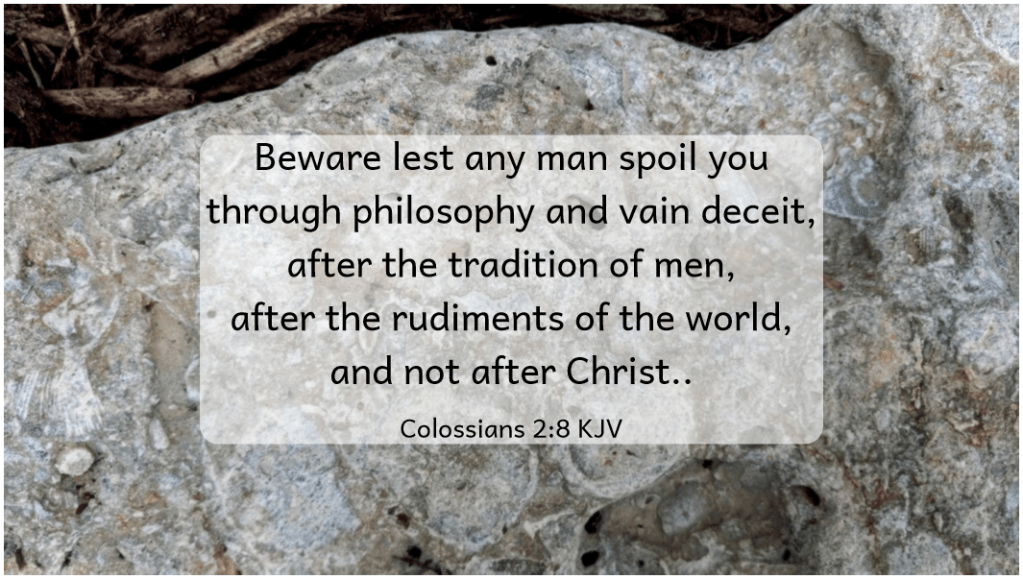
Sunday Walk 66 – The Mythology of Deep Time

A few years ago I would likely be labeled a theistic evolutionist without realizing what that meant. I was reading Alvin Plantinga’s Where the Conflict Really Lies and studying his evolutionary argument against naturalism. I was also studying how William Lang Craig accepted the deep time of the Big Bang to try to make the kalam cosmological argument work for him.

To caricature my position I tolerated ideas of evolutionary and cosmological deep time as long as I could sugar-coat them with some kind of spirit “guiding” evolution or somehow squeeze in the kalam argument to assert the existence of that spirit. By accepting deep time I was, unwittingly, throwing original sin under the bus along with the rest of the Bible. And all for what? My goal was to assert the existence of some spirit without checking first just what that spirit was.

I now realize that whatever that spirit might be it could not be Yahweh as revealed in the Bible because I had replaced the historical chronology of Genesis with the pseudo-scientific mythology of deep time. Rejection of Genesis is a rejection of the entire Bible. Atheists understand this which is why they ridicule Creation, Noah and Babel. Compromising Christians do not. What I needed was an apologetics directed back at myself that would lead me to take the Bible seriously.

All of that changed when a fellow member of our Men’s Group briefly mentioned the rapid geological change that happened as a result of the eruption of Mount St Helens. Looking into this, I was shocked to realize that places like the Grand Canyon did not need millions of years of deep time to form. The catastrophic global flood and its aftermath could explain the present state of continents, oceans, mountains, coal deposits, canyons, fossil-filled sedimentation layers and glaciers.

Furthermore, if I started with God creating the universe in a functionally mature state, that is, if I took Genesis as seriously as I should have, I could get to the present state of the universe with only a few thousand years of change using processes identified and measured by modern operational science.

By contrast, if I started with the Big Bang and over 13 billion years of deep time, I could not get to the universe I see today. Too much entropy would have occurred over that span of time. Indeed, the evidence is so overwhelming against deep time that Don Batten could provide 101 separate lines of evidence suggesting that the earth and the universe could not be anywhere near as old as deep time mythologies claim it to be. I began to see that the hypothesis of deep time had been falsified over and over again.

The reason I mention all this is because experimental, operational science (not naturalistic speculations presented as “science”) has matured to a point that no one needs to shy away from the historical creation and fall accounts in Genesis.

Cal Smith, The Trojan Horse of Long Ages, Answers in Genesis Canada

Weekly Bible Reading:  Obadiah (Audio), Joel (Audio)
2 Kislev, 5782, Toldot: Parashat Genesis 25:19-28:9; Haftarat Malachi 1:1-2:7
Commentaries: 
David Pawson, Obadiah and Joel, Part 48, Part 49, Unlocking the Bible
Bible Project, Obadiah and Joel