The Beatitudes and the Woes

I listened to all 28 chapters of the Gospel of Matthew one after the other today. Some parallels stood out like Peter’s denial and the betrayal of Judas. They both bitterly regretted what they did.

I remember well the beatitudes and the woes. However, I didn’t associate them with each other until now. The structure of this gospel is well crafted as one would expect. It was inspired by no ordinary muse, after all, but by the Holy Spirit Himself.

The Nine Beatitudes

Matthew 5:3-12 KJV3 Blessed are the poor in spirit: for theirs is the kingdom of heaven.
4 Blessed are they that mourn: for they shall be comforted.
5 Blessed are the meek: for they shall inherit the earth.
6 Blessed are they which do hunger and thirst after righteousness: for they shall be filled.
7 Blessed are the merciful: for they shall obtain mercy.
8 Blessed are the pure in heart: for they shall see God.
9 Blessed are the peacemakers: for they shall be called the children of God.
10 Blessed are they which are persecuted for righteousness’ sake: for theirs is the kingdom of heaven.
11 Blessed are ye, when men shall revile you, and persecute you, and shall say all manner of evil against you falsely, for my sake.

12 Rejoice, and be exceeding glad: for great is your reward in heaven: for so persecuted they the prophets which were before you.

The Eight Woes

Matthew 23:13-31 KJV13 But woe unto you, scribes and Pharisees, hypocrites! for ye shut up the kingdom of heaven against men: for ye neither go in yourselves, neither suffer ye them that are entering to go in.
14 Woe unto you, scribes and Pharisees, hypocrites! for ye devour widows’ houses, and for a pretence make long prayer: therefore ye shall receive the greater damnation.
15 Woe unto you, scribes and Pharisees, hypocrites! for ye compass sea and land to make one proselyte, and when he is made, ye make him twofold more the child of hell than yourselves.
16 Woe unto you, ye blind guides, which say, Whosoever shall swear by the temple, it is nothing; but whosoever shall swear by the gold of the temple, he is a debtor!
17 Ye fools and blind: for whether is greater, the gold, or the temple that sanctifieth the gold?
18 And, Whosoever shall swear by the altar, it is nothing; but whosoever sweareth by the gift that is upon it, he is guilty.
19 Ye fools and blind: for whether is greater, the gift, or the altar that sanctifieth the gift?
20 Whoso therefore shall swear by the altar, sweareth by it, and by all things thereon.
21 And whoso shall swear by the temple, sweareth by it, and by him that dwelleth therein.
22 And he that shall swear by heaven, sweareth by the throne of God, and by him that sitteth thereon.
23 Woe unto you, scribes and Pharisees, hypocrites! for ye pay tithe of mint and anise and cummin, and have omitted the weightier matters of the law, judgment, mercy, and faith: these ought ye to have done, and not to leave the other undone.
24 Ye blind guides, which strain at a gnat, and swallow a camel.
25 Woe unto you, scribes and Pharisees, hypocrites! for ye make clean the outside of the cup and of the platter, but within they are full of extortion and excess.
26 Thou blind Pharisee, cleanse first that which is within the cup and platter, that the outside of them may be clean also.
27 Woe unto you, scribes and Pharisees, hypocrites! for ye are like unto whited sepulchres, which indeed appear beautiful outward, but are within full of dead men’s bones, and of all uncleanness.
28 Even so ye also outwardly appear righteous unto men, but within ye are full of hypocrisy and iniquity.
29 Woe unto you, scribes and Pharisees, hypocrites! because ye build the tombs of the prophets, and garnish the sepulchres of the righteous,
30 And say, If we had been in the days of our fathers, we would not have been partakers with them in the blood of the prophets.
31 Wherefore ye be witnesses unto yourselves, that ye are the children of them which killed the prophets.

Patching Together Two Messianic Chronologies

A messianic chronology is a history of the events in the life of Jesus the Messiah. There are many messianic chronologies and hence many controversies over which one is right.

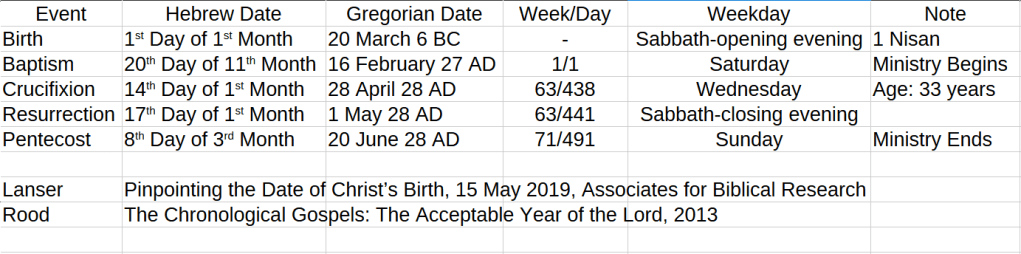
To add to these, I will present another one that merges the research of Rick Lanser1 with that of Michael Rood2 because I find it hard accept either of them alone.

The reason for doing this is there are only three viable dates for the Crucifixion: Rood’s Wednesday 28 AD, Lanser’s Friday 30 AD and Friday 33 AD. When Lanser showed that 33 AD could not be the date, his argument (as I see it) also showed 30 AD could not be the date either. That left Rood’s 28 AD as the only option. However, I prefer Lanser’s date of the birth of Jesus (20 March 6 BC) and believe that Rood’s date of creation (4000 BC) and his views of the multiple layers of the Daniel 9 prophecies are incorrect.

The following are where disagreements might arise with this merged chronology.

  • With Rood’s Wednesday Crucifixion, a Sunday Resurrection is not necessary, but it still remains the day when the tomb was first found to be empty (which is all the Gospels say about it anyway).
  • The ministry of Jesus from His baptism to Pentecost was only 70 weeks fulfilling the Daniel 9:24 prophecy, the first part of Daniel 9:26 and the first part of Daniel 9:27.
  • The rest of the Daniel 9:24-27 prophecies were fulfilled in the destruction of the Temple in 70 AD. There are no more Daniel 9 prophecies awaiting fulfillment. Revelation, however, contains separate prophecies.
  • John 6:4 was not in the original autograph of the Gospel of John as Greek Manuscript #472 testifies by preserving its absence.
  • With Lanser’s date of the birth of Jesus on 20 March 6 BC and Rood’s Crucifixion date on 28 April 28 AD, I was surprised to calculate (6 + 28 – 1 = 33) that the age of Jesus at the Crucifixion is 33 years. That’s what I always heard His age was, but that would not have been His age in either Lanser’s (6 + 30 – 1 = 35) or Rood’s (2 + 28 – 1 = 29) chronology.

If you don’t agree with the above, don’t worry. I might be wrong. Also, I am pretty sure neither Lanser nor Rood would agree with me either (nor with each other). So, you would be in good company.

I will break the construction of this merged chronology into sections where questions are answered and constraints and conclusions are highlighted.

______

What Is the Upper Bound for the Year of the Crucifixion?

Lanser believes the Crucifixion occurred on Friday in 30 AD, but there is another possible Friday Crucifixion that could have occurred in 33 AD. Lanser argued3 against the 33 AD date by synchronizing Galatians 2:14 with Acts 12:1-4,255 to show that Paul was in Jerusalem for the Feast of Unleavened Bread in 44 AD, the year Herod Agrippa I died, which was 14 years after his conversion on the road to Damascus.

From Lanser’s argument I draw the following constraints.

CONSTRAINT: Herod Agrippa I died in 44 AD.6

CONSTRAINT: Paul went to Jerusalem 14 years after his conversion on the road to Damascus.7

CONSTRAINT: Herod Agrippa I and Paul were in Jerusalem during the Feast of Unleavened Bread before Herod Agrippa I’s death.8

Knowing the year was 44 AD, the time was the Feast of Unleavened Bread (after Passover) and that the length of time was 14 years since Paul’s conversion on the Damascus Road, I come to the conclusion that Paul was converted before the Passover of 30 AD by subtracting, as I normally would, 14 from 44. That means 30 AD could not be the year of the Crucifixion.

Although Lanser argued successfully for this synchronization to discredit the 33 AD date for the Crucifixion, he did not want to also discredit 30 AD. To preserve the 30 AD date Lanser made two assertions neither of which I find credible:

  • He claimed that the subtraction of the 14 year length since Paul’s conversion from the secular dated year 44 AD of Herod Agrippa I’s death should use “inclusive reckoning”, that is, 44 minus 14 should equal 31, not 30.9 Since we are concerned with finding a secular date I do not think that such inclusive reckoning is justified.10
  • He also claimed that the events from the Crucifixion to Paul’s conversion took only 9 months. It has to be less than a year, since that is all the extra time his inclusive reckoning is giving him. However, 9 months from his preferred Crucifixion date puts Paul’s trip to Damascus during winter, an unlikely time to travel from Jerusalem to Damascus especially with a team intending on bring back prisoners, but if Lanser extended this to spring (after Passover, only 3 to 4 months later), then 30 AD would be discredited as well as 33 AD. He also does not explain how Paul could have become personally notorious, even in Damascus, only 2 months after Stephen’s martyrdom.

If Lanser is right about the synchronization and I am right in rejecting his assertions then both 33 AD and 30 AD are eliminated as possible dates for the Crucifixion.

Lanser’s argument is the main reason I am trying to combine his chronology with that of Rood. Rood gets dates wrong as well. Combining these chronologies, I hope to avoid inconsistencies and construct a better view of what happened.

CONSTRAINT: Paul’s conversion on the road to Damascus occurred before the Passover of 30 AD.

That constraint gives the upper bound for the Crucifixion.

What Is the Lower Bound for the Year of the Crucifixion?

CONSTRAINT: Daniel 9:25 predicts 483 years or 69 weeks of years prior to the coming of the Messiah.11

Both Lanser12 and Rood13 agree that Daniel 9:25 determines the date after which the ministry of Jesus would begin. They agree that the start year is 457 BC and after 69 sevens or 483 years we reach 27 AD (-457 + 483 + 1).

Which Was the Year of the Crucifixion?

From these upper and lower bounds, the Crucifixion occurred after the Passover of 27 AD and before the Passover of 30 AD. There are only two Passovers to consider: Wednesday 28 April 28 AD and Monday 17 April 29 AD.

CONSTRAINT: There are only three days of the week on which the Crucifixion could occur to fulfill the three days and three nights Jonah prophecy: Wednesday, Thursday or Friday.14

Since the Passover occurred on a Monday in 29 AD, the constraint eliminates 29 AD.

When Was Jesus Born?

Lanser15 assigns the birth of Jesus to 1 Nisan of 20 March 6 BC based on an occultation of Jupiter with the new moon as the star seen by the magi and with His birth foreshadowed by the first day of the year (1 Nisan) in Exodus 12:216 and by the completion of the temple on 1 Nisan in Exodus 40:217. Rood18 assigns it to the High Sabbath of the Feast of Tabernacles on 26 September 3 BC as a fulfillment of that Feast.

Both of these dates are associated with the Lord tabernacling with His people, however, given that Lanser’s date explains both the star and has foreshadowing events at the beginning rather than the end of the year I will assume Lanser’s date is correct.

Was John 6:4 in the original autograph of the Gospel of John?

Since the lower bound of 27 AD and Passover of Wednesday 28 April 28 AD is at most a little over a year in length I have to accept that the ministry of Jesus was no longer than that.

Normally one assumes the ministry of Jesus was three and a half years. However, as Rood points out only the Gospel of John justifies such a long time and that only with one verse: John 6:419. Rood also mentions that there is an 11th century manuscript of the Gospel of John without John 6:4 in it.20

Since I accept the reasoning up to this point, I will accept the manuscript that Rood mentions as testifying and preserving that John 6:4 was not in the original text.

How long was the ministry of Jesus?

In The Chronological Gospels: The Acceptable Year of the Lord, Rood links verses of the four Gospels with each of 70 weeks of the ministry of Jesus starting with His baptism by John on 16 February 27 AD and ending with Pentecost on 20 June 28 AD. These 70 weeks fulfill the 70 weeks prophecy of Daniel 9:2421. In Rood’s association of weeks with verses, the Crucifixion occurs on the 63rd week. This fulfills the first part of Daniel 9:26 which reads: “And after threescore and two weeks shall Messiah be cut off, but not for himself:

Although I don’t know if Rood mentions this, the 63rd week with the Crucifixion and Resurrection seems to me to fulfill the first part of Daniel 9:27 as well which reads: “And he shall confirm the covenant with many for one week: and in the midst of the week he shall cause the sacrifice and the oblation to cease,” However, he may understand that prophecy differently.

Since 28 AD is the only available year of the Crucifixion and Rood’s association shows a fulfillment of Daniel 9:24, 9:26 and 9:27, I accept in general his chronology for those 70 weeks. However, I doubt Rood’s end time views when he claims that the ministry of Jesus is only the second layer of three fulfillments with the third still coming22.

A prophecy should have only one fulfillment, but perhaps I just see Daniel 9 containing many separate prophecies while he may see it as one. The 70 weeks of Daniel 9:24 prophesies the number of weeks of the Messiah’s ministry. The 69 weeks of years of Daniel 9:25 is a separate prophecy giving the number of years before the Messiah’s ministry begins. The 63rd week of Daniel 9:26 is a separate prophecy stating in which week of the 70 weeks of Daniel 9:24 the Crucifixion would occur. The significance of the 63rd week of Daniel 9:26 is a separate prophecy in the first part of Daniel 9:27.

Once a prophecy is fulfilled, there is no point looking for an additional fulfillment of it unless one doesn’t believe the fulfillment has already occurred.

On Which Day of the Week Was the Resurrection?

Rood clarifies that the Resurrection occurred at the end of precisely three days and three nights after the body of Jesus was placed in the tomb on Wednesday before sunset. That is what one would expect with a Wednesday Passover. That means the Resurrection occurred at the end of the weekly Sabbath but before sunset and not on Sunday itself.

What the Gospels report is that the women went to the tomb and found it empty with the stone rolled away not so Jesus could leave but so they could see that He was no longer there. This is what happened on Sunday23 or the morning of the first day of the week.

Church tradition needs a Sunday Resurrection because those creating that tradition misunderstood that the preparation day on which Jesus died was not for the weekly Sabbath, which would have been on a Friday, but for the Passover. They had to fit three days and three nights in that short span. Using inclusive reckoning they could get away with three days (if they ignored the three nights), but they needed Jesus to be in the grave on Sunday to do that. According to Rood’s chronology, with a longer span, Jesus could rise on Saturday evening at the end of the Sabbath, fulfill the three days and three nights Jonah prophecy and fulfill the Feast of First Fruits on Sunday.

What about the rest of Daniel 9:24-27?

As I see it the parts of Daniel 9:24-27 that were not fulfilled by Rood’s 70 weeks were fulfilled with the Roman attack on Jerusalem resulting in the destruction of the Temple in 70 AD.

These are the two parts involved:

  • The second half of Daniel 9:26 reads “and the people of the prince that shall come shall destroy the city and the sanctuary; and the end thereof shall be with a flood, and unto the end of the war desolations are determined.
  • The second half of Daniel 9:27 reads “and for the overspreading of abominations he shall make it desolate, even until the consummation, and that determined shall be poured upon the desolate.

That completes the merged messianic chronology.

______

______

  1. Rick Lanser is a contributor to the Daniel 9:24-27 Project at the Associates for Biblical Research (ABR). ABR is one of my favorite resources. In particular, I am grateful for Henry B. Smith Jr’s work on the Genesis 5 & 11 Project. ↩︎
  2. Michael Rood is an Hebraic Roots researcher and founder of A Rood Awakening!. His book The Chronological Gospels: The Acceptable Year of the Lord presents a detailed chronology using the four gospels showing the ministry of Jesus as 70 weeks from His baptism to Pentecost fulfilling Daniel 9:24. ↩︎
  3. Lanser, How Acts and Galatians Indicate the Date of the Crucifixion, 15 May 2019, ABR. ↩︎
  4. Galatians 2:1 KJVThen fourteen years after I went up again to Jerusalem with Barnabas, and took Titus with me also. ↩︎
  5. Lanser, How Acts and Galatians Indicate the Date of the Crucifixion, 15 May 2019, ABR. ↩︎
  6. Herod Agrippa, Wikipedia ↩︎
  7. Galatians 2:1 KJVThen fourteen years after I went up again to Jerusalem with Barnabas, and took Titus with me also. ↩︎
  8. Acts 12:1-3, 20-23, 25 KJV1 Now about that time Herod the king stretched forth his hands to vex certain of the church. 2 And he killed James the brother of John with the sword. 3 And because he saw it pleased the Jews, he proceeded further to take Peter also. (Then were the days of unleavened bread.) … 20 And Herod was highly displeased with them of Tyre and Sidon: but they came with one accord to him, and, having made Blastus the king’s chamberlain their friend, desired peace; because their country was nourished by the king’s country. 21 And upon a set day Herod, arrayed in royal apparel, sat upon his throne, and made an oration unto them. 22 And the people gave a shout, saying, It is the voice of a god, and not of a man. 23 And immediately the angel of the Lord smote him, because he gave not God the glory: and he was eaten of worms, and gave up the ghost. … 25 And Barnabas and Saul returned from Jerusalem, when they had fulfilled their ministry, and took with them John, whose surname was Mark. ↩︎
  9. Lanser writes, “Counting back fourteen years from 44 AD using inclusive reckoning, we conclude Paul was saved in 31 AD, possibly even late 30 AD depending on how much time was spanned by the events of Acts 1-9.” How Acts and Galatians Indicate the Date of the Crucifixion, 15 May 2019, ABR. ↩︎
  10. Such reckoning might make sense if one is looking at two biblical dates and we want to know how much time elapsed between them or if we have a biblical date and a biblical elapsed time and we want to know what date the Bible might assign to the other event. In the present case we have a secular date of 44 AD for the Feast of Unleavened Bread and we want to know the secular date of another event (Paul’s conversion) given that Paul wrote it was fourteen years ago. ↩︎
  11. Daniel 9:25 KJV Know therefore and understand, that from the going forth of the commandment to restore and to build Jerusalem unto the Messiah the Prince shall be seven weeks, and threescore and two weeks: the street shall be built again, and the wall, even in troublous times. ↩︎
  12. Lanser, The Going Forth of Artaxerxes’ Decree Part 1, 16 November 2019, ABR. ↩︎
  13. Rood, The Chronological Gospels, 2013, page 8. ↩︎
  14. On what day was Jesus crucified? Got Questions ↩︎
  15. Lanser, Pinpointing the Date of Christ’s Birth, 15 May 2019, ABR. ↩︎
  16. Exodus 12:2 KJVThis month shall be unto you the beginning of months: it shall be the first month of the year to you. ↩︎
  17. Exodus 40:2 KJVOn the first day of the first month shalt thou set up the tabernacle of the tent of the congregation. ↩︎
  18. Rood, The Chronological Gospels, 2013, page 52. ↩︎
  19. John 6:4 KJVAnd the passover, a feast of the Jews, was nigh. ↩︎
  20. Greek Manuscript #472. See Rood, The Chronological Gospels, page 9. ↩︎
  21. Daniel 9:24 KJVSeventy weeks are determined upon thy people and upon thy holy city, to finish the transgression, and to make an end of sins, and to make reconciliation for iniquity, and to bring in everlasting righteousness, and to seal up the vision and prophecy, and to anoint the most Holy. ↩︎
  22. Rood, The Chronological Gospels, 2013, page 16. ↩︎
  23. In these four Gospel accounts what is reported is that the tomb was empty and the stone was rolled back so they could see that it was. Jesus did not need the stone rolled back so He could leave.
    Matthew 28:1-6 KJV1 In the end of the sabbath, as it began to dawn toward the first day of the week, came Mary Magdalene and the other Mary to see the sepulchre. 2 And, behold, there was a great earthquake: for the angel of the Lord descended from heaven, and came and rolled back the stone from the door, and sat upon it. 3 His countenance was like lightning, and his raiment white as snow: 4 And for fear of him the keepers did shake, and became as dead men. 5 And the angel answered and said unto the women, Fear not ye: for I know that ye seek Jesus, which was crucified. 6 He is not here: for he is risen, as he said. Come, see the place where the Lord lay.
    Mark 16:1-6 KJV1 And when the sabbath was past, Mary Magdalene, and Mary the mother of James, and Salome, had bought sweet spices, that they might come and anoint him. 2 And very early in the morning the first day of the week, they came unto the sepulchre at the rising of the sun. 3 And they said among themselves, Who shall roll us away the stone from the door of the sepulchre? 4 And when they looked, they saw that the stone was rolled away: for it was very great. 5 And entering into the sepulchre, they saw a young man sitting on the right side, clothed in a long white garment; and they were affrighted. 6 And he saith unto them, Be not affrighted: Ye seek Jesus of Nazareth, which was crucified: he is risen; he is not here: behold the place where they laid him.
    Luke 24:1-7 KJV1 Now upon the first day of the week, very early in the morning, they came unto the sepulchre, bringing the spices which they had prepared, and certain others with them. 2 And they found the stone rolled away from the sepulchre. 3 And they entered in, and found not the body of the Lord Jesus. 4 And it came to pass, as they were much perplexed thereabout, behold, two men stood by them in shining garments: 5 And as they were afraid, and bowed down their faces to the earth, they said unto them, Why seek ye the living among the dead? 6 He is not here, but is risen: remember how he spake unto you when he was yet in Galilee, 7 Saying, The Son of man must be delivered into the hands of sinful men, and be crucified, and the third day rise again.
    John 20:1-2 KJV1 The first day of the week cometh Mary Magdalene early, when it was yet dark, unto the sepulchre, and seeth the stone taken away from the sepulchre. 2 Then she runneth, and cometh to Simon Peter, and to the other disciple, whom Jesus loved, and saith unto them, They have taken away the Lord out of the sepulchre, and we know not where they have laid him. ↩︎

Holes in the Net

Christian apologists who accept evolution do not realize how huge the holes are in their gospel nets.

What they don’t see is that the Bible offers not only a viable explanation of the universe we live in, but it offers the only viable explanation for it. The others are impossible modern mythologies masquerading as scientific theories.

The problem for the atheist is that one would have to accept the God of the Bible for the biblical explanation to be viable especially with the age of the universe being less than 8000 years.

  • But isn’t the universe billions of years old?
    Under Newtonian physics, perhaps, but not under relativity physics. If relativity is true, distant starlight can no longer be used as a clock.1
  • But aren’t there fossils half a billion years old?
    Radioactive decay is not a clock either. If it were then all of the rates of decay, including erosion rates and biological decay that we notice today, would have to line up. That dinosaur fossils have soft tissue2 still in them suggests – no, it insists – that they are much, much younger than that.
  • But isn’t humanity hundreds of thousands of years old?
    Historical records only go back about 5000 years. Let that sink in. That length of time is what one would expect given a global flood occurring about 3300 BC. Real people leave historical records. The existence and age of these historical records confirm the biblical chronology that the universe is less than 8000 years old3 and that there was a global catastrophe about 5300 years ago.

But that’s ridiculous! Once you realize that it is not, you will start taking the Bible seriously enough to mend the holes in the net.

______

In a 13 minute video Calvin Smith presented arguments every Christian apologist who still accepts evolution needs to hear. Atheists already know these arguments: any god who would use the cruel and destructive means of elimination known as evolution to bring about creation is unloving and morally suspect. Christian morals should make one reject the very god those apologists witlessly try to promote.

Smith described Christian apologists who accept evolution as casting gospel nets with holes in them.

  1. The reason relativity doesn’t allow the speed of light to be used as a clock to measure the age of the universe is due to the conventionality of simultaneity thesis which Veritasium explained rather well. Allen Janis’s article Conventionality of Simultaneity summarizes the thesis in more detail providing additional references. Jason Lisle applied it to solve the distant starlight problem of creationism in his paper Anisotropic Synchrony Convention, Answers Research Journal, 2010. Bottom line: We cannot tell how old the universe is by knowing the two-way speed of light and the estimated distance of a celestial object unless we go back to Newtonian physics. ↩︎
  2. Creation Ministries International provided a one-minute video summarizing the significance of the discovery of soft tissue in fossils: those fossils must have been laid down recently. That soft tissue exists in fossils at all marks the end of the evolutionary worldview unless one is addicted to that worldview much like those who promote a flat earth are addicted to theirs. ↩︎
  3. There are various biblical chronologies because there are multiple manuscript traditions. The ultimate original source is lost, but one can piece it together using parts from each of these traditions. The chronology I currently find most convincing comes from the Associates for Biblical Research. ↩︎

Biblical Genealogy

I found the following video on Robert Carter’s site Biblical Genetics. The key take-away from this video is that the ultimate benefit of all of the genealogical data in the Bible was to trace the ancestry of Jesus back to Adam.

Most people (including myself) skip over the biblical genealogies unless they know what to look for. Carter says it is like looking for a fossil in a river basin. If you know what to look for you can find an amazing fossil. If you don’t, well, there are plenty of other things to enjoy.

Robert Carter and Chris Hardy were the authors of a paper on Creation Ministries International that I keep going back to called The biblical minimum and maximum age of the earth. The creation year of the minimum age supported by at least one biblical manuscript tradition is 3822 BC. The creation year of the maximum age is 5665 BC. That’s a difference of 1,843 years.

Many Christians support the younger age close to James Ussher’s chronology with a creation date of 4004 BC. Since that was a bit over 6000 years ago many of them also get tempted by speculations of the end of the age.

Early Christians along with Henry B. Smith, Jr at the Associates for Biblical Research support an older creation year of around 5500 BC. Based on this chronology the rabbinic tradition of the Messiah coming during the 6th millennium has already been fulfilled by Jesus. Smith, Jr’s argument in favor of the older age is available at the 2018 International Conference on Creationism called The case for the Septuagint’s chronology in Genesis 5 and 11. It’s another one of the papers I keep going back to.

At the moment, I favor Smith, Jr’s view, but I am a recent supporter of creationism. I am still learning. I only began taking the Bible seriously, that is, more seriously than, say, the Bhagavad Gita, about five years ago.

Over five years ago, I would have thought the earth was a gazillion years old. Why? Because that’s what I was told. My religious traditions were a mix of Catholic Teilhard de Chardin new age leaning mysticism and Protestant William Lane Craig atheist leaning rationalizations. Don’t worry if you aren’t familiar with those two names. I wish I weren’t as well.

When I was about 10 years old I remember telling my aunt that chickens came from dinosaurs. Why? Because that’s what I was told. Looking back on that incident as an adult who has now listened to many children talk I imagine she thought I was a cute kid, but stupid.

I realize today that she was right about the stupid part. Or, better put, deceived part, but then those telling me the “truth” were deceived as well. They are not the enemy. I forgive them. Today I have more important things to do like taking back all that stolen life, stolen hope, stolen joy and stolen peace.

Sunday Walk 10

22 And the Lord spake unto Moses, saying, 23 Speak unto Aaron and unto his sons, saying, On this wise ye shall bless the children of Israel, saying unto them, 24 The Lord bless thee, and keep thee: 25 The Lord make his face shine upon thee, and be gracious unto thee: 26 The Lord lift up his countenance upon thee, and give thee peace. 27 And they shall put my name upon the children of Israel, and I will bless them.

Numbers 6: 22-27 King James Version

The Blessing was written earlier this year (February, 2020) by Chris Brown, Cody Carnes, Kari Jobe and Steven Furtick. See Z & Z’s post for the radio version with lyrics. There are many composite videos of The Blessing formed from a diverse group of individuals from the churches in a region. I have not heard all of them, but I have listened to this one many times.

The Blessing Australia

I am a registered Democrat in Miami Beach, Florida. I voted for the President, Donald Trump, and I predict he will win on November 3rd. Then I predict he, along with the help of others, will drain this swamp.

I am grateful that the Senate confirmed Amy Coney Barrett as an Associate Justice of the U.S. Supreme Court with a vote of 52 to 48.