
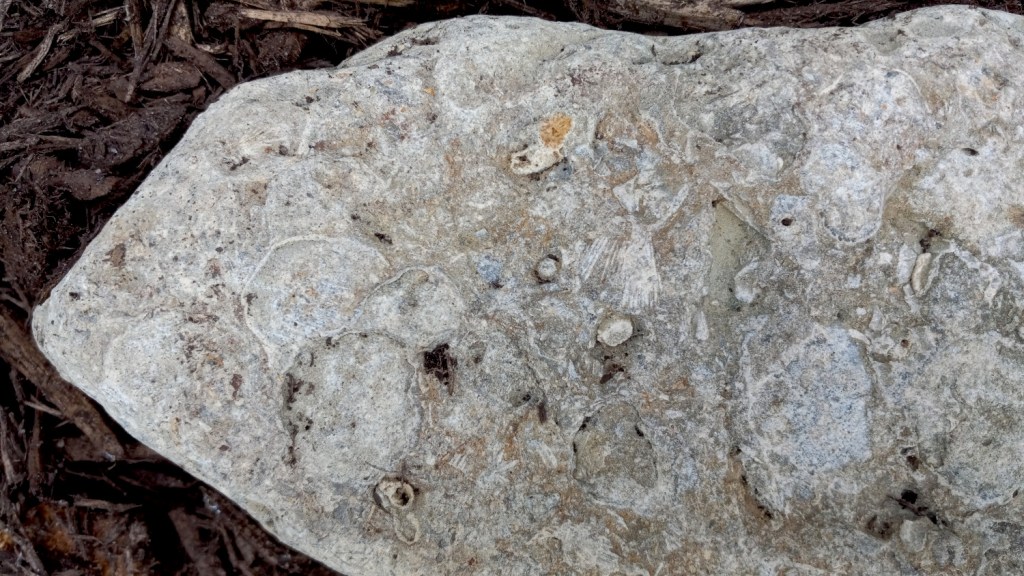
We are back in South Carolina. As I was putting mulch around some bushes I noticed the fossils in a bit of mudrock we brought back from a property we once owned on Green Bay in Wisconsin. That rock (along with the mulch) are shown in the photo above.
Ten years ago when I found the stone I tried to identify the fossils1 in it using a field guide. The field guide said that they were between 300 to 400 million years old (assuming I remember what it said correctly and matched what was in the book with what was in my hand).
I was impressed, but I was also disappointed that they weren’t 600 million years old, or older. I kept looking for more of those stones.
Over the past ten years I smartened up. I realized that given erosion rates all of the stuff I had in my hand would have eroded away2 long before it reached anywhere near 300 million years.
Today, I can tell you how old that stone is to within about 10 years, but you need to understand something about fossils first.
Fossils don’t form from dead stuff falling to the ground and being slowly buried over millennia. Dead stuff falling to the ground quickly decays. They have to die rapidly with a heavy weight pressing them down so they do not decompose. That occurs when heavy sediment carried by flooding waters provides the weight to press the plants and animals to the ground.
You would apply the same process to a leaf you wanted to preserve. You would pick it fresh and place it between paper with many books piled on top of it. When it dried out, you would have a nice, flat leaf, not a curled up piece of decaying leaf mold.
So, when in the history of humanity did such a flooding occur so that you could expect to find fossils all over the world? Think. The only time such flooding occurred on a global scale was the flood recorded in Genesis 6-9 and echoed through many legends.
That allows me to date the stone that I now have in my garden.
Given the biblical chronology that Henry B. Smith, Jr from Associates for Biblical Research provided3, the flood could be dated to 3298 BC. Now there is some wiggle-room here due to when in the year births occurred in the Genesis 5 and 11 chronologies, but I suspect that wiggle-room could be reduced to plus or minus 10 years.
You might object that what we read in Genesis are just stories. They are stories, but the important question is this: Are they TRUE stories? If you do not want to believe they are true, to the extent that archeologists can align those stories with historical events to that extent you might want to seriously reconsider any disbelief. This is why Christian archeologists try to align those dates with historical evidence so that the only ignorance that remains is willful ignorance.
So, how old is that stone?
It is, given today’s year of 2025 and subtracting one year since there is no 0 year in the Gregorian calendar, 3298 + 2025 – 1 = 5322 years old plus or minus those 10 years.
That is far less than the 300,000,000 years which the field guide wanted me to believe, but a far more reasonable number given erosion rates. That stone had already suffered much erosion damage when I found it.
And it is continuing to be eroded away every year I leave it unprotected in my garden, but it is not rare. Fossils like the one I have are all over the world because sedimentation layers are all over the world as one would expect given a catastrophic, global flooding less than 5,400 years ago.
- I think some of those fossils are crinoids. Wikipedia says: “In 2012, three geologists reported they had isolated complex organic molecules from 340-million-year-old (Mississippian) fossils of multiple species of crinoids.” That there are complex organic molecules at all in there should raise a red flag that the millions of years are wrong. ↩︎
- I’ve heard that a uniformitarian erosion rate would push all of the continents into the ocean in 50 million years. The problem with erosion is that it doesn’t all happen uniformly. If you have a house on a cliff near the water, you are likely very aware of the effects of erosion. ↩︎
- One can find videos and other information about the controversy over the Genesis 5 and 11 chronologies at the Associates for Biblical Research site. There’s a controversy because the Septuagint and the Masoretic manuscripts have different, but not randomly different, dates. They are not unintentional scribal errors, but deliberate distortions of the original. I get the 3298 BC date for the flood (and 5554 BC date for creation) from Henry B. Smith, Jr’s article at the 2018 International Conference on Creationism. The 5554 BC date puts the ministry of Jesus in the 6th millennium when the Messiah was expected to come. ↩︎

 Poetry, Short Prose and Walking