
Arguments for the existence of God are responses to philosophical skepticism. If you have not been deceived by this skepticism to the point of refusing to see when you look, all you have to do is look around yourself for evidence that God is real.
Romans 1:19-20 KJV – 19 Because that which may be known of God is manifest in them; for God hath shewed it unto them. 20 For the invisible things of him from the creation of the world are clearly seen, being understood by the things that are made, even his eternal power and Godhead; so that they are without excuse:
People who are willing to look and see – people whose minds have not been deceived – don’t need a philosophical argument for God. They already know He’s real. They might want to know more about Him, but the fact that He’s real is not a problem.
Furthermore, if they are born again Christians who follow where the Holy Spirit leads, they are sons of God. 1 The skeptic has no hope to convince such people. If you are one these people, you can skip the rest of this post. You are indeed blessed.
For those who are unsure, trust that the answers to any of your questions about God are in the Bible, but beware. Although you have passed the first level of deceivers, the skeptics, there are other wolves (or snakes) who would love to tell you what’s in the Bible like the serpent did to Eve.2
The existence of these wolves3 is as sure as the existence of God. I suspect most of them don’t even know they’re wolves. The Way is narrow4. Don’t let yourself be led astray by blind guides which would be a kind of persecution.5 Forgive them.6 Bless them.7 But move on.8
Skeptics of God’s existence
Philosophical skeptics about God are biblically referred to as fools. They love to run their mouths. If no one listened to them, they would only harm themselves.
Romans 1:21-23 KJV – 21 Because that, when they knew God, they glorified him not as God, neither were thankful; but became vain in their imaginations, and their foolish heart was darkened. 22 Professing themselves to be wise, they became fools, 23 And changed the glory of the uncorruptible God into an image made like to corruptible man, and to birds, and fourfooted beasts, and creeping things.
When skeptics talk they introduce doubt into the minds of their listeners and reinforce it in themselves. When they keep expressing this doubt it becomes a commercial selling speculative lies over and over again.
On the bright side, since skeptics are speaking falsehood, whatever they say will counterproductively spring back on them when people argue against their positions effectively. That defense is the only reason to make these philosophical arguments.
When listeners (including the skeptics themselves) realize that no one in his right mind wants what the skeptics are selling in their commercials, the defense will have succeeded.
Formalized propositional logic
There are many philosophical arguments against skeptics of God’s existence. The kind I am focusing on here is called transcendental arguments. Immanuel Kant began this type of argumentation to address the skepticism of David Hume.9
All I will be doing in this post is formalizing the logical steps that one needs to go through in propositional logic to make a transcendental argument. I will also use an online proof checker10 to validate these steps.
What that will do, hopefully, is make clear what the structure of a transcendental argument is and demonstrate that the structure is valid.
Presuppositions11
To get started I need a proposition, a statement of something obvious that no one would want to reject such as “I think”. Then I need to identify what that proposition presupposes. Following Descartes I might say that “I think” presupposes that “I am”.
Even though I might have to chain these presuppositions to get where I want to go, if I can reach a proposition that some unknown God12 exists, then it is game over for the skeptic. Because of that, I should not expect the skeptic to quietly agree with anything I have to offer. He will claim that I just asserted the presupposition without demonstrating it.13 To make sure that no one agrees with him, I need to make sure that I argue persuasively and clearly.
This is the hardest part of the argument. It is also the part that I’m skipping. All I want to show now is what is going on with such arguments by formalizing them as a propositional proof. I want to make sure that it is clear what these arguments are trying to show.
For an example of a specific transcendental argument, Parker Settecase showed how C.S. Lewis set one up.14
What is a presupposition?
A presupposition is the consequent of two implications where the antecedent of one is the negation of the antecedent of the other. If I say that A presupposes B I mean not only that A implies B but also that not A implies B. If the proposition A and its negation both imply the proposition B, then B is a presupposition of A or A presupposes B.
Although that might sound confusing, presuppositions are easy to find. Here’s an example:
Proposition: There is writing on the paper.
Presupposition: There is a piece of paper.
There is writing on the paper implies that there is a piece of paper.
There is not writing on the paper also implies that there is a piece of paper.
If you accept the proposition or its negation, it makes no sense to reject the presupposition.
Setting up the formalization
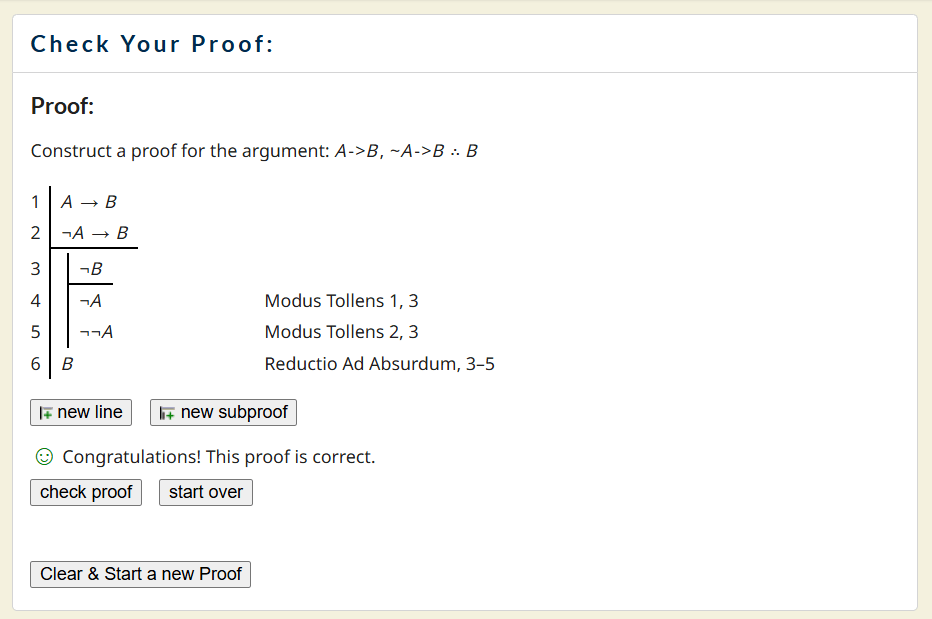
Let A stand for the proposition and let B stand for the presupposition. Next assume the two implications (which I would have to successfully argue for), namely, A implies B and not A implies B.
A → B as the first assumption
¬A → B as the second assumption
What I want to do is show that if I am skeptical and assume not B, then all I get is a contradiction. So, I will assume not B with the intent of deriving a contradiction. That is, I plan to push the skeptic into a corner.
¬B by hypothesis
Since I have assumed not B, I can use modus tollens on A implies B to derive not A. I can do the same to not A implies B to derive not not A. With that I derive the next two lines of the proof.
¬A by modus tollens from the hypothesis and first assumption
¬¬A by modus tollens from the hypothesis and second assumption
Note that those two lines together form a contradiction, not A and not not A. Since I derived a contradiction I can use reductio ad absurdum to reject the hypothesis as absurd. Given a presupposition B, if I hypothesize not B, all I can derive is B.
Proof checker validation15
Moral of the story
If you can show that a true proposition has a presupposition, that presupposition is a necessary condition not only for the proposition but also for its negation.
If the skeptic wants the proposition to be true, he has to accept the presupposition. That is the transcendental argument.
The goal of a transcendental argument for God starts with a proposition even the skeptic can’t reject. It identifies a presupposition of that proposition which leads to some unspecified, unknown God’s existence.
Having that unknown God is all I need. The philosophical step is over. The deception has been broken. The Bible and the Holy Spirit take over (although they have been guiding me all along this philosophical journey which wouldn’t have been necessary if I weren’t deceived in the first place).
______
- Romans 8:14 KJV – 14 For as many as are led by the Spirit of God, they are the sons of God. ↩︎
- Genesis 3:1-5 KJV – 1 Now the serpent was more subtil than any beast of the field which the LORD God had made. And he said unto the woman, Yea, hath God said, Ye shall not eat of every tree of the garden? 2 And the woman said unto the serpent, We may eat of the fruit of the trees of the garden: 3 But of the fruit of the tree which is in the midst of the garden, God hath said, Ye shall not eat of it, neither shall ye touch it, lest ye die. 4 And the serpent said unto the woman, Ye shall not surely die: 5 For God doth know that in the day ye eat thereof, then your eyes shall be opened, and ye shall be as gods, knowing good and evil. ↩︎
- Matthew 7:15-20 KJV – 15 Beware of false prophets, which come to you in sheep’s clothing, but inwardly they are ravening wolves. 16 Ye shall know them by their fruits. Do men gather grapes of thorns, or figs of thistles? 17 Even so every good tree bringeth forth good fruit; but a corrupt tree bringeth forth evil fruit. 18 A good tree cannot bring forth evil fruit, neither can a corrupt tree bring forth good fruit. 19 Every tree that bringeth not forth good fruit is hewn down, and cast into the fire. 20 Wherefore by their fruits ye shall know them. ↩︎
- Matthew 7:13-14 KJV – 13 Enter ye in at the strait gate: for wide is the gate, and broad is the way, that leadeth to destruction, and many there be which go in thereat: 14 Because strait is the gate, and narrow is the way, which leadeth unto life, and few there be that find it. ↩︎
- Mark 10:29-30 KJV – 29 And Jesus answered and said, Verily I say unto you, There is no man that hath left house, or brethren, or sisters, or father, or mother, or wife, or children, or lands, for my sake, and the gospel’s, 30 But he shall receive an hundredfold now in this time, houses, and brethren, and sisters, and mothers, and children, and lands, with persecutions; and in the world to come eternal life. ↩︎
- Matthew 5:43-45 KJV – 43 Ye have heard that it hath been said, Thou shalt love thy neighbour, and hate thine enemy. 44 But I say unto you, Love your enemies, bless them that curse you, do good to them that hate you, and pray for them which despitefully use you, and persecute you; 45 That ye may be the children of your Father which is in heaven: for he maketh his sun to rise on the evil and on the good, and sendeth rain on the just and on the unjust. ↩︎
- Luke 6:27-28 KJV – 27 But I say unto you which hear, Love your enemies, do good to them which hate you, 28 Bless them that curse you, and pray for them which despitefully use you. ↩︎
- 1 Timothy 6:3-5 KJV – 3 If any man teach otherwise, and consent not to wholesome words, even the words of our Lord Jesus Christ, and to the doctrine which is according to godliness; 4 He is proud, knowing nothing, but doting about questions and strifes of words, whereof cometh envy, strife, railings, evil surmisings, 5 Perverse disputings of men of corrupt minds, and destitute of the truth, supposing that gain is godliness: from such withdraw thyself. ↩︎
- Bardon, Adrian, “Transcendental Arguments”, Internet Encyclopedia of Philosophy, https://iep.utm.edu/trans-ar/ ↩︎
- Open Logic Project: https://openlogicproject.org/ ↩︎
- Beaver, David I., Bart Geurts, and Kristie Denlinger, “Presupposition”, The Stanford Encyclopedia of Philosophy (Fall 2024 Edition), Edward N. Zalta & Uri Nodelman (eds.), URL = <https://plato.stanford.edu/archives/fall2024/entries/presupposition/> ↩︎
- Acts 17:22-23 KJV – 22 Then Paul stood in the midst of Mars’ hill, and said, Ye men of Athens, I perceive that in all things ye are too superstitious. 23 For as I passed by, and beheld your devotions, I found an altar with this inscription, TO THE UNKNOWN GOD. Whom therefore ye ignorantly worship, him declare I unto you. ↩︎
- Sheng-Ta Tsai, Deconstructing Christianity, Transcendental Argument for God’s Existence Debunked, 9/20/2023 ↩︎
- Parker Settecase provided a detailed presentation of this proof in his blog post of 11/13/2017, C.S.Lewis’s Transcendental Argument for God. ↩︎
- https://proof-checker.org/ ↩︎
 Poetry, Short Prose and Walking