Linda G. Hill’s One Liner Wednesday.


Arguments for the existence of God are responses to philosophical skepticism. If you have not been deceived by this skepticism to the point of refusing to see when you look, all you have to do is look around yourself for evidence that God is real.
Romans 1:19-20 KJV – 19 Because that which may be known of God is manifest in them; for God hath shewed it unto them. 20 For the invisible things of him from the creation of the world are clearly seen, being understood by the things that are made, even his eternal power and Godhead; so that they are without excuse:
People who are willing to look and see – people whose minds have not been deceived – don’t need a philosophical argument for God. They already know He’s real. They might want to know more about Him, but the fact that He’s real is not a problem.
Furthermore, if they are born again Christians who follow where the Holy Spirit leads, they are sons of God. 1 The skeptic has no hope to convince such people. If you are one these people, you can skip the rest of this post. You are indeed blessed.
For those who are unsure, trust that the answers to any of your questions about God are in the Bible, but beware. Although you have passed the first level of deceivers, the skeptics, there are other wolves (or snakes) who would love to tell you what’s in the Bible like the serpent did to Eve.2
The existence of these wolves3 is as sure as the existence of God. I suspect most of them don’t even know they’re wolves. The Way is narrow4. Don’t let yourself be led astray by blind guides which would be a kind of persecution.5 Forgive them.6 Bless them.7 But move on.8
Skeptics of God’s existence
Philosophical skeptics about God are biblically referred to as fools. They love to run their mouths. If no one listened to them, they would only harm themselves.
Romans 1:21-23 KJV – 21 Because that, when they knew God, they glorified him not as God, neither were thankful; but became vain in their imaginations, and their foolish heart was darkened. 22 Professing themselves to be wise, they became fools, 23 And changed the glory of the uncorruptible God into an image made like to corruptible man, and to birds, and fourfooted beasts, and creeping things.
When skeptics talk they introduce doubt into the minds of their listeners and reinforce it in themselves. When they keep expressing this doubt it becomes a commercial selling speculative lies over and over again.
On the bright side, since skeptics are speaking falsehood, whatever they say will counterproductively spring back on them when people argue against their positions effectively. That defense is the only reason to make these philosophical arguments.
When listeners (including the skeptics themselves) realize that no one in his right mind wants what the skeptics are selling in their commercials, the defense will have succeeded.
Formalized propositional logic
There are many philosophical arguments against skeptics of God’s existence. The kind I am focusing on here is called transcendental arguments. Immanuel Kant began this type of argumentation to address the skepticism of David Hume.9
All I will be doing in this post is formalizing the logical steps that one needs to go through in propositional logic to make a transcendental argument. I will also use an online proof checker10 to validate these steps.
What that will do, hopefully, is make clear what the structure of a transcendental argument is and demonstrate that the structure is valid.
Presuppositions11
To get started I need a proposition, a statement of something obvious that no one would want to reject such as “I think”. Then I need to identify what that proposition presupposes. Following Descartes I might say that “I think” presupposes that “I am”.
Even though I might have to chain these presuppositions to get where I want to go, if I can reach a proposition that some unknown God12 exists, then it is game over for the skeptic. Because of that, I should not expect the skeptic to quietly agree with anything I have to offer. He will claim that I just asserted the presupposition without demonstrating it.13 To make sure that no one agrees with him, I need to make sure that I argue persuasively and clearly.
This is the hardest part of the argument. It is also the part that I’m skipping. All I want to show now is what is going on with such arguments by formalizing them as a propositional proof. I want to make sure that it is clear what these arguments are trying to show.
For an example of a specific transcendental argument, Parker Settecase showed how C.S. Lewis set one up.14
What is a presupposition?
A presupposition is the consequent of two implications where the antecedent of one is the negation of the antecedent of the other. If I say that A presupposes B I mean not only that A implies B but also that not A implies B. If the proposition A and its negation both imply the proposition B, then B is a presupposition of A or A presupposes B.
Although that might sound confusing, presuppositions are easy to find. Here’s an example:
Proposition: There is writing on the paper.
Presupposition: There is a piece of paper.
There is writing on the paper implies that there is a piece of paper.
There is not writing on the paper also implies that there is a piece of paper.
If you accept the proposition or its negation, it makes no sense to reject the presupposition.
Setting up the formalization
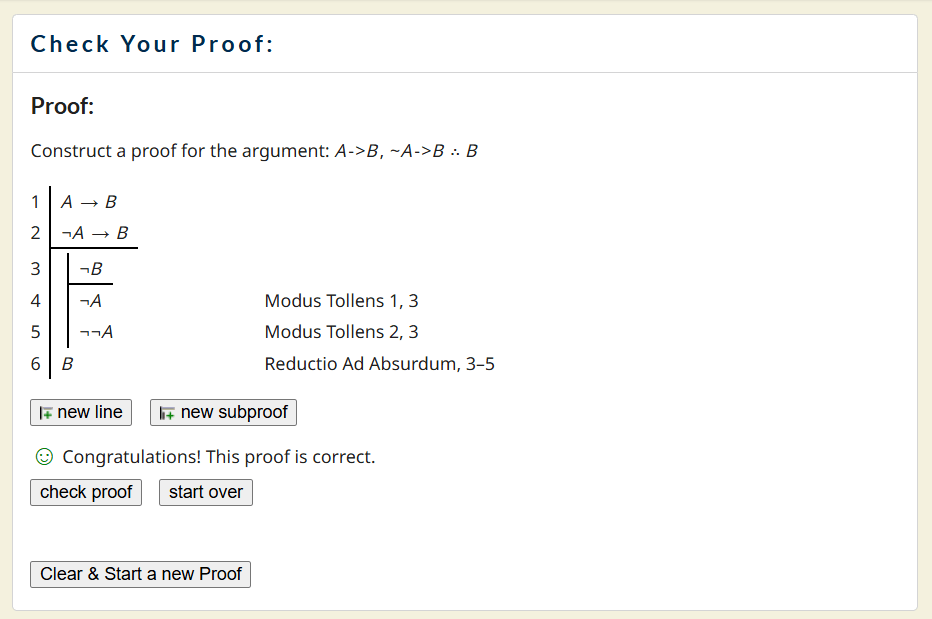
Let A stand for the proposition and let B stand for the presupposition. Next assume the two implications (which I would have to successfully argue for), namely, A implies B and not A implies B.
A → B as the first assumption
¬A → B as the second assumption
What I want to do is show that if I am skeptical and assume not B, then all I get is a contradiction. So, I will assume not B with the intent of deriving a contradiction. That is, I plan to push the skeptic into a corner.
¬B by hypothesis
Since I have assumed not B, I can use modus tollens on A implies B to derive not A. I can do the same to not A implies B to derive not not A. With that I derive the next two lines of the proof.
¬A by modus tollens from the hypothesis and first assumption
¬¬A by modus tollens from the hypothesis and second assumption
Note that those two lines together form a contradiction, not A and not not A. Since I derived a contradiction I can use reductio ad absurdum to reject the hypothesis as absurd. Given a presupposition B, if I hypothesize not B, all I can derive is B.
Proof checker validation15
Moral of the story
If you can show that a true proposition has a presupposition, that presupposition is a necessary condition not only for the proposition but also for its negation.
If the skeptic wants the proposition to be true, he has to accept the presupposition. That is the transcendental argument.
The goal of a transcendental argument for God starts with a proposition even the skeptic can’t reject. It identifies a presupposition of that proposition which leads to some unspecified, unknown God’s existence.
Having that unknown God is all I need. The philosophical step is over. The deception has been broken. The Bible and the Holy Spirit take over (although they have been guiding me all along this philosophical journey which wouldn’t have been necessary if I weren’t deceived in the first place).
______
Steven followed the thread until it broke which made him worry that he might not be able to find his way home. Fear of shame kept him from crying out for help since he had no business being where he was.
The creatures from the caverns of Blislisnis where he went to waste his time approached to collect additional fees. They lured him back to the pleasure rooms of their little Babylon by offering him piece after piece of wormy delights like one might lure a largish dog when it refuses to go where you want it to.
Forgetting that he dreadfully wanted to leave only moments ago Steven lapped up morsel after morsel consuming as much of the delicacy as they would allow him to eat. With him secured deep inside his accusers, those scornful, lying mockers, induced him to vomit, surrounded him with derision and gloated that now he could never leave.
______
Denise offers the prompt word “thread” for this week’s Six Sentence Stories. Steven’s story continues from last week and will continue next week. I don’t have the heart to leave him in Blislisnis.
Romans 1:24 Wherefore God also gave them up to uncleanness through the lusts of their own hearts…
______

 Poetry, Short Prose and Walking