
Dale offers the theme “house plants” for this week’s Cosmic Photo Challenge.


Dale offers the theme “house plants” for this week’s Cosmic Photo Challenge.
The Fall, contra to what you may have seen…in Sunday School, is not simply the eating of the forbidden fruit…. What happens in Genesis 3…is actually an attack on creation order.
Owen Strachan, Issues in Biblical Anthropology, Lecture 3 (about 57:45)
Creation order is the order of Genesis 1 and 2. As Strachan put it: “There’s God and under God there is the man who’s called to this position of headship as the New Testament will call it. There’s the woman underneath him. There are the animals underneath them.” (about 59:00)
Biblical anthropology does not take the creation order from the world but from the Bible. The world blurs distinctions the Bible makes and creates distinctions the Bible doesn’t.
Owen Strachan wanted the future pastors in this seminary lecture to see clearly the creation order so they could effectively lead their churches and not be themselves led by the world. He said, “Are you feeling how alien Christianity increasingly is from what our secular culture teaches? Are you feeling that? I hope you are. If you are, good. That’s what you should feel. You should feel that Christianity is distinct from the world.” (about 42:45)
Weekly Bible Reading: Psalms (Audio), Proverbs (Audio)
Commentaries:
David Pawson, Psalms, Part 32, Proverbs, Part 33, Unlocking the Bible
Bible Project, Psalms and Proverbs

We’re persevering. Let me send
a blessing on what you may do
that it be right and it be true.
At last I know you as a friend
to look for when we reach the end.
We’ve seen the way the devil groups
despair with his deceitful troops,
because he wants to hold his ground.
Deep time is short. We’re homeward bound.
He’ll trip and fall, his final oops.
Ronovan Hester offers the rhyme word “oops” to be used in the C line of a décima having rhyme pattern ABBAACCDDC for this week’s challenge.


Jerome thought of all the good he’d be able to do if he made the deal.
“You really could do a lot of good with that money,” reaffirmed the lawyer offering him the contract.
With those additional billions Jerome would be able to implement his plans for climate control by reflecting solar radiation back into space, stop genetic entropy by cloning engineered species, medically manipulate the population into an addicted state of happiness, and eliminate any unhappy terrorists who’d try to stop him.
“Just to make sure you understand,” the lawyer continued, “after fifty years my company will acquire your soul, which you’ve admitted doesn’t materially matter to you anyway, and in exchange you will have enough resources to save your planet in any way you’ve a mind to do so.”
Some years later after a good deal of planet-saving had wrecked the planet, Jerome listened to his top scientists explain how they might be able to remove the orbiting sun-reflecting micromirrors they released earlier that year, but it would be more expensive than Jerome had expected.
He then asked them, “Hypothetically, if someone were fool enough to sell his soul to the devil to hire guys like you, is there another way out of the contract than the one you are now proposing and how much would that cost me?”
Denise offers the word “deal” to be used in this week’s Six Sentence Stories.
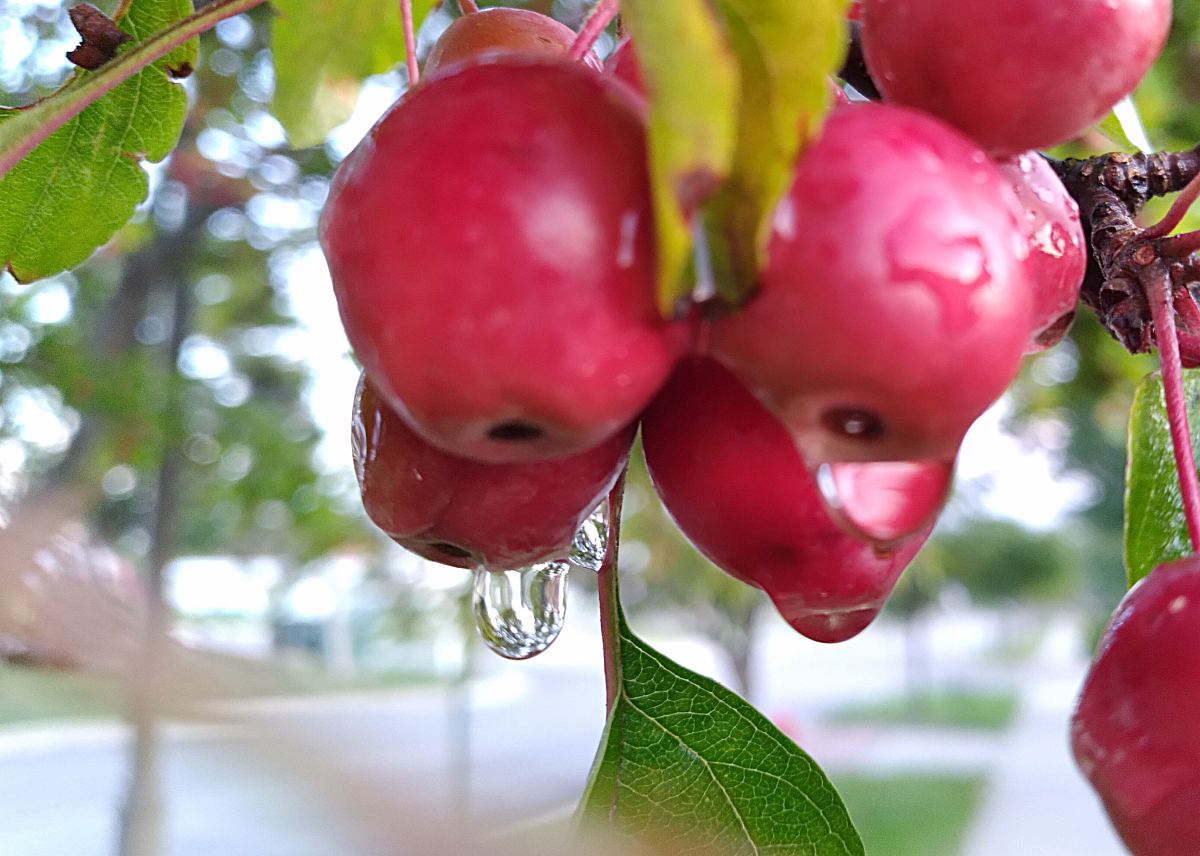
Dale offers the prompt “focus on flowers” for this week’s Cosmic Photo Challenge.

Answer not a fool according to his folly, lest thou also be like unto him. Answer a fool according to his folly, lest he be wise in his own conceit.
Proverbs 26:4-5, King James Bible 1769, and expounded in Greg Bahnsen’s Always Ready.
In one of Jim Lee’s posts he linked to Reconstructionist Radio, a site offering Grey Toombs’ narration of Always Ready, a collection of essays by Greg Bahnsen. Bahnsen was a proponent of Van Til’s presuppositional apologetics. Keeping Proverbs 26:4-5 in mind, this apologetics answers the fool without capitulating to the fool’s presuppositions.
After reading C.S. Lewis’s Miracles, Bahnsen’s essay, The Problem of Miracles, reprinted as Chapter 34, caught my attention.
At the beginning of the essay, Bahnsen explained why miracles are a problem for the modern mind: “Miracles would disrupt our simplistic and impersonalistic views of the predictability and uniformity of the world around us.”
We should be careful not to accept Naturalism’s presuppositions by becoming aware of what they are. For example, there needs to be a reason for the uniformity of nature. Can the Naturalist presupposition of the existence of impersonal laws of nature provide that reason? Given that “impersonal” implies those laws arose by chance, it is not likely. Furthermore as Bahnsen claimed at about 21:30 in the narration of the chapter, “God’s self-revelation in the scriptures offers no support for the idea that there are impersonal laws of nature which make the world operate mechanically and with an inevitability which is free ordinarily from the choices of God’s will.” So, there is no need for a Christian to capitulate to the Naturalist’s presupposition of impersonal laws of nature.
The Christian presupposition is that the Bible is the Word of God. The creation account in Genesis 1-2 provides a reason for the uniformity of nature since the creation was good and Genesis 3 provides a reason for the disorderliness of evil (rebellion) that we also see.
Is the source of the orderliness we experience personal or impersonal? If we accept that it is personal (rather than arising from impersonal chance), does the Bible reveal the true personal source or might there some other source such as panpsychism, Brahma or some Baal? The Christian presupposes that the Bible reveals the true source and, given that source, miracles are possible.
At the end of the chapter, Bahnsen warned us to be careful with miracles. They are possible, but the presence of a miracle, or perhaps better put, a sign or wonder, does not mean that God was responsible for it. Signs or wonders, given the serpent in Genesis 3, may also come from demonic sources seeking to deceive.
All knowledge is deposited in Christ. Man’s knowledge of the truth depends upon God’s prior knowledge, begins with the fear of the Lord, and it requires submission to God’s Word.
Greg Bahnsen, Always Ready, Chapter 6
Weekly Bible Reading: Psalms (Audio)
Commentary: David Pawson, Hebrew Poetry, Part 30, and Psalms, Part 31, Unlocking the Bible

This prairie’s thick with butterflies.
From bloom to bloom they make a trip
as summer’s winds through flowers slip
at home with life and cloudy skies.
These butterflies distract my eyes
like yellow leaves that float and fall.
They calmly work though very small.
While on this journey patiently,
though home seems far away from me,
I’ll walk and pray, obey the call.
Ronovan Hester offers the rhyme word “trip” to be used in a B line of a décima having rhyme pattern ABBAACCDDC for this week’s challenge. And Eugenia offers “journey” for her prompt this week.


Considering how nebulous his mind was only a few years ago, Joel knew he was being led by someone beyond what he thought the word “beyond” meant.
Shamefully he admitted he didn’t deserve any of this insight, or help as he sometimes called it, having filled his life with vanity and trouble. Now all he was interested in were questions like How can you feel at home in this world?
When Joel disappeared most of them thought the hunters got him. The hunters got a lot of them. Sometimes they found body parts, but so far nothing turned up that could be linked to Joel giving them hope that whoever or whatever he thought was on his side led him beyond the hell they were living in and wishing they could have gone along even if it meant dying to get there.
Denise offers the prompt word “nebulous” to be used in this week’s Six Sentence Stories.

Dale offers the theme “as summer fades” for this week’s Cosmic Photo Challenge.

What we learn from experience depends on the kind of philosophy we bring to experience.
C.S. Lewis, Miracles: A Preliminary Study, Page 11.
In Miracles C.S. Lewis wants to convince his readers that miracles, especially the grand miracle of the Incarnation where God became Man in Jesus, are possible and fitting. He does this by challenging views of nature, both theistic and atheistic, that reject the supernatural as a source for miracles.
Naturalism claims that supernatural reality does not exist implying that there could be no miracles. Lewis takes from Naturalism that nature is orderly, impersonal cause and effect processes. He then shows that our reasoning ability would not be the result of such processes. Whenever we reason we thereby demonstrate reality that Naturalism cannot explain without something else outside it.
Hence, given Naturalism’s presuppositions about nature, nature cannot be the whole show. Alvin Plantinga carried this idea further in his Evolutionary Argument Against Naturalism.
Combine Naturalism with some field of consciousness (to avoid the supernatural) and one gets Pantheism, an ancient but ever-popular form of spirituality. Lewis writes (pages 99-100), “The popular ‘religion’ excludes miracles because it excludes the ‘living God’ of Christianity and believes instead in a kind of God who obviously would not do miracles, or indeed anything else.”
Although that characterization of Pantheism makes sense, it seems limited. These nature religions also have an ominous underbelly of demonic activity that Ephesians 6 warns us about. Miracles are wonders to our eyes. God is not the only source of them.
Furthermore, I see Platonism as a rationalization of these popular religions that Lewis objects to. However, and this is where my problems start, Lewis views Christianity as having “incorporated both” Platonism and Judaism (page 101). After reading his appendix on special providences I lost the ‘living God’ in all that philosophy.
There is much in Miracles of value especially when Lewis uses the presuppositions of Naturalism to argue for the supernatural, however, I suspect that Lewis accepted without adequate questioning many of the presuppositions of Naturalism such as impersonal natural laws and my own worldview inclines me to trust the Jewish scriptures over Plato.
Next Sunday I will look at miracles as presented by Greg Bahnsen.
The audio below is a reading of a shorter essay by Lewis on the topic of miracles.
Weekly Bible Reading: Job (Audio)
Commentary: David Pawson, Job, Part 28 and Part 29, Unlocking the Bible



 Poetry, Short Prose and Walking