But what saith it? The word is nigh thee, even in thy mouth, and in thy heart: that is, the word of faith, which we preach; That if thou shalt confess with thy mouth the Lord Jesus, and shalt believe in thine heart that God hath raised him from the dead, thou shalt be saved.
Once upon a time when the lad returned uneaten questions arose. If the lad wasn’t eaten, how were the town folk going to explain the statue and the truly tall tales they were telling to the tourists?
The town’s scientist came to the rescue explaining that if they only knew science the way he did they would see that when light hit the lad’s chiral polypeptide lipid loving amino acids they’d order the polymerization end to end bringing back together again the lad as if nothing happened. Our beloved scientist patiently lectured the uneducated town folk (since they patiently listened) on how science had proven over and over again that stuff that couldn’t happen happened all the time.
Although the town folk didn’t buy his tale (deep down anyway), they were glad to have something to tell those tourists who wouldn’t shut their mouths when they were told nonsense. Besides – town folk being town folk – once they realized that they were just too stupid to understand, what they couldn’t understand previously suddenly made sense so everyone could go back to living happily ever after again.
Once upon a time there was a big bad wolf who liked to eat and a lad who liked to cry “Wolf! Wolf!” even when big bad wasn’t hungry. The wolf got barbequed and the lad – whom, it turned out, wasn’t eaten – went off to make his fortune somewhere where people listened to him when he cried wolf.
After many, many years our dear lad heard about a town with a weird statue and realized that this was his home town and after hearing the truly tall tales the tourists were told figured that statue must be a statue of him.
He went on a march back home to see the statue and ran into many of the lassies who still hadn’t washed those spots where they insisted, despite his faulty memory, that he kissed them long, long ago. These lassies, who now ran the town, set the lad up in a prosperous business of freely kissing any lassie – tourist or local – for only $10 per decent peck on the cheek.
After that who wouldn’t want to live happily ever after?
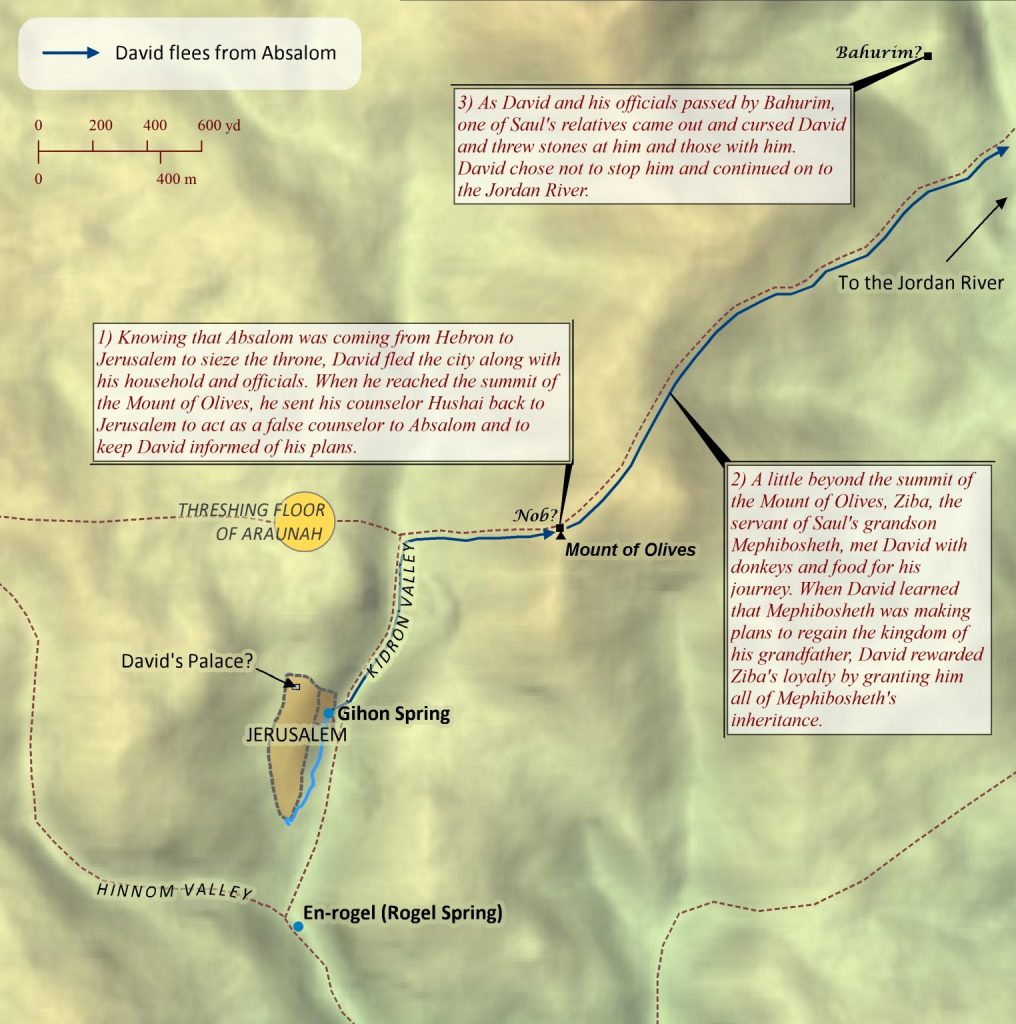
It is amazing what a map can do to bring to life events in the Bible.
Today, David P. Barrett of Bible Mapper Atlas posted a map of the events of 2 Samuel 15-16 where David leaves Jerusalem after hearing that his son Absalom has been declared king in Hebron.
Below is the map from Bible Mapper Atlas detailing the events. The events are described in more detail on the site along with links to other maps.
Once upon a time the leaders of the town where the lad used to live decided to conduct a series of investigations to find out precisely what happened to the lad in all its gory details. However, no one actually saw the lad get eaten by the big bad wolf in spite of the tall tales offered to tourists.
One investigation centered on the lassies who said they were kissed by the lad and had vowed never ever to wash that spot again. These lassies were highly popular with the tourists.
The town leaders commissioned the most renowned scientist they could afford to construct from those unwashed spots where the lad kissed these gorgeous lassies his full DNA sequence that they planned to display in their newly opened museum. In spite of there being hundreds of distinct Y-chromosomes on those unwashed spots our brilliant scientist was able to swing a home run by miraculously producing with the help of a random number generator the commissioned DNA sequence that allowed him to live happily ever after.
Once upon a time there was an ever-growing clan of pigeons who found the statue of the lad and the big bad wolf as attractive as the photographers who featured photos of it everywhere. It was a beautiful bronze color, that is, it was until the pigeons did what they normally do when they float over your head and take aim.
Over the years people thought the spots turned the statue into a magical masterpiece that the town council – to save funds – cheerfully agreed to leave uncleaned. Eventually all that the tourists who came looking for the statue could find was a huge whitish gray, compost wannabe pile that the pigeons kept contributing to.
Thankfully most tourists thought the artistic touch added by the pigeons was even more impressive than the original statue which was no longer visible. By doing nothing the town found itself living happily ever after.
In the following video Henry B. Smith, Jr from the Associates for Biblical Research interviews Bryan Windle who provides a top ten list of archeological discoveries that justify taking the book of Esther in the Bible as actual history.
As a conclusion, Windle quotes Karen H. Jobes’ NIV Application Commentary on the book of Esther:
Judaism and Christianity rest not on the inward, mystical journey of the mind and soul of the individual, but on events in history through which the Creator-Redeemer God revealed himself to people.
Biblical narratives such as Esther are the record of those events in the form of story. Purim would be a hollow religious celebration if the Jews in Persia had not truly been delivered from destruction.
Once upon a time, after the lad-wolf incident, Save The Wolf Foundation got a few votes too many in a low turnout election (except for all the dead people who miraculously voted) for seats on the town council. As the new majority they immediately demanded that a statue be set up to honor the big bad wolf who was brutally, but deliciously, barbequed.
This plan didn’t fly well with the majority of the (living) town folk – like maybe 100% of them – who now regretted not voting because they figured no one in his right mind would vote for Save The Wolf (as indeed no one in his right mind did). Threatened to be ousted in the next election – which would be watched like a hawk – Save The Wolf compromised enough to permit the town council to commission a statue of the lad with the big bad wolf chewing his leg.
After the statue was erected the town became a notorious tourist attraction drawing visitors from far and wide who wanted to see the statue that no one in his right mind would have erected. Anyone who could find a way to profit from this unexpected popularity by delaying the tourists’ stay with some lucrative lad-wolf amusement lived happily ever after.
This is the final video in a course on abiogenesis by Dr. James Tour. If the subject of the naturalistic origin of life from nonlife intrigues you, it may be good to keep in mind how unlikely something like that actually is. And yet here we are. How did we get here? If you don’t like Genesis, that question is not easy to answer and so far it has not been answered.
Regardless what you might hear in the media or the hype from origins of life researchers, no one has been able to create life from nonlife in a laboratory. They have done many amazing things with already existing life, but they have not started with nonliving chemicals and produced life. There are many reasons why this problem is difficult.
Life requires homochirality. Molecules do not naturally separate into left and right handed versions, but biological molecules have to for a cell to function without overheating.
Carbohydrates are the hardest to synthesize in a modern lab. How they could have synthesized in a prebiotic environment without lab equipment or trained technicians running that equipment is a mystery.
Peptides are also difficult to synthesize. Any partial success in the lab involves processes unavailable in a prebiotic environment.
Nucleotides may be easier until one tries to link them together, because they depend on synthesizing carbohydrates to get the ribose that joins them.
Lipids are sometimes said to form spontaneously. Tour said that “spontaneously” is an origin of life researcher’s code word for “I have no idea how that happened”.
Chiral-induced spin selectivity requires homochirality. It permits cell functions without overheating while maintaining the purity of the cell’s components.
RNA can not replicate enough of itself to be useful. Linking parts of it together leads to errors which make it useless. It is also unstable. The RNA World hypothesis that relies on RNA alone cannot even get started.
Life requires a non-random DNA code that can usefully direct the cell’s functions. Not just any random code will do. So even if you get past the other problems of synthesizing a cell from chemicals, the information problem blocks the process. How does mindless nature know what a useful code sequence could be?
Even though Bahnsen’s lecture is some decades older than Tour’s course, Bahnsen’s chemical arguments against life coming from nonlife is in line with what Tour had to say. And Tour’s objections to abiogenesis reinforced Bahnsen’s assessment of evolution in general, not just abiogenesis, as a “grand fairy tale for adults”.
Once upon a time there was a big bad wolf who liked to eat. Big bad ate this and big bad ate that. Once big bad ate a lad who cried “Wolf! Wolf!” even when big bad was minding its own business.
Eventually, like always, big bad got hungry again and wondered what might be on the menu besides the garbage he’s been eating on the ground.
It’s surprising, but true, that ordinary town folk do smarten up given enough time and motivation and this time when big bad returned they decided to give it a taste of its own medicine by trapping it and – gulp – eating it in spite of protests organized by Save The Wolf Foundation.
When the town folk did as they planned to do and big bad got his just deserts, they all lived happily ever after except for the protestors who would have been unhappy no matter what happened, but that’s another tale I probably won’t bother to tell, although I just might.
In case anyone is wondering, as I was, there is no actual Save The Wolf Foundation. I searched for one and AI told me to stop wasting my time: The search results do not contain specific information about an organization named “Save The Wolf Foundation”.



 Poetry, Short Prose and Walking