The Beatitudes and the Woes

I listened to all 28 chapters of the Gospel of Matthew one after the other today. Some parallels stood out like Peter’s denial and the betrayal of Judas. They both bitterly regretted what they did.

I remember well the beatitudes and the woes. However, I didn’t associate them with each other until now. The structure of this gospel is well crafted as one would expect. It was inspired by no ordinary muse, after all, but by the Holy Spirit Himself.

The Nine Beatitudes

Matthew 5:3-12 KJV3 Blessed are the poor in spirit: for theirs is the kingdom of heaven.
4 Blessed are they that mourn: for they shall be comforted.
5 Blessed are the meek: for they shall inherit the earth.
6 Blessed are they which do hunger and thirst after righteousness: for they shall be filled.
7 Blessed are the merciful: for they shall obtain mercy.
8 Blessed are the pure in heart: for they shall see God.
9 Blessed are the peacemakers: for they shall be called the children of God.
10 Blessed are they which are persecuted for righteousness’ sake: for theirs is the kingdom of heaven.
11 Blessed are ye, when men shall revile you, and persecute you, and shall say all manner of evil against you falsely, for my sake.

12 Rejoice, and be exceeding glad: for great is your reward in heaven: for so persecuted they the prophets which were before you.

The Eight Woes

Matthew 23:13-31 KJV13 But woe unto you, scribes and Pharisees, hypocrites! for ye shut up the kingdom of heaven against men: for ye neither go in yourselves, neither suffer ye them that are entering to go in.
14 Woe unto you, scribes and Pharisees, hypocrites! for ye devour widows’ houses, and for a pretence make long prayer: therefore ye shall receive the greater damnation.
15 Woe unto you, scribes and Pharisees, hypocrites! for ye compass sea and land to make one proselyte, and when he is made, ye make him twofold more the child of hell than yourselves.
16 Woe unto you, ye blind guides, which say, Whosoever shall swear by the temple, it is nothing; but whosoever shall swear by the gold of the temple, he is a debtor!
17 Ye fools and blind: for whether is greater, the gold, or the temple that sanctifieth the gold?
18 And, Whosoever shall swear by the altar, it is nothing; but whosoever sweareth by the gift that is upon it, he is guilty.
19 Ye fools and blind: for whether is greater, the gift, or the altar that sanctifieth the gift?
20 Whoso therefore shall swear by the altar, sweareth by it, and by all things thereon.
21 And whoso shall swear by the temple, sweareth by it, and by him that dwelleth therein.
22 And he that shall swear by heaven, sweareth by the throne of God, and by him that sitteth thereon.
23 Woe unto you, scribes and Pharisees, hypocrites! for ye pay tithe of mint and anise and cummin, and have omitted the weightier matters of the law, judgment, mercy, and faith: these ought ye to have done, and not to leave the other undone.
24 Ye blind guides, which strain at a gnat, and swallow a camel.
25 Woe unto you, scribes and Pharisees, hypocrites! for ye make clean the outside of the cup and of the platter, but within they are full of extortion and excess.
26 Thou blind Pharisee, cleanse first that which is within the cup and platter, that the outside of them may be clean also.
27 Woe unto you, scribes and Pharisees, hypocrites! for ye are like unto whited sepulchres, which indeed appear beautiful outward, but are within full of dead men’s bones, and of all uncleanness.
28 Even so ye also outwardly appear righteous unto men, but within ye are full of hypocrisy and iniquity.
29 Woe unto you, scribes and Pharisees, hypocrites! because ye build the tombs of the prophets, and garnish the sepulchres of the righteous,
30 And say, If we had been in the days of our fathers, we would not have been partakers with them in the blood of the prophets.
31 Wherefore ye be witnesses unto yourselves, that ye are the children of them which killed the prophets.

Dramatic Readings of the Bible and Other Resources

When reading the Bible online I have found Blue Letter Bible to be very helpful. I can copy verses and then paste them on photos (like the one at the bottom of this post). It also includes a well-formatted interlinear option among other tools.

Sometimes I just want to hear the Bible read slowly with the dialog dramatized. The Time Is Up channel offers such a dramatized, slow reading of the books of the Bible. Earlier today, I listened to Daniel.

Time Is Up

The Bible Society in Israel also offers dramatizations of the scriptures, but these are in Hebrew.

Don’t know Hebrew? It’s not that hard to learn, at least to learn well enough to not be intimidated by an interlinear translation, but ask the Holy Spirit if learning Hebrew is what you should be doing now. If He encourages you, one resource that has helped me is the Alef with Beth biblical Hebrew lessons.

Alef With Beth

Whether you know Hebrew or not there are many wonderful songs you can enjoy such as those offered by Shilo Ben Hod and MIQEDEM.

Shilo Ben Hod
Miqedem

Blessings to you!

______

Patching Together Two Messianic Chronologies

A messianic chronology is a history of the events in the life of Jesus the Messiah. There are many messianic chronologies and hence many controversies over which one is right.

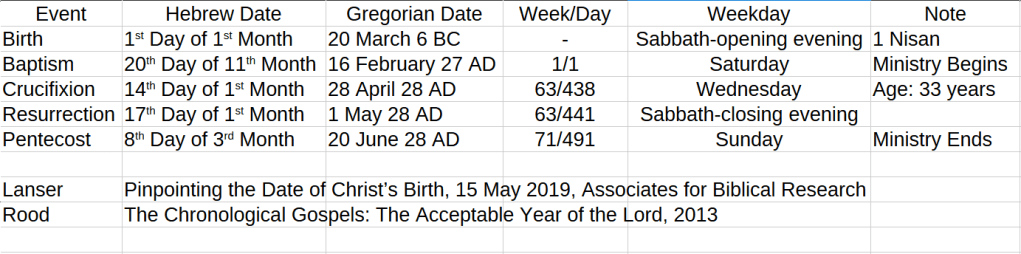
To add to these, I will present another one that merges the research of Rick Lanser1 with that of Michael Rood2 because I find it hard accept either of them alone.

The reason for doing this is there are only three viable dates for the Crucifixion: Rood’s Wednesday 28 AD, Lanser’s Friday 30 AD and Friday 33 AD. When Lanser showed that 33 AD could not be the date, his argument (as I see it) also showed 30 AD could not be the date either. That left Rood’s 28 AD as the only option. However, I prefer Lanser’s date of the birth of Jesus (20 March 6 BC) and believe that Rood’s date of creation (4000 BC) and his views of the multiple layers of the Daniel 9 prophecies are incorrect.

The following are where disagreements might arise with this merged chronology.

  • With Rood’s Wednesday Crucifixion, a Sunday Resurrection is not necessary, but it still remains the day when the tomb was first found to be empty (which is all the Gospels say about it anyway).
  • The ministry of Jesus from His baptism to Pentecost was only 70 weeks fulfilling the Daniel 9:24 prophecy, the first part of Daniel 9:26 and the first part of Daniel 9:27.
  • The rest of the Daniel 9:24-27 prophecies were fulfilled in the destruction of the Temple in 70 AD. There are no more Daniel 9 prophecies awaiting fulfillment. Revelation, however, contains separate prophecies.
  • John 6:4 was not in the original autograph of the Gospel of John as Greek Manuscript #472 testifies by preserving its absence.
  • With Lanser’s date of the birth of Jesus on 20 March 6 BC and Rood’s Crucifixion date on 28 April 28 AD, I was surprised to calculate (6 + 28 – 1 = 33) that the age of Jesus at the Crucifixion is 33 years. That’s what I always heard His age was, but that would not have been His age in either Lanser’s (6 + 30 – 1 = 35) or Rood’s (2 + 28 – 1 = 29) chronology.

If you don’t agree with the above, don’t worry. I might be wrong. Also, I am pretty sure neither Lanser nor Rood would agree with me either (nor with each other). So, you would be in good company.

I will break the construction of this merged chronology into sections where questions are answered and constraints and conclusions are highlighted.

______

What Is the Upper Bound for the Year of the Crucifixion?

Lanser believes the Crucifixion occurred on Friday in 30 AD, but there is another possible Friday Crucifixion that could have occurred in 33 AD. Lanser argued3 against the 33 AD date by synchronizing Galatians 2:14 with Acts 12:1-4,255 to show that Paul was in Jerusalem for the Feast of Unleavened Bread in 44 AD, the year Herod Agrippa I died, which was 14 years after his conversion on the road to Damascus.

From Lanser’s argument I draw the following constraints.

CONSTRAINT: Herod Agrippa I died in 44 AD.6

CONSTRAINT: Paul went to Jerusalem 14 years after his conversion on the road to Damascus.7

CONSTRAINT: Herod Agrippa I and Paul were in Jerusalem during the Feast of Unleavened Bread before Herod Agrippa I’s death.8

Knowing the year was 44 AD, the time was the Feast of Unleavened Bread (after Passover) and that the length of time was 14 years since Paul’s conversion on the Damascus Road, I come to the conclusion that Paul was converted before the Passover of 30 AD by subtracting, as I normally would, 14 from 44. That means 30 AD could not be the year of the Crucifixion.

Although Lanser argued successfully for this synchronization to discredit the 33 AD date for the Crucifixion, he did not want to also discredit 30 AD. To preserve the 30 AD date Lanser made two assertions neither of which I find credible:

  • He claimed that the subtraction of the 14 year length since Paul’s conversion from the secular dated year 44 AD of Herod Agrippa I’s death should use “inclusive reckoning”, that is, 44 minus 14 should equal 31, not 30.9 Since we are concerned with finding a secular date I do not think that such inclusive reckoning is justified.10
  • He also claimed that the events from the Crucifixion to Paul’s conversion took only 9 months. It has to be less than a year, since that is all the extra time his inclusive reckoning is giving him. However, 9 months from his preferred Crucifixion date puts Paul’s trip to Damascus during winter, an unlikely time to travel from Jerusalem to Damascus especially with a team intending on bring back prisoners, but if Lanser extended this to spring (after Passover, only 3 to 4 months later), then 30 AD would be discredited as well as 33 AD. He also does not explain how Paul could have become personally notorious, even in Damascus, only 2 months after Stephen’s martyrdom.

If Lanser is right about the synchronization and I am right in rejecting his assertions then both 33 AD and 30 AD are eliminated as possible dates for the Crucifixion.

Lanser’s argument is the main reason I am trying to combine his chronology with that of Rood. Rood gets dates wrong as well. Combining these chronologies, I hope to avoid inconsistencies and construct a better view of what happened.

CONSTRAINT: Paul’s conversion on the road to Damascus occurred before the Passover of 30 AD.

That constraint gives the upper bound for the Crucifixion.

What Is the Lower Bound for the Year of the Crucifixion?

CONSTRAINT: Daniel 9:25 predicts 483 years or 69 weeks of years prior to the coming of the Messiah.11

Both Lanser12 and Rood13 agree that Daniel 9:25 determines the date after which the ministry of Jesus would begin. They agree that the start year is 457 BC and after 69 sevens or 483 years we reach 27 AD (-457 + 483 + 1).

Which Was the Year of the Crucifixion?

From these upper and lower bounds, the Crucifixion occurred after the Passover of 27 AD and before the Passover of 30 AD. There are only two Passovers to consider: Wednesday 28 April 28 AD and Monday 17 April 29 AD.

CONSTRAINT: There are only three days of the week on which the Crucifixion could occur to fulfill the three days and three nights Jonah prophecy: Wednesday, Thursday or Friday.14

Since the Passover occurred on a Monday in 29 AD, the constraint eliminates 29 AD.

When Was Jesus Born?

Lanser15 assigns the birth of Jesus to 1 Nisan of 20 March 6 BC based on an occultation of Jupiter with the new moon as the star seen by the magi and with His birth foreshadowed by the first day of the year (1 Nisan) in Exodus 12:216 and by the completion of the temple on 1 Nisan in Exodus 40:217. Rood18 assigns it to the High Sabbath of the Feast of Tabernacles on 26 September 3 BC as a fulfillment of that Feast.

Both of these dates are associated with the Lord tabernacling with His people, however, given that Lanser’s date explains both the star and has foreshadowing events at the beginning rather than the end of the year I will assume Lanser’s date is correct.

Was John 6:4 in the original autograph of the Gospel of John?

Since the lower bound of 27 AD and Passover of Wednesday 28 April 28 AD is at most a little over a year in length I have to accept that the ministry of Jesus was no longer than that.

Normally one assumes the ministry of Jesus was three and a half years. However, as Rood points out only the Gospel of John justifies such a long time and that only with one verse: John 6:419. Rood also mentions that there is an 11th century manuscript of the Gospel of John without John 6:4 in it.20

Since I accept the reasoning up to this point, I will accept the manuscript that Rood mentions as testifying and preserving that John 6:4 was not in the original text.

How long was the ministry of Jesus?

In The Chronological Gospels: The Acceptable Year of the Lord, Rood links verses of the four Gospels with each of 70 weeks of the ministry of Jesus starting with His baptism by John on 16 February 27 AD and ending with Pentecost on 20 June 28 AD. These 70 weeks fulfill the 70 weeks prophecy of Daniel 9:2421. In Rood’s association of weeks with verses, the Crucifixion occurs on the 63rd week. This fulfills the first part of Daniel 9:26 which reads: “And after threescore and two weeks shall Messiah be cut off, but not for himself:

Although I don’t know if Rood mentions this, the 63rd week with the Crucifixion and Resurrection seems to me to fulfill the first part of Daniel 9:27 as well which reads: “And he shall confirm the covenant with many for one week: and in the midst of the week he shall cause the sacrifice and the oblation to cease,” However, he may understand that prophecy differently.

Since 28 AD is the only available year of the Crucifixion and Rood’s association shows a fulfillment of Daniel 9:24, 9:26 and 9:27, I accept in general his chronology for those 70 weeks. However, I doubt Rood’s end time views when he claims that the ministry of Jesus is only the second layer of three fulfillments with the third still coming22.

A prophecy should have only one fulfillment, but perhaps I just see Daniel 9 containing many separate prophecies while he may see it as one. The 70 weeks of Daniel 9:24 prophesies the number of weeks of the Messiah’s ministry. The 69 weeks of years of Daniel 9:25 is a separate prophecy giving the number of years before the Messiah’s ministry begins. The 63rd week of Daniel 9:26 is a separate prophecy stating in which week of the 70 weeks of Daniel 9:24 the Crucifixion would occur. The significance of the 63rd week of Daniel 9:26 is a separate prophecy in the first part of Daniel 9:27.

Once a prophecy is fulfilled, there is no point looking for an additional fulfillment of it unless one doesn’t believe the fulfillment has already occurred.

On Which Day of the Week Was the Resurrection?

Rood clarifies that the Resurrection occurred at the end of precisely three days and three nights after the body of Jesus was placed in the tomb on Wednesday before sunset. That is what one would expect with a Wednesday Passover. That means the Resurrection occurred at the end of the weekly Sabbath but before sunset and not on Sunday itself.

What the Gospels report is that the women went to the tomb and found it empty with the stone rolled away not so Jesus could leave but so they could see that He was no longer there. This is what happened on Sunday23 or the morning of the first day of the week.

Church tradition needs a Sunday Resurrection because those creating that tradition misunderstood that the preparation day on which Jesus died was not for the weekly Sabbath, which would have been on a Friday, but for the Passover. They had to fit three days and three nights in that short span. Using inclusive reckoning they could get away with three days (if they ignored the three nights), but they needed Jesus to be in the grave on Sunday to do that. According to Rood’s chronology, with a longer span, Jesus could rise on Saturday evening at the end of the Sabbath, fulfill the three days and three nights Jonah prophecy and fulfill the Feast of First Fruits on Sunday.

What about the rest of Daniel 9:24-27?

As I see it the parts of Daniel 9:24-27 that were not fulfilled by Rood’s 70 weeks were fulfilled with the Roman attack on Jerusalem resulting in the destruction of the Temple in 70 AD.

These are the two parts involved:

  • The second half of Daniel 9:26 reads “and the people of the prince that shall come shall destroy the city and the sanctuary; and the end thereof shall be with a flood, and unto the end of the war desolations are determined.
  • The second half of Daniel 9:27 reads “and for the overspreading of abominations he shall make it desolate, even until the consummation, and that determined shall be poured upon the desolate.

That completes the merged messianic chronology.

______

______

  1. Rick Lanser is a contributor to the Daniel 9:24-27 Project at the Associates for Biblical Research (ABR). ABR is one of my favorite resources. In particular, I am grateful for Henry B. Smith Jr’s work on the Genesis 5 & 11 Project. ↩︎
  2. Michael Rood is an Hebraic Roots researcher and founder of A Rood Awakening!. His book The Chronological Gospels: The Acceptable Year of the Lord presents a detailed chronology using the four gospels showing the ministry of Jesus as 70 weeks from His baptism to Pentecost fulfilling Daniel 9:24. ↩︎
  3. Lanser, How Acts and Galatians Indicate the Date of the Crucifixion, 15 May 2019, ABR. ↩︎
  4. Galatians 2:1 KJVThen fourteen years after I went up again to Jerusalem with Barnabas, and took Titus with me also. ↩︎
  5. Lanser, How Acts and Galatians Indicate the Date of the Crucifixion, 15 May 2019, ABR. ↩︎
  6. Herod Agrippa, Wikipedia ↩︎
  7. Galatians 2:1 KJVThen fourteen years after I went up again to Jerusalem with Barnabas, and took Titus with me also. ↩︎
  8. Acts 12:1-3, 20-23, 25 KJV1 Now about that time Herod the king stretched forth his hands to vex certain of the church. 2 And he killed James the brother of John with the sword. 3 And because he saw it pleased the Jews, he proceeded further to take Peter also. (Then were the days of unleavened bread.) … 20 And Herod was highly displeased with them of Tyre and Sidon: but they came with one accord to him, and, having made Blastus the king’s chamberlain their friend, desired peace; because their country was nourished by the king’s country. 21 And upon a set day Herod, arrayed in royal apparel, sat upon his throne, and made an oration unto them. 22 And the people gave a shout, saying, It is the voice of a god, and not of a man. 23 And immediately the angel of the Lord smote him, because he gave not God the glory: and he was eaten of worms, and gave up the ghost. … 25 And Barnabas and Saul returned from Jerusalem, when they had fulfilled their ministry, and took with them John, whose surname was Mark. ↩︎
  9. Lanser writes, “Counting back fourteen years from 44 AD using inclusive reckoning, we conclude Paul was saved in 31 AD, possibly even late 30 AD depending on how much time was spanned by the events of Acts 1-9.” How Acts and Galatians Indicate the Date of the Crucifixion, 15 May 2019, ABR. ↩︎
  10. Such reckoning might make sense if one is looking at two biblical dates and we want to know how much time elapsed between them or if we have a biblical date and a biblical elapsed time and we want to know what date the Bible might assign to the other event. In the present case we have a secular date of 44 AD for the Feast of Unleavened Bread and we want to know the secular date of another event (Paul’s conversion) given that Paul wrote it was fourteen years ago. ↩︎
  11. Daniel 9:25 KJV Know therefore and understand, that from the going forth of the commandment to restore and to build Jerusalem unto the Messiah the Prince shall be seven weeks, and threescore and two weeks: the street shall be built again, and the wall, even in troublous times. ↩︎
  12. Lanser, The Going Forth of Artaxerxes’ Decree Part 1, 16 November 2019, ABR. ↩︎
  13. Rood, The Chronological Gospels, 2013, page 8. ↩︎
  14. On what day was Jesus crucified? Got Questions ↩︎
  15. Lanser, Pinpointing the Date of Christ’s Birth, 15 May 2019, ABR. ↩︎
  16. Exodus 12:2 KJVThis month shall be unto you the beginning of months: it shall be the first month of the year to you. ↩︎
  17. Exodus 40:2 KJVOn the first day of the first month shalt thou set up the tabernacle of the tent of the congregation. ↩︎
  18. Rood, The Chronological Gospels, 2013, page 52. ↩︎
  19. John 6:4 KJVAnd the passover, a feast of the Jews, was nigh. ↩︎
  20. Greek Manuscript #472. See Rood, The Chronological Gospels, page 9. ↩︎
  21. Daniel 9:24 KJVSeventy weeks are determined upon thy people and upon thy holy city, to finish the transgression, and to make an end of sins, and to make reconciliation for iniquity, and to bring in everlasting righteousness, and to seal up the vision and prophecy, and to anoint the most Holy. ↩︎
  22. Rood, The Chronological Gospels, 2013, page 16. ↩︎
  23. In these four Gospel accounts what is reported is that the tomb was empty and the stone was rolled back so they could see that it was. Jesus did not need the stone rolled back so He could leave.
    Matthew 28:1-6 KJV1 In the end of the sabbath, as it began to dawn toward the first day of the week, came Mary Magdalene and the other Mary to see the sepulchre. 2 And, behold, there was a great earthquake: for the angel of the Lord descended from heaven, and came and rolled back the stone from the door, and sat upon it. 3 His countenance was like lightning, and his raiment white as snow: 4 And for fear of him the keepers did shake, and became as dead men. 5 And the angel answered and said unto the women, Fear not ye: for I know that ye seek Jesus, which was crucified. 6 He is not here: for he is risen, as he said. Come, see the place where the Lord lay.
    Mark 16:1-6 KJV1 And when the sabbath was past, Mary Magdalene, and Mary the mother of James, and Salome, had bought sweet spices, that they might come and anoint him. 2 And very early in the morning the first day of the week, they came unto the sepulchre at the rising of the sun. 3 And they said among themselves, Who shall roll us away the stone from the door of the sepulchre? 4 And when they looked, they saw that the stone was rolled away: for it was very great. 5 And entering into the sepulchre, they saw a young man sitting on the right side, clothed in a long white garment; and they were affrighted. 6 And he saith unto them, Be not affrighted: Ye seek Jesus of Nazareth, which was crucified: he is risen; he is not here: behold the place where they laid him.
    Luke 24:1-7 KJV1 Now upon the first day of the week, very early in the morning, they came unto the sepulchre, bringing the spices which they had prepared, and certain others with them. 2 And they found the stone rolled away from the sepulchre. 3 And they entered in, and found not the body of the Lord Jesus. 4 And it came to pass, as they were much perplexed thereabout, behold, two men stood by them in shining garments: 5 And as they were afraid, and bowed down their faces to the earth, they said unto them, Why seek ye the living among the dead? 6 He is not here, but is risen: remember how he spake unto you when he was yet in Galilee, 7 Saying, The Son of man must be delivered into the hands of sinful men, and be crucified, and the third day rise again.
    John 20:1-2 KJV1 The first day of the week cometh Mary Magdalene early, when it was yet dark, unto the sepulchre, and seeth the stone taken away from the sepulchre. 2 Then she runneth, and cometh to Simon Peter, and to the other disciple, whom Jesus loved, and saith unto them, They have taken away the Lord out of the sepulchre, and we know not where they have laid him. ↩︎

The Rabbinic Deflation Hypothesis

If one compares the chronologies of Genesis 5 and 11 as they appear in the Masoretic Text (MT) – which is what most of our bibles use for these dates – with those in the Septuagint (LXX), one finds roughly a 1500 year discrepancy.

The LXX (or Alexandrian) Inflation Hypothesis explains this discrepancy by saying that the Greek translators of the lost Hebrew text of Genesis of their time (called the Vorlage) inflated the dates in the 3rd century BC to better agree with Egyptian history. The Rabbinic Deflation Hypothesis explains this discrepancy by saying that the rabbis in the 2nd century AD deflated the numbers to discredit Jesus as the Messiah.

In the following interview Henry B. Smith Jr of the Associates for Biblical Research (ABR) argues for the Rabbinic Deflation Hypothesis. It is long, so I have commented on it section by section with links to each part.

The correct dates are important for both archeology and apologetics.

The Christian archeologist has to know what the original Genesis text said about the events following the flood. Apologists who accept the Bible as an historical document also need to be clear about what that history actually is. Attacks against any Christianity that has not been watered down to a new age belief system come from those who want to discredit the Bible as reliable history.

  1. 0:00 Michael Filipek’s introduction
  2. 6:20 Henry B. Smith Jr’s introduction. He notes that there are no chronological gaps in these genealogies. He also asserts that the biblical text has higher authority over external evidence.
  3. 16:05 There are three textual traditions with differences in the genealogies: the MT, the LXX, and the Samaritan Pentateuch (SP). The correct dates are needed for archeological research and for apologetics. Smith Jr focuses on Genesis 11 because these dates come after the flood where archeological evidence has to be located and there the internal evidence is greatest for the Rabbinic Deflation Hypothesis.
  4. 25:02 Smith Jr contrasts the total number of years in these chronologies. For the MT it is 2008 years. For the SP it is 2249 years. For the LXX it is 3394 years. Although creation science explores the entire chronology beginning with creation, archeologists would only have evidence for the time after the flood.
  5. 33:15 Smith Jr analyzes the dates for Peleg as an example.
  6. 35:00 Smith Jr analyzes the dates for Kainan as another example. Kainan is mentioned in Luke 3:36 and the LXX, but not in the MT nor the SP.
  7. 40:37 Smith Jr offers a warning about critical scholarship: although there might be treasures hidden there many of these scholars support the Documentary Hypothesis which entirely discredits the historical value of these chronologies. He also comments that preservation of Scripture does not require that it be preserved in Hebrew manuscripts. It could be preserved in other languages, such as, Greek.
  8. 44:51 Whoever made the deliberate changes to the text would need a high enough motivation to overcome the command in Deuteronomy 4:2 not to change the text. They would also need the means to disseminate the changes and the opportunity to do so.
  9. 54:30 There are external witnesses before the second century AD to the LXX reading of Genesis 5 and 11: Liber Antiquitatum Biblicarum (LAB), Josephus, Eupolemus, and Demetrius of Alexandria as early as 220 BC. However, there are no external witnesses before the second century AD to the MT reading.
  10. 1:24:00 Smith Jr returns to Peleg as an example of a methodology on how to approach these texts.
  11. 1:28:54 Smith Jr points out the internal evidence in the MT that there is not enough time from the flood to the Babel dispersion for the population to reach the state that Genesis 10 describes it to be in. He notes that some people may find it hard to believe that the rabbis would have deflated their own texts and some may also have a long-term commitment to Ussher’s chronology which is based on the MT.
  12. 1:43:45 Smith Jr introduces the Rabbinic Deflation Hypothesis. Chrono-messianism used 1000-year blocks and the Daniel 9 prophecies to predict the coming of the Messiah. The Seder ‘Olam Rabbah became a new chronology in the second century AD. The rabbis wanted to put Jesus outside of biblical prophecies.
  13. 1:59:21 Ancient support for the Rabbinic Deflation Hypothesis comes from Eusebius, Julian of Toledo, Jacob of Edessa and Bar Hebraeus.

The following diagram compares the ABR chronology1 which prefers the LXX dates because it accepts the Rabbinic Deflation Hypothesis with James Ussher’s chronology2 which prefers the MT because it accepts the LXX Inflation Hypothesis.

______

  1. Henry B.. Smith Jr, The Case for the Septuagint’s Chronology in Genesis 5 and 11, International Conference on Creationism, 2018 for the Creation and Flood date and the chart at the bottom of the Genesis 5 and 11 Project page for the Call of Abraham date: Creation 5554 BC, Flood 3298 BC, Calling of Abraham 2091 BC ↩︎
  2. James Ussher, The Annals of the World, 1650: Creation 4004 BC, Flood 2348 BC, Calling of Abraham 1921 BC ↩︎

Formalizing the Transcendental Argument Against Skepticism

Arguments for the existence of God are responses to philosophical skepticism. If you have not been deceived by this skepticism to the point of refusing to see when you look, all you have to do is look around yourself for evidence that God is real.

Romans 1:19-20 KJV19 Because that which may be known of God is manifest in them; for God hath shewed it unto them. 20 For the invisible things of him from the creation of the world are clearly seen, being understood by the things that are made, even his eternal power and Godhead; so that they are without excuse:

People who are willing to look and see – people whose minds have not been deceived – don’t need a philosophical argument for God. They already know He’s real. They might want to know more about Him, but the fact that He’s real is not a problem.

Furthermore, if they are born again Christians who follow where the Holy Spirit leads, they are sons of God. 1 The skeptic has no hope to convince such people. If you are one these people, you can skip the rest of this post. You are indeed blessed.

For those who are unsure, trust that the answers to any of your questions about God are in the Bible, but beware. Although you have passed the first level of deceivers, the skeptics, there are other wolves (or snakes) who would love to tell you what’s in the Bible like the serpent did to Eve.2

The existence of these wolves3 is as sure as the existence of God. I suspect most of them don’t even know they’re wolves. The Way is narrow4. Don’t let yourself be led astray by blind guides which would be a kind of persecution.5 Forgive them.6 Bless them.7 But move on.8

Skeptics of God’s existence

Philosophical skeptics about God are biblically referred to as fools. They love to run their mouths. If no one listened to them, they would only harm themselves.

Romans 1:21-23 KJV21 Because that, when they knew God, they glorified him not as God, neither were thankful; but became vain in their imaginations, and their foolish heart was darkened. 22 Professing themselves to be wise, they became fools, 23 And changed the glory of the uncorruptible God into an image made like to corruptible man, and to birds, and fourfooted beasts, and creeping things.

When skeptics talk they introduce doubt into the minds of their listeners and reinforce it in themselves. When they keep expressing this doubt it becomes a commercial selling speculative lies over and over again.

On the bright side, since skeptics are speaking falsehood, whatever they say will counterproductively spring back on them when people argue against their positions effectively. That defense is the only reason to make these philosophical arguments.

When listeners (including the skeptics themselves) realize that no one in his right mind wants what the skeptics are selling in their commercials, the defense will have succeeded.

Formalized propositional logic

There are many philosophical arguments against skeptics of God’s existence. The kind I am focusing on here is called transcendental arguments. Immanuel Kant began this type of argumentation to address the skepticism of David Hume.9

All I will be doing in this post is formalizing the logical steps that one needs to go through in propositional logic to make a transcendental argument. I will also use an online proof checker10 to validate these steps.

What that will do, hopefully, is make clear what the structure of a transcendental argument is and demonstrate that the structure is valid.

Presuppositions11

To get started I need a proposition, a statement of something obvious that no one would want to reject such as “I think”. Then I need to identify what that proposition presupposes. Following Descartes I might say that “I think” presupposes that “I am”.

Even though I might have to chain these presuppositions to get where I want to go, if I can reach a proposition that some unknown God12 exists, then it is game over for the skeptic. Because of that, I should not expect the skeptic to quietly agree with anything I have to offer. He will claim that I just asserted the presupposition without demonstrating it.13 To make sure that no one agrees with him, I need to make sure that I argue persuasively and clearly.

This is the hardest part of the argument. It is also the part that I’m skipping. All I want to show now is what is going on with such arguments by formalizing them as a propositional proof. I want to make sure that it is clear what these arguments are trying to show.

For an example of a specific transcendental argument, Parker Settecase showed how C.S. Lewis set one up.14

What is a presupposition?

A presupposition is the consequent of two implications where the antecedent of one is the negation of the antecedent of the other. If I say that A presupposes B I mean not only that A implies B but also that not A implies B. If the proposition A and its negation both imply the proposition B, then B is a presupposition of A or A presupposes B.

Although that might sound confusing, presuppositions are easy to find. Here’s an example:

Proposition: There is writing on the paper.
Presupposition: There is a piece of paper.
There is writing on the paper implies that there is a piece of paper.
There is not writing on the paper also implies that there is a piece of paper.
If you accept the proposition or its negation, it makes no sense to reject the presupposition.

Setting up the formalization

Let A stand for the proposition and let B stand for the presupposition. Next assume the two implications (which I would have to successfully argue for), namely, A implies B and not A implies B.

What I want to do is show that if I am skeptical and assume not B, then all I get is a contradiction. So, I will assume not B with the intent of deriving a contradiction. That is, I plan to push the skeptic into a corner.

Since I have assumed not B, I can use modus tollens on A implies B to derive not A. I can do the same to not A implies B to derive not not A. With that I derive the next two lines of the proof.

Note that those two lines together form a contradiction, not A and not not A. Since I derived a contradiction I can use reductio ad absurdum to reject the hypothesis as absurd. Given a presupposition B, if I hypothesize not B, all I can derive is B.

Proof checker validation15

Moral of the story

If you can show that a true proposition has a presupposition, that presupposition is a necessary condition not only for the proposition but also for its negation.

If the skeptic wants the proposition to be true, he has to accept the presupposition. That is the transcendental argument.

The goal of a transcendental argument for God starts with a proposition even the skeptic can’t reject. It identifies a presupposition of that proposition which leads to some unspecified, unknown God’s existence.

Having that unknown God is all I need. The philosophical step is over. The deception has been broken. The Bible and the Holy Spirit take over (although they have been guiding me all along this philosophical journey which wouldn’t have been necessary if I weren’t deceived in the first place).

______

  1. Romans 8:14 KJV14 For as many as are led by the Spirit of God, they are the sons of God. ↩︎
  2. Genesis 3:1-5 KJV1 Now the serpent was more subtil than any beast of the field which the LORD God had made. And he said unto the woman, Yea, hath God said, Ye shall not eat of every tree of the garden? 2 And the woman said unto the serpent, We may eat of the fruit of the trees of the garden: 3 But of the fruit of the tree which is in the midst of the garden, God hath said, Ye shall not eat of it, neither shall ye touch it, lest ye die. 4 And the serpent said unto the woman, Ye shall not surely die: 5 For God doth know that in the day ye eat thereof, then your eyes shall be opened, and ye shall be as gods, knowing good and evil. ↩︎
  3. Matthew 7:15-20 KJV15 Beware of false prophets, which come to you in sheep’s clothing, but inwardly they are ravening wolves. 16 Ye shall know them by their fruits. Do men gather grapes of thorns, or figs of thistles? 17 Even so every good tree bringeth forth good fruit; but a corrupt tree bringeth forth evil fruit. 18 A good tree cannot bring forth evil fruit, neither can a corrupt tree bring forth good fruit. 19 Every tree that bringeth not forth good fruit is hewn down, and cast into the fire. 20 Wherefore by their fruits ye shall know them. ↩︎
  4. Matthew 7:13-14 KJV13 Enter ye in at the strait gate: for wide is the gate, and broad is the way, that leadeth to destruction, and many there be which go in thereat: 14 Because strait is the gate, and narrow is the way, which leadeth unto life, and few there be that find it. ↩︎
  5. Mark 10:29-30 KJV29 And Jesus answered and said, Verily I say unto you, There is no man that hath left house, or brethren, or sisters, or father, or mother, or wife, or children, or lands, for my sake, and the gospel’s, 30 But he shall receive an hundredfold now in this time, houses, and brethren, and sisters, and mothers, and children, and lands, with persecutions; and in the world to come eternal life. ↩︎
  6. Matthew 5:43-45 KJV43 Ye have heard that it hath been said, Thou shalt love thy neighbour, and hate thine enemy. 44 But I say unto you, Love your enemies, bless them that curse you, do good to them that hate you, and pray for them which despitefully use you, and persecute you; 45 That ye may be the children of your Father which is in heaven: for he maketh his sun to rise on the evil and on the good, and sendeth rain on the just and on the unjust. ↩︎
  7. Luke 6:27-28 KJV27 But I say unto you which hear, Love your enemies, do good to them which hate you, 28 Bless them that curse you, and pray for them which despitefully use you. ↩︎
  8. 1 Timothy 6:3-5 KJV3 If any man teach otherwise, and consent not to wholesome words, even the words of our Lord Jesus Christ, and to the doctrine which is according to godliness; 4 He is proud, knowing nothing, but doting about questions and strifes of words, whereof cometh envy, strife, railings, evil surmisings, 5 Perverse disputings of men of corrupt minds, and destitute of the truth, supposing that gain is godliness: from such withdraw thyself. ↩︎
  9. Bardon, Adrian, “Transcendental Arguments”, Internet Encyclopedia of Philosophy, https://iep.utm.edu/trans-ar/ ↩︎
  10. Open Logic Project: https://openlogicproject.org/ ↩︎
  11. Beaver, David I., Bart Geurts, and Kristie Denlinger, “Presupposition”, The Stanford Encyclopedia of Philosophy (Fall 2024 Edition), Edward N. Zalta & Uri Nodelman (eds.), URL = <https://plato.stanford.edu/archives/fall2024/entries/presupposition/&gt; ↩︎
  12. Acts 17:22-23 KJV22 Then Paul stood in the midst of Mars’ hill, and said, Ye men of Athens, I perceive that in all things ye are too superstitious. 23 For as I passed by, and beheld your devotions, I found an altar with this inscription, TO THE UNKNOWN GOD. Whom therefore ye ignorantly worship, him declare I unto you. ↩︎
  13. Sheng-Ta Tsai, Deconstructing Christianity, Transcendental Argument for God’s Existence Debunked, 9/20/2023 ↩︎
  14. Parker Settecase provided a detailed presentation of this proof in his blog post of 11/13/2017, C.S.Lewis’s Transcendental Argument for God. ↩︎
  15. https://proof-checker.org/ ↩︎

Diotrephes and Demetrius

The short epistle of 3 John contrasts two leaders in the early church: Diotrephes and Demetrius.

Diotrephes

3 John 1:9-10 KJV9 I wrote unto the church: but Diotrephes, who loveth to have the preeminence among them, receiveth us not.
10 Wherefore, if I come, I will remember his deeds which he doeth, prating against us with malicious words: and not content therewith, neither doth he himself receive the brethren, and forbiddeth them that would, and casteth them out of the church.

Demetrius

3 John 1:11-12 KJV11 Beloved, follow not that which is evil, but that which is good. He that doeth good is of God: but he that doeth evil hath not seen God.
12 Demetrius hath good report of all men, and of the truth itself: yea, and we also bear record; and ye know that our record is true.

Leadership in Church History

When Paul described the qualities that a bishop must have, he indirectly warned about the kind of men who should not be followed if given leadership positions in the church.

1 Timothy 3:2-7 KJV2 A bishop then must be blameless, the husband of one wife, vigilant, sober, of good behaviour, given to hospitality, apt to teach;
3 Not given to wine, no striker, not greedy of filthy lucre; but patient, not a brawler, not covetous;
4 One that ruleth well his own house, having his children in subjection with all gravity;
5 (For if a man know not how to rule his own house, how shall he take care of the church of God?)
6 Not a novice, lest being lifted up with pride he fall into the condemnation of the devil.
7 Moreover he must have a good report of them which are without; lest he fall into reproach and the snare of the devil.

Before the church gained political power, it was persecuted. After it gained political power, it began persecuting others itself. This was the result of people who should have never received leadership roles.

Justo L. Gonzalez1 commented on the persecution of the Anabaptists (and I have read far enough into that book to highly suspect that it applies to any Christian group that suffered persecution at the hands of other Christians):

The martyrs were many—probably more than those who died during the three centuries of persecution before the time of Constantine.

Paul tells us what could have happened from the very beginning of church history if people chose to follow the lead of the Spirit of God rather than their own lusts.

What could have happened is almost beyond imagining:

Romans 8:14 KJVFor as many as are led by the Spirit of God, they are the sons of God.

The Point

None of the faulty leadership in the church had to happen. It could have all been avoided.

God did not will it. Don’t blame Him.

It was not caused by Augustinian total depravity nor was it caused by materialistic determinism, the atheistic rehashing of that Augustinian teaching.

Those responsible cannot hide behind any of these lame excuses for their own choices, their own defiant refusals to become the sons of God.

  1. Justo L. Gonzalez, The Story of Christianity: The Reformation to the Present Day, page 56. ↩︎

The Church of the Holy Sepulchre and the Shroud of Turin

This morning I followed an email link from the Associates for Biblical Research to one of their Digging for Truth episodes on the tomb of Jesus.

The tour we took when in Israel scheduled us to see the Garden Tomb, but neglected the Church of the Holy Sepulchre. This episode, however, convinces me that we should have gone to the Church of the Holy Sepulchre instead.

In the above video they mentioned the Shroud of Turin. I realized that I knew little to nothing about this shroud except that it was claimed to have covered the body of Jesus.

The following is a 8 minute summary of the evidence that favors the view that this was, indeed, the actual shroud that covered Jesus.

Fossils

We are back in South Carolina. As I was putting mulch around some bushes I noticed the fossils in a bit of mudrock we brought back from a property we once owned on Green Bay in Wisconsin. That rock (along with the mulch) are shown in the photo above.

Ten years ago when I found the stone I tried to identify the fossils1 in it using a field guide. The field guide said that they were between 300 to 400 million years old (assuming I remember what it said correctly and matched what was in the book with what was in my hand).

I was impressed, but I was also disappointed that they weren’t 600 million years old, or older. I kept looking for more of those stones.

Over the past ten years I smartened up. I realized that given erosion rates all of the stuff I had in my hand would have eroded away2 long before it reached anywhere near 300 million years.

Today, I can tell you how old that stone is to within about 10 years, but you need to understand something about fossils first.

Fossils don’t form from dead stuff falling to the ground and being slowly buried over millennia. Dead stuff falling to the ground quickly decays. They have to die rapidly with a heavy weight pressing them down so they do not decompose. That occurs when heavy sediment carried by flooding waters provides the weight to press the plants and animals to the ground.

You would apply the same process to a leaf you wanted to preserve. You would pick it fresh and place it between paper with many books piled on top of it. When it dried out, you would have a nice, flat leaf, not a curled up piece of decaying leaf mold.

So, when in the history of humanity did such a flooding occur so that you could expect to find fossils all over the world? Think. The only time such flooding occurred on a global scale was the flood recorded in Genesis 6-9 and echoed through many legends.

That allows me to date the stone that I now have in my garden.

Given the biblical chronology that Henry B. Smith, Jr from Associates for Biblical Research provided3, the flood could be dated to 3298 BC. Now there is some wiggle-room here due to when in the year births occurred in the Genesis 5 and 11 chronologies, but I suspect that wiggle-room could be reduced to plus or minus 10 years.

You might object that what we read in Genesis are just stories. They are stories, but the important question is this: Are they TRUE stories? If you do not want to believe they are true, to the extent that archeologists can align those stories with historical events to that extent you might want to seriously reconsider any disbelief. This is why Christian archeologists try to align those dates with historical evidence so that the only ignorance that remains is willful ignorance.

So, how old is that stone?

It is, given today’s year of 2025 and subtracting one year since there is no 0 year in the Gregorian calendar, 3298 + 2025 – 1 = 5322 years old plus or minus those 10 years.

That is far less than the 300,000,000 years which the field guide wanted me to believe, but a far more reasonable number given erosion rates. That stone had already suffered much erosion damage when I found it.

And it is continuing to be eroded away every year I leave it unprotected in my garden, but it is not rare. Fossils like the one I have are all over the world because sedimentation layers are all over the world as one would expect given a catastrophic, global flooding less than 5,400 years ago.

The “ungodly men” are those who “willingly are ignorant”. They are not blindly ignorant, a class I would put myself in on many issues. They are liars.
  1. I think some of those fossils are crinoids. Wikipedia says: “In 2012, three geologists reported they had isolated complex organic molecules from 340-million-year-old (Mississippian) fossils of multiple species of crinoids.” That there are complex organic molecules at all in there should raise a red flag that the millions of years are wrong. ↩︎
  2. I’ve heard that a uniformitarian erosion rate would push all of the continents into the ocean in 50 million years. The problem with erosion is that it doesn’t all happen uniformly. If you have a house on a cliff near the water, you are likely very aware of the effects of erosion. ↩︎
  3. One can find videos and other information about the controversy over the Genesis 5 and 11 chronologies at the Associates for Biblical Research site. There’s a controversy because the Septuagint and the Masoretic manuscripts have different, but not randomly different, dates. They are not unintentional scribal errors, but deliberate distortions of the original. I get the 3298 BC date for the flood (and 5554 BC date for creation) from Henry B. Smith, Jr’s article at the 2018 International Conference on Creationism. The 5554 BC date puts the ministry of Jesus in the 6th millennium when the Messiah was expected to come. ↩︎

Noah’s Flood Date: 3298 BC

Yesterday John Hartnett provided a model based on historic measurements collected by George F. Dodwell of the change in the earth’s tilt1 confirming the biblical chronology that Henry B. Smith, Jr argued for in 20182.

The date Hartnett’s model estimated for the flood event was 3154 ± 191 BC. That range excludes Ussher’s flood date of 2348 BC3 but Smith, Jr’s date of 3298 BC still fits.

If we use Smith, Jr’s chronology, that would put creation at about 5500 BC, Noah’s flood at about 3300 BC, the Tower of Babel at about 2850 BC, the call of Abraham in 2091 BC, the Exodus from Egypt in 1446 BC, Solomon crowned in 971 BC and the birth of Jesus in 2 BC.4

The reason for the discrepancy between Ussher’s and Smith, Jr’s dates is due to conflicting dates provided in the chronologies of Genesis 5 and 11 coming from different manuscript traditions of the Bible. Smith, Jr argued that the Hebrew manuscript which became the Masoretic text was modified in the first or second century after the fall of Jerusalem in 70 AD to void prophecies that Jesus could have been the Messiah. The Septuagint, however, preserved the original text, but the Masoretic text became the preferred source for modern bible translations.

    Hartnett’s model not only excluded Ussher’s date, but it also estimated a date for something which happened affecting the tilt of the earth at a time which aligned with the biblical chronology that Smith, Jr has promoted.

    The Flood Waters of Noah
    1. https://biblescienceforum.com/2025/04/21/can-we-know-the-year-of-noahs-flood/ ↩︎
    2. https://digitalcommons.cedarville.edu/icc_proceedings/vol8/iss1/48/ ↩︎
    3. https://en.wikipedia.org/wiki/Ussher_chronology ↩︎
    4. https://biblearchaeology.org/abr-projects/genesis-5-11-project ↩︎

    Stardust

    Our words affirm who we think we are.

    Beyond their truth values, they are powerful spells. They bless. They curse. Though others might get in the way, we ourselves are the ones who are blessed or defiled by what comes out of our own mouths.1

    A song written by Joni Mitchell called Woodstock2 in 1969 influenced me through the early 1970s. In the final refrain is a declaration of what Mitchell thought we were.

    We are stardust
    Billion year old carbon

    However, as I’ve come to realize, there is no natural way that we could be stardust and as a metaphor the idea is sentimental nonsense.

    There are those who fantasize how that stardust to man might have happened, but the only thing they proclaim is their rebellion against a Creator. Dust from a supernova cannot get back together again no matter how often one waves a magic wand – or a professor’s hand – insisting on billions of years of evolution.

    And yet, back in the 1970s, I had no problem believing such mythology. I had no more problem with it than an ancient Greek would have had with Zeus or a Hindu with Krishna. Those were the words spoken to me and those were the words I chose to listen to. Today, I repent of that misleading idolatry.

    That our bodies come from the earth is true.3 However, the dust of the earth has never been stardust no more than it has ever been pixie dust.

    The words we speak and the words we listen to matter. I can testify – first hand – that God is not mocked. What we sow we shall reap.4

    I can also testify that repentance brings more joy than delusion, rebellion and disobedience5.

    1. Matthew 15:17-20 KJV – 17 Do not ye yet understand, that whatsoever entereth in at the mouth goeth into the belly, and is cast out into the draught? 18 But those things which proceed out of the mouth come forth from the heart; and they defile the man. 19 For out of the heart proceed evil thoughts, murders, adulteries, fornications, thefts, false witness, blasphemies: 20 These are the things which defile a man: but to eat with unwashen hands defileth not a man. ↩︎
    2. https://jonimitchell.com/music/lyricsprint.cfm?id=75 ↩︎
    3. Genesis 2:7 KJV – 7 And the LORD God formed man of the dust of the ground, and breathed into his nostrils the breath of life; and man became a living soul. ↩︎
    4. Galatians 6:7-8 KJV – 7 Be not deceived; God is not mocked: for whatsoever a man soweth, that shall he also reap. 8 For he that soweth to his flesh shall of the flesh reap corruption; but he that soweth to the Spirit shall of the Spirit reap life everlasting. ↩︎
    5. Luke 15:10 KJV – 10 Likewise, I say unto you, there is joy in the presence of the angels of God over one sinner that repenteth. ↩︎