Dramatic Readings of the Bible and Other Resources

When reading the Bible online I have found Blue Letter Bible to be very helpful. I can copy verses and then paste them on photos (like the one at the bottom of this post). It also includes a well-formatted interlinear option among other tools.

Sometimes I just want to hear the Bible read slowly with the dialog dramatized. The Time Is Up channel offers such a dramatized, slow reading of the books of the Bible. Earlier today, I listened to Daniel.

Time Is Up

The Bible Society in Israel also offers dramatizations of the scriptures, but these are in Hebrew.

Don’t know Hebrew? It’s not that hard to learn, at least to learn well enough to not be intimidated by an interlinear translation, but ask the Holy Spirit if learning Hebrew is what you should be doing now. If He encourages you, one resource that has helped me is the Alef with Beth biblical Hebrew lessons.

Alef With Beth

Whether you know Hebrew or not there are many wonderful songs you can enjoy such as those offered by Shilo Ben Hod and MIQEDEM.

Shilo Ben Hod
Miqedem

Blessings to you!

______

Six Sentence Story: Emperor Dunklematerie’s New Clothes

Emperor Dunklematerie walked down the street in his new clothes which were so finely made that he might have appeared – to the untrained eye – naked.

“I applaud our glorious Emperor who’s not only a brilliant scientist but a connoisseur of the arts,” one well-paid servant of the realm posted with a billion AI-generated likes.

Another showcased the ingenious tailors who fashioned the exquisite clothing out of the “density of the darkest gravity”.

And another remarked how pricelessly expensive those designer clothes were with holes in them everywhere – not just the knees – to cover the Emperor “in the cosmic void itself”.

Unfortunately, once a certain breed of children reach a certain age and before they reach a certain other age when they start thinking like they’re supposed to, there’s not much you can do with them. Thanks to them the whole world got to see AI-manipulated clips of Dunklematerie before their social media accounts where locked.

______

Denise offers the prompt word “breed” for this week’s Six Sentence Stories.

Proverbs 16:18 KJV18 Pride goeth before destruction, and an haughty spirit before a fall.

A fallen tree clothed in fungus

One of my poems, Words, has been published today in Whispers and Echoes. I am grateful to Sammi Cox for accepting it.

Cosmic Photo Challenge: In the Garden

Dale offers the prompt “in the garden” for this week’s Cosmic Photo Challenge.

The following photos were taken last year at Mirabell, the garden in Salzburg, Austria, where the song, Do Re Me, from the Sound of Music was partially filmed.

I think I was in the 8th grade when our class went to see this film at a theater in Chicago when it first came out in 1965.

______

One entrance with a view of the castle in the distance
Flowers along a rock wall
From inside the garden
One of the dwarf statues. Others can be seen around the circle.
The garden is in the last part of the song, but there are many views of Salzburg before that

Six Sentence Story: Prodigal Son

Brian spent most of his life running away from blessings, but they overtook him anyway. His heart changed as he physically stopped, turned around and went home. Although the time he wasted overtaking useless stuff overwhelmed him, he was relieved that he no longer felt compelled to do any of that.

They say the narrow way is narrow and Brian was just beginning to realize how narrow, yet fulfilling, it was.

One day the devil challenged God, “Being omniscient and all, surely You still know, even though You might not want to remember, all those wicked things I got Brian to do, don’t You?”

The devil stared at God trying without success to penetrate the Light with the dense darkness of his trimmed vision hoping God would give him a philosophically precise answer this time that he could pick apart with satisfaction through eternity, but all God said was, “Nope.”

______

Denise offers the prompt word “trim” to be used in this week’s Six Sentence Stories.
Hebrews 10:16-17 KJV16 This is the covenant that I will make with them after those days, saith the Lord, I will put my laws into their hearts, and in their minds will I write them; 17 And their sins and iniquities will I remember no more.

June Limericks

All of these limericks were originally posted to Esther Chilton’s Laughing Along With A Limerick during the month of June. Some I have slightly modified.

I’ve added two photos for those who prefer a picture to a thousand words.

There’s a trail that some call the Way.
There are others that lead one astray.
Some are wide. Some are paved.
Some are sweetly depraved,
but astray I won’t wander today.
Prompt Word “trail” June 2, 2025 (modified)

One and a half roses

Though I thought I was perfectly Frank,
I was Jerry. Then Bill. My heart sank.
Then it rose with the thought
that whatever I caught . . .
You caught what? . . . and my mind drew a blank.
Prompt word: “frank” June 9, 2025 (modified)

There’s a bowl filled with soup and a spoon
as a girl, Goldilocks, hums a tune.
Since the bears are away
she’ll have soup, but she may
have to leave and she’d better leave soon.
Prompt word: “bowl” June 16, 2025

Another view of the roses

There once was a crack in the code
and a hack from a coder who showed
if the hack fixed the crack
then the crack was the hack
and the code with the hack would explode.
Prompt word: “hack” June 23, 2025

There once were some thieves and a clock
with a sonorous tick for each tock,
but the thieves weren’t aware
that a lock was placed there
as a block of foul theft of our clock.
Prompt word: “block” June 30, 2025 (modified)

Cosmic Photo Challenge: Take a Hike

Dale offers the prompt “take a hike” for this week’s Cosmic Photo Challenge.

I begin the hike by crossing Regent Parkway. I go up and down many hills because this part of South Carolina is not the plains, but more like the foothills of the Blue Ridge Mountains, or some other mountains, I don’t know which.

After following the trail (or sidewalk) I reach a park. Soon I reach my neighbor’s flower garden. Then I wander down the neighborhood street until I reach the entrance to the abandoned golf course.

There is a (very) steep incline which I normally wouldn’t take except today I’m giving a tour. Then I follow the cement trail making sure I avoid any snakes needlessly sunning themselves. Then I reach the pond with the ruined structures.

And then I’m back home.

We have crossed Regent Parkway and are on the sidewalk lining that road.
Now we are at the park with Regent Parkway to the right.
A sunflower that is no longer in bloom, but producing seeds in my neighbor’s garden.
The steep incline. The top in the picture is not the top.
If you survived the incline, here is a view of the top.
A view of the pond.
On the way down the hill there are some ruins such as this one.
On the way home there are wild blackberries.
I bring some home for my wife.

Patching Together Two Messianic Chronologies

A messianic chronology is a history of the events in the life of Jesus the Messiah. There are many messianic chronologies and hence many controversies over which one is right.

To add to these, I will present another one that merges the research of Rick Lanser1 with that of Michael Rood2 because I find it hard accept either of them alone.

The reason for doing this is there are only three viable dates for the Crucifixion: Rood’s Wednesday 28 AD, Lanser’s Friday 30 AD and Friday 33 AD. When Lanser showed that 33 AD could not be the date, his argument (as I see it) also showed 30 AD could not be the date either. That left Rood’s 28 AD as the only option. However, I prefer Lanser’s date of the birth of Jesus (20 March 6 BC) and believe that Rood’s date of creation (4000 BC) and his views of the multiple layers of the Daniel 9 prophecies are incorrect.

The following are where disagreements might arise with this merged chronology.

  • With Rood’s Wednesday Crucifixion, a Sunday Resurrection is not necessary, but it still remains the day when the tomb was first found to be empty (which is all the Gospels say about it anyway).
  • The ministry of Jesus from His baptism to Pentecost was only 70 weeks fulfilling the Daniel 9:24 prophecy, the first part of Daniel 9:26 and the first part of Daniel 9:27.
  • The rest of the Daniel 9:24-27 prophecies were fulfilled in the destruction of the Temple in 70 AD. There are no more Daniel 9 prophecies awaiting fulfillment. Revelation, however, contains separate prophecies.
  • John 6:4 was not in the original autograph of the Gospel of John as Greek Manuscript #472 testifies by preserving its absence.
  • With Lanser’s date of the birth of Jesus on 20 March 6 BC and Rood’s Crucifixion date on 28 April 28 AD, I was surprised to calculate (6 + 28 – 1 = 33) that the age of Jesus at the Crucifixion is 33 years. That’s what I always heard His age was, but that would not have been His age in either Lanser’s (6 + 30 – 1 = 35) or Rood’s (2 + 28 – 1 = 29) chronology.

If you don’t agree with the above, don’t worry. I might be wrong. Also, I am pretty sure neither Lanser nor Rood would agree with me either (nor with each other). So, you would be in good company.

I will break the construction of this merged chronology into sections where questions are answered and constraints and conclusions are highlighted.

______

What Is the Upper Bound for the Year of the Crucifixion?

Lanser believes the Crucifixion occurred on Friday in 30 AD, but there is another possible Friday Crucifixion that could have occurred in 33 AD. Lanser argued3 against the 33 AD date by synchronizing Galatians 2:14 with Acts 12:1-4,255 to show that Paul was in Jerusalem for the Feast of Unleavened Bread in 44 AD, the year Herod Agrippa I died, which was 14 years after his conversion on the road to Damascus.

From Lanser’s argument I draw the following constraints.

CONSTRAINT: Herod Agrippa I died in 44 AD.6

CONSTRAINT: Paul went to Jerusalem 14 years after his conversion on the road to Damascus.7

CONSTRAINT: Herod Agrippa I and Paul were in Jerusalem during the Feast of Unleavened Bread before Herod Agrippa I’s death.8

Knowing the year was 44 AD, the time was the Feast of Unleavened Bread (after Passover) and that the length of time was 14 years since Paul’s conversion on the Damascus Road, I come to the conclusion that Paul was converted before the Passover of 30 AD by subtracting, as I normally would, 14 from 44. That means 30 AD could not be the year of the Crucifixion.

Although Lanser argued successfully for this synchronization to discredit the 33 AD date for the Crucifixion, he did not want to also discredit 30 AD. To preserve the 30 AD date Lanser made two assertions neither of which I find credible:

  • He claimed that the subtraction of the 14 year length since Paul’s conversion from the secular dated year 44 AD of Herod Agrippa I’s death should use “inclusive reckoning”, that is, 44 minus 14 should equal 31, not 30.9 Since we are concerned with finding a secular date I do not think that such inclusive reckoning is justified.10
  • He also claimed that the events from the Crucifixion to Paul’s conversion took only 9 months. It has to be less than a year, since that is all the extra time his inclusive reckoning is giving him. However, 9 months from his preferred Crucifixion date puts Paul’s trip to Damascus during winter, an unlikely time to travel from Jerusalem to Damascus especially with a team intending on bring back prisoners, but if Lanser extended this to spring (after Passover, only 3 to 4 months later), then 30 AD would be discredited as well as 33 AD. He also does not explain how Paul could have become personally notorious, even in Damascus, only 2 months after Stephen’s martyrdom.

If Lanser is right about the synchronization and I am right in rejecting his assertions then both 33 AD and 30 AD are eliminated as possible dates for the Crucifixion.

Lanser’s argument is the main reason I am trying to combine his chronology with that of Rood. Rood gets dates wrong as well. Combining these chronologies, I hope to avoid inconsistencies and construct a better view of what happened.

CONSTRAINT: Paul’s conversion on the road to Damascus occurred before the Passover of 30 AD.

That constraint gives the upper bound for the Crucifixion.

What Is the Lower Bound for the Year of the Crucifixion?

CONSTRAINT: Daniel 9:25 predicts 483 years or 69 weeks of years prior to the coming of the Messiah.11

Both Lanser12 and Rood13 agree that Daniel 9:25 determines the date after which the ministry of Jesus would begin. They agree that the start year is 457 BC and after 69 sevens or 483 years we reach 27 AD (-457 + 483 + 1).

Which Was the Year of the Crucifixion?

From these upper and lower bounds, the Crucifixion occurred after the Passover of 27 AD and before the Passover of 30 AD. There are only two Passovers to consider: Wednesday 28 April 28 AD and Monday 17 April 29 AD.

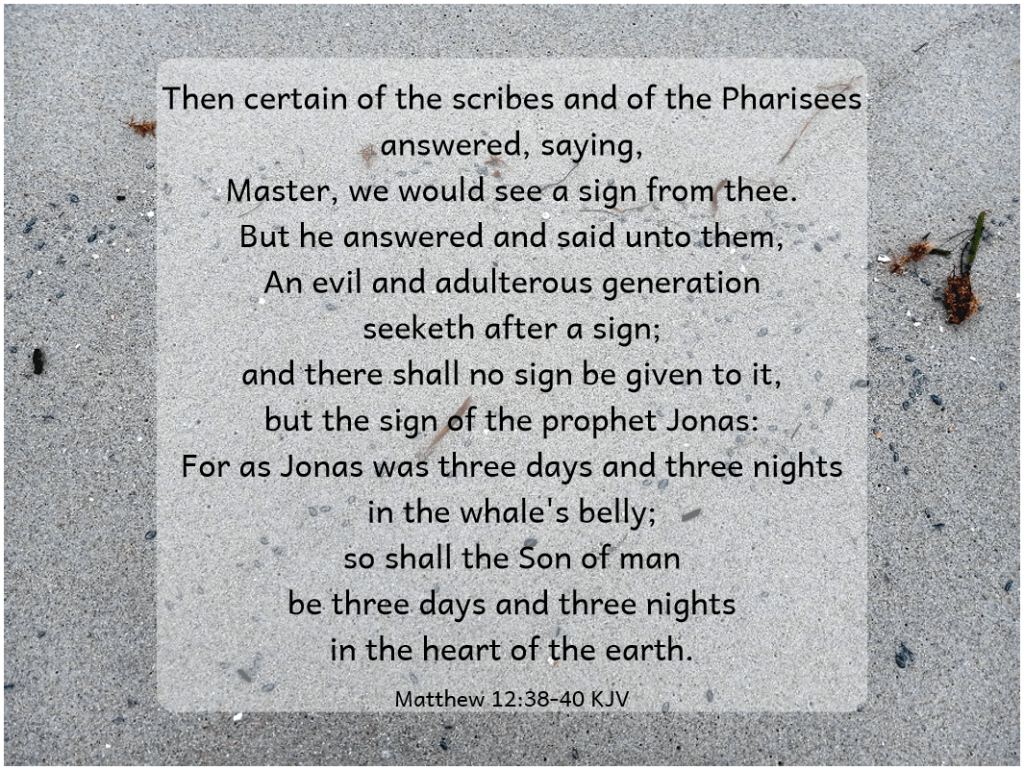
CONSTRAINT: There are only three days of the week on which the Crucifixion could occur to fulfill the three days and three nights Jonah prophecy: Wednesday, Thursday or Friday.14

Since the Passover occurred on a Monday in 29 AD, the constraint eliminates 29 AD.

When Was Jesus Born?

Lanser15 assigns the birth of Jesus to 1 Nisan of 20 March 6 BC based on an occultation of Jupiter with the new moon as the star seen by the magi and with His birth foreshadowed by the first day of the year (1 Nisan) in Exodus 12:216 and by the completion of the temple on 1 Nisan in Exodus 40:217. Rood18 assigns it to the High Sabbath of the Feast of Tabernacles on 26 September 3 BC as a fulfillment of that Feast.

Both of these dates are associated with the Lord tabernacling with His people, however, given that Lanser’s date explains both the star and has foreshadowing events at the beginning rather than the end of the year I will assume Lanser’s date is correct.

Was John 6:4 in the original autograph of the Gospel of John?

Since the lower bound of 27 AD and Passover of Wednesday 28 April 28 AD is at most a little over a year in length I have to accept that the ministry of Jesus was no longer than that.

Normally one assumes the ministry of Jesus was three and a half years. However, as Rood points out only the Gospel of John justifies such a long time and that only with one verse: John 6:419. Rood also mentions that there is an 11th century manuscript of the Gospel of John without John 6:4 in it.20

Since I accept the reasoning up to this point, I will accept the manuscript that Rood mentions as testifying and preserving that John 6:4 was not in the original text.

How long was the ministry of Jesus?

In The Chronological Gospels: The Acceptable Year of the Lord, Rood links verses of the four Gospels with each of 70 weeks of the ministry of Jesus starting with His baptism by John on 16 February 27 AD and ending with Pentecost on 20 June 28 AD. These 70 weeks fulfill the 70 weeks prophecy of Daniel 9:2421. In Rood’s association of weeks with verses, the Crucifixion occurs on the 63rd week. This fulfills the first part of Daniel 9:26 which reads: “And after threescore and two weeks shall Messiah be cut off, but not for himself:

Although I don’t know if Rood mentions this, the 63rd week with the Crucifixion and Resurrection seems to me to fulfill the first part of Daniel 9:27 as well which reads: “And he shall confirm the covenant with many for one week: and in the midst of the week he shall cause the sacrifice and the oblation to cease,” However, he may understand that prophecy differently.

Since 28 AD is the only available year of the Crucifixion and Rood’s association shows a fulfillment of Daniel 9:24, 9:26 and 9:27, I accept in general his chronology for those 70 weeks. However, I doubt Rood’s end time views when he claims that the ministry of Jesus is only the second layer of three fulfillments with the third still coming22.

A prophecy should have only one fulfillment, but perhaps I just see Daniel 9 containing many separate prophecies while he may see it as one. The 70 weeks of Daniel 9:24 prophesies the number of weeks of the Messiah’s ministry. The 69 weeks of years of Daniel 9:25 is a separate prophecy giving the number of years before the Messiah’s ministry begins. The 63rd week of Daniel 9:26 is a separate prophecy stating in which week of the 70 weeks of Daniel 9:24 the Crucifixion would occur. The significance of the 63rd week of Daniel 9:26 is a separate prophecy in the first part of Daniel 9:27.

Once a prophecy is fulfilled, there is no point looking for an additional fulfillment of it unless one doesn’t believe the fulfillment has already occurred.

On Which Day of the Week Was the Resurrection?

Rood clarifies that the Resurrection occurred at the end of precisely three days and three nights after the body of Jesus was placed in the tomb on Wednesday before sunset. That is what one would expect with a Wednesday Passover. That means the Resurrection occurred at the end of the weekly Sabbath but before sunset and not on Sunday itself.

What the Gospels report is that the women went to the tomb and found it empty with the stone rolled away not so Jesus could leave but so they could see that He was no longer there. This is what happened on Sunday23 or the morning of the first day of the week.

Church tradition needs a Sunday Resurrection because those creating that tradition misunderstood that the preparation day on which Jesus died was not for the weekly Sabbath, which would have been on a Friday, but for the Passover. They had to fit three days and three nights in that short span. Using inclusive reckoning they could get away with three days (if they ignored the three nights), but they needed Jesus to be in the grave on Sunday to do that. According to Rood’s chronology, with a longer span, Jesus could rise on Saturday evening at the end of the Sabbath, fulfill the three days and three nights Jonah prophecy and fulfill the Feast of First Fruits on Sunday.

What about the rest of Daniel 9:24-27?

As I see it the parts of Daniel 9:24-27 that were not fulfilled by Rood’s 70 weeks were fulfilled with the Roman attack on Jerusalem resulting in the destruction of the Temple in 70 AD.

These are the two parts involved:

  • The second half of Daniel 9:26 reads “and the people of the prince that shall come shall destroy the city and the sanctuary; and the end thereof shall be with a flood, and unto the end of the war desolations are determined.
  • The second half of Daniel 9:27 reads “and for the overspreading of abominations he shall make it desolate, even until the consummation, and that determined shall be poured upon the desolate.

That completes the merged messianic chronology.

______

______

  1. Rick Lanser is a contributor to the Daniel 9:24-27 Project at the Associates for Biblical Research (ABR). ABR is one of my favorite resources. In particular, I am grateful for Henry B. Smith Jr’s work on the Genesis 5 & 11 Project. ↩︎
  2. Michael Rood is an Hebraic Roots researcher and founder of A Rood Awakening!. His book The Chronological Gospels: The Acceptable Year of the Lord presents a detailed chronology using the four gospels showing the ministry of Jesus as 70 weeks from His baptism to Pentecost fulfilling Daniel 9:24. ↩︎
  3. Lanser, How Acts and Galatians Indicate the Date of the Crucifixion, 15 May 2019, ABR. ↩︎
  4. Galatians 2:1 KJVThen fourteen years after I went up again to Jerusalem with Barnabas, and took Titus with me also. ↩︎
  5. Lanser, How Acts and Galatians Indicate the Date of the Crucifixion, 15 May 2019, ABR. ↩︎
  6. Herod Agrippa, Wikipedia ↩︎
  7. Galatians 2:1 KJVThen fourteen years after I went up again to Jerusalem with Barnabas, and took Titus with me also. ↩︎
  8. Acts 12:1-3, 20-23, 25 KJV1 Now about that time Herod the king stretched forth his hands to vex certain of the church. 2 And he killed James the brother of John with the sword. 3 And because he saw it pleased the Jews, he proceeded further to take Peter also. (Then were the days of unleavened bread.) … 20 And Herod was highly displeased with them of Tyre and Sidon: but they came with one accord to him, and, having made Blastus the king’s chamberlain their friend, desired peace; because their country was nourished by the king’s country. 21 And upon a set day Herod, arrayed in royal apparel, sat upon his throne, and made an oration unto them. 22 And the people gave a shout, saying, It is the voice of a god, and not of a man. 23 And immediately the angel of the Lord smote him, because he gave not God the glory: and he was eaten of worms, and gave up the ghost. … 25 And Barnabas and Saul returned from Jerusalem, when they had fulfilled their ministry, and took with them John, whose surname was Mark. ↩︎
  9. Lanser writes, “Counting back fourteen years from 44 AD using inclusive reckoning, we conclude Paul was saved in 31 AD, possibly even late 30 AD depending on how much time was spanned by the events of Acts 1-9.” How Acts and Galatians Indicate the Date of the Crucifixion, 15 May 2019, ABR. ↩︎
  10. Such reckoning might make sense if one is looking at two biblical dates and we want to know how much time elapsed between them or if we have a biblical date and a biblical elapsed time and we want to know what date the Bible might assign to the other event. In the present case we have a secular date of 44 AD for the Feast of Unleavened Bread and we want to know the secular date of another event (Paul’s conversion) given that Paul wrote it was fourteen years ago. ↩︎
  11. Daniel 9:25 KJV Know therefore and understand, that from the going forth of the commandment to restore and to build Jerusalem unto the Messiah the Prince shall be seven weeks, and threescore and two weeks: the street shall be built again, and the wall, even in troublous times. ↩︎
  12. Lanser, The Going Forth of Artaxerxes’ Decree Part 1, 16 November 2019, ABR. ↩︎
  13. Rood, The Chronological Gospels, 2013, page 8. ↩︎
  14. On what day was Jesus crucified? Got Questions ↩︎
  15. Lanser, Pinpointing the Date of Christ’s Birth, 15 May 2019, ABR. ↩︎
  16. Exodus 12:2 KJVThis month shall be unto you the beginning of months: it shall be the first month of the year to you. ↩︎
  17. Exodus 40:2 KJVOn the first day of the first month shalt thou set up the tabernacle of the tent of the congregation. ↩︎
  18. Rood, The Chronological Gospels, 2013, page 52. ↩︎
  19. John 6:4 KJVAnd the passover, a feast of the Jews, was nigh. ↩︎
  20. Greek Manuscript #472. See Rood, The Chronological Gospels, page 9. ↩︎
  21. Daniel 9:24 KJVSeventy weeks are determined upon thy people and upon thy holy city, to finish the transgression, and to make an end of sins, and to make reconciliation for iniquity, and to bring in everlasting righteousness, and to seal up the vision and prophecy, and to anoint the most Holy. ↩︎
  22. Rood, The Chronological Gospels, 2013, page 16. ↩︎
  23. In these four Gospel accounts what is reported is that the tomb was empty and the stone was rolled back so they could see that it was. Jesus did not need the stone rolled back so He could leave.
    Matthew 28:1-6 KJV1 In the end of the sabbath, as it began to dawn toward the first day of the week, came Mary Magdalene and the other Mary to see the sepulchre. 2 And, behold, there was a great earthquake: for the angel of the Lord descended from heaven, and came and rolled back the stone from the door, and sat upon it. 3 His countenance was like lightning, and his raiment white as snow: 4 And for fear of him the keepers did shake, and became as dead men. 5 And the angel answered and said unto the women, Fear not ye: for I know that ye seek Jesus, which was crucified. 6 He is not here: for he is risen, as he said. Come, see the place where the Lord lay.
    Mark 16:1-6 KJV1 And when the sabbath was past, Mary Magdalene, and Mary the mother of James, and Salome, had bought sweet spices, that they might come and anoint him. 2 And very early in the morning the first day of the week, they came unto the sepulchre at the rising of the sun. 3 And they said among themselves, Who shall roll us away the stone from the door of the sepulchre? 4 And when they looked, they saw that the stone was rolled away: for it was very great. 5 And entering into the sepulchre, they saw a young man sitting on the right side, clothed in a long white garment; and they were affrighted. 6 And he saith unto them, Be not affrighted: Ye seek Jesus of Nazareth, which was crucified: he is risen; he is not here: behold the place where they laid him.
    Luke 24:1-7 KJV1 Now upon the first day of the week, very early in the morning, they came unto the sepulchre, bringing the spices which they had prepared, and certain others with them. 2 And they found the stone rolled away from the sepulchre. 3 And they entered in, and found not the body of the Lord Jesus. 4 And it came to pass, as they were much perplexed thereabout, behold, two men stood by them in shining garments: 5 And as they were afraid, and bowed down their faces to the earth, they said unto them, Why seek ye the living among the dead? 6 He is not here, but is risen: remember how he spake unto you when he was yet in Galilee, 7 Saying, The Son of man must be delivered into the hands of sinful men, and be crucified, and the third day rise again.
    John 20:1-2 KJV1 The first day of the week cometh Mary Magdalene early, when it was yet dark, unto the sepulchre, and seeth the stone taken away from the sepulchre. 2 Then she runneth, and cometh to Simon Peter, and to the other disciple, whom Jesus loved, and saith unto them, They have taken away the Lord out of the sepulchre, and we know not where they have laid him. ↩︎

Six Sentence Story: Blue Sky, Green Grass

Jeffrey lay on a sofa in the student lounge of the University of Noital with his mind full of sleepy sky-is-blue-grass-is-green dreams. He knew he had an assignment, due that afternoon, to write a six sentence story using the word “minute”, but, as usual, he preferred dreaming about the assignment being done rather than getting up and doing it.

Eventually he got so tired of being tired that he chased his dreams away, sat upright on the sofa, opened his laptop and typed: “The sky is blue.” He added, because he needed more than one sentence: “The grass is green.” Hoping it might encourage some stray muse to have pity on him, he wrote the last sentence next: “The End.”

Then Jeffrey closed his laptop and lay back down on the sofa as his sleepy dreams returned to remind him like a nagging conscience annoyed with having been pushed away earlier, “Don’t forget to use that word minute in your story”.

______

Denise offers the prompt word “minute” to be used in this week’s Six Sentence Stories.