A messianic chronology is a history of the events in the life of Jesus the Messiah. There are many messianic chronologies and hence many controversies over which one is right.
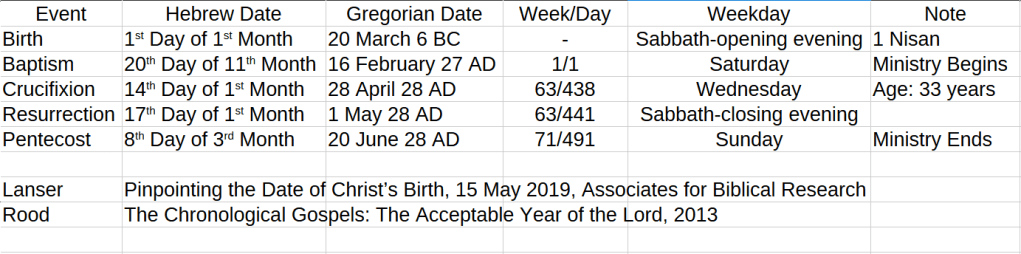
To add to these, I will present another one that merges the research of Rick Lanser1 with that of Michael Rood2 because I find it hard accept either of them alone.
The reason for doing this is there are only three viable dates for the Crucifixion: Rood’s Wednesday 28 AD, Lanser’s Friday 30 AD and Friday 33 AD. When Lanser showed that 33 AD could not be the date, his argument (as I see it) also showed 30 AD could not be the date either. That left Rood’s 28 AD as the only option. However, I prefer Lanser’s date of the birth of Jesus (20 March 6 BC) and believe that Rood’s date of creation (4000 BC) and his views of the multiple layers of the Daniel 9 prophecies are incorrect.
The following are where disagreements might arise with this merged chronology.
- With Rood’s Wednesday Crucifixion, a Sunday Resurrection is not necessary, but it still remains the day when the tomb was first found to be empty (which is all the Gospels say about it anyway).
- The ministry of Jesus from His baptism to Pentecost was only 70 weeks fulfilling the Daniel 9:24 prophecy, the first part of Daniel 9:26 and the first part of Daniel 9:27.
- The rest of the Daniel 9:24-27 prophecies were fulfilled in the destruction of the Temple in 70 AD. There are no more Daniel 9 prophecies awaiting fulfillment. Revelation, however, contains separate prophecies.
- John 6:4 was not in the original autograph of the Gospel of John as Greek Manuscript #472 testifies by preserving its absence.
- With Lanser’s date of the birth of Jesus on 20 March 6 BC and Rood’s Crucifixion date on 28 April 28 AD, I was surprised to calculate (6 + 28 – 1 = 33) that the age of Jesus at the Crucifixion is 33 years. That’s what I always heard His age was, but that would not have been His age in either Lanser’s (6 + 30 – 1 = 35) or Rood’s (2 + 28 – 1 = 29) chronology.
If you don’t agree with the above, don’t worry. I might be wrong. Also, I am pretty sure neither Lanser nor Rood would agree with me either (nor with each other). So, you would be in good company.
I will break the construction of this merged chronology into sections where questions are answered and constraints and conclusions are highlighted.
______
What Is the Upper Bound for the Year of the Crucifixion?
Lanser believes the Crucifixion occurred on Friday in 30 AD, but there is another possible Friday Crucifixion that could have occurred in 33 AD. Lanser argued3 against the 33 AD date by synchronizing Galatians 2:14 with Acts 12:1-4,255 to show that Paul was in Jerusalem for the Feast of Unleavened Bread in 44 AD, the year Herod Agrippa I died, which was 14 years after his conversion on the road to Damascus.
From Lanser’s argument I draw the following constraints.
CONSTRAINT: Herod Agrippa I died in 44 AD.6
CONSTRAINT: Paul went to Jerusalem 14 years after his conversion on the road to Damascus.7
CONSTRAINT: Herod Agrippa I and Paul were in Jerusalem during the Feast of Unleavened Bread before Herod Agrippa I’s death.8
Knowing the year was 44 AD, the time was the Feast of Unleavened Bread (after Passover) and that the length of time was 14 years since Paul’s conversion on the Damascus Road, I come to the conclusion that Paul was converted before the Passover of 30 AD by subtracting, as I normally would, 14 from 44. That means 30 AD could not be the year of the Crucifixion.
Although Lanser argued successfully for this synchronization to discredit the 33 AD date for the Crucifixion, he did not want to also discredit 30 AD. To preserve the 30 AD date Lanser made two assertions neither of which I find credible:
- He claimed that the subtraction of the 14 year length since Paul’s conversion from the secular dated year 44 AD of Herod Agrippa I’s death should use “inclusive reckoning”, that is, 44 minus 14 should equal 31, not 30.9 Since we are concerned with finding a secular date I do not think that such inclusive reckoning is justified.10
- He also claimed that the events from the Crucifixion to Paul’s conversion took only 9 months. It has to be less than a year, since that is all the extra time his inclusive reckoning is giving him. However, 9 months from his preferred Crucifixion date puts Paul’s trip to Damascus during winter, an unlikely time to travel from Jerusalem to Damascus especially with a team intending on bring back prisoners, but if Lanser extended this to spring (after Passover, only 3 to 4 months later), then 30 AD would be discredited as well as 33 AD. He also does not explain how Paul could have become personally notorious, even in Damascus, only 2 months after Stephen’s martyrdom.
If Lanser is right about the synchronization and I am right in rejecting his assertions then both 33 AD and 30 AD are eliminated as possible dates for the Crucifixion.
Lanser’s argument is the main reason I am trying to combine his chronology with that of Rood. Rood gets dates wrong as well. Combining these chronologies, I hope to avoid inconsistencies and construct a better view of what happened.
CONSTRAINT: Paul’s conversion on the road to Damascus occurred before the Passover of 30 AD.
That constraint gives the upper bound for the Crucifixion.
CONCLUSION: The Crucifixion occurred before 30 AD.
What Is the Lower Bound for the Year of the Crucifixion?
CONSTRAINT: Daniel 9:25 predicts 483 years or 69 weeks of years prior to the coming of the Messiah.11
Both Lanser12 and Rood13 agree that Daniel 9:25 determines the date after which the ministry of Jesus would begin. They agree that the start year is 457 BC and after 69 sevens or 483 years we reach 27 AD (-457 + 483 + 1).
CONCLUSION: The Crucifixion occurred after 27 AD.
Which Was the Year of the Crucifixion?
From these upper and lower bounds, the Crucifixion occurred after the Passover of 27 AD and before the Passover of 30 AD. There are only two Passovers to consider: Wednesday 28 April 28 AD and Monday 17 April 29 AD.
CONSTRAINT: There are only three days of the week on which the Crucifixion could occur to fulfill the three days and three nights Jonah prophecy: Wednesday, Thursday or Friday.14
Since the Passover occurred on a Monday in 29 AD, the constraint eliminates 29 AD.
CONCLUSION: The Crucifixion occurred in 28 AD.
When Was Jesus Born?
Lanser15 assigns the birth of Jesus to 1 Nisan of 20 March 6 BC based on an occultation of Jupiter with the new moon as the star seen by the magi and with His birth foreshadowed by the first day of the year (1 Nisan) in Exodus 12:216 and by the completion of the temple on 1 Nisan in Exodus 40:217. Rood18 assigns it to the High Sabbath of the Feast of Tabernacles on 26 September 3 BC as a fulfillment of that Feast.
Both of these dates are associated with the Lord tabernacling with His people, however, given that Lanser’s date explains both the star and has foreshadowing events at the beginning rather than the end of the year I will assume Lanser’s date is correct.
CONCLUSION: Jesus was born on 1 Nisan of 6 BC.
Was John 6:4 in the original autograph of the Gospel of John?
Since the lower bound of 27 AD and Passover of Wednesday 28 April 28 AD is at most a little over a year in length I have to accept that the ministry of Jesus was no longer than that.
Normally one assumes the ministry of Jesus was three and a half years. However, as Rood points out only the Gospel of John justifies such a long time and that only with one verse: John 6:419. Rood also mentions that there is an 11th century manuscript of the Gospel of John without John 6:4 in it.20
Since I accept the reasoning up to this point, I will accept the manuscript that Rood mentions as testifying and preserving that John 6:4 was not in the original text.
CONCLUSION: John 6:4 was not in the original autograph of the Gospel of John.
How long was the ministry of Jesus?
In The Chronological Gospels: The Acceptable Year of the Lord, Rood links verses of the four Gospels with each of 70 weeks of the ministry of Jesus starting with His baptism by John on 16 February 27 AD and ending with Pentecost on 20 June 28 AD. These 70 weeks fulfill the 70 weeks prophecy of Daniel 9:2421. In Rood’s association of weeks with verses, the Crucifixion occurs on the 63rd week. This fulfills the first part of Daniel 9:26 which reads: “And after threescore and two weeks shall Messiah be cut off, but not for himself:”
Although I don’t know if Rood mentions this, the 63rd week with the Crucifixion and Resurrection seems to me to fulfill the first part of Daniel 9:27 as well which reads: “And he shall confirm the covenant with many for one week: and in the midst of the week he shall cause the sacrifice and the oblation to cease,” However, he may understand that prophecy differently.
Since 28 AD is the only available year of the Crucifixion and Rood’s association shows a fulfillment of Daniel 9:24, 9:26 and 9:27, I accept in general his chronology for those 70 weeks. However, I doubt Rood’s end time views when he claims that the ministry of Jesus is only the second layer of three fulfillments with the third still coming22.
A prophecy should have only one fulfillment, but perhaps I just see Daniel 9 containing many separate prophecies while he may see it as one. The 70 weeks of Daniel 9:24 prophesies the number of weeks of the Messiah’s ministry. The 69 weeks of years of Daniel 9:25 is a separate prophecy giving the number of years before the Messiah’s ministry begins. The 63rd week of Daniel 9:26 is a separate prophecy stating in which week of the 70 weeks of Daniel 9:24 the Crucifixion would occur. The significance of the 63rd week of Daniel 9:26 is a separate prophecy in the first part of Daniel 9:27.
Once a prophecy is fulfilled, there is no point looking for an additional fulfillment of it unless one doesn’t believe the fulfillment has already occurred.
CONCLUSION: The 70 weeks of the ministry of Jesus completely and precisely fulfill the seventy weeks of Daniel 9:24 the first part of Daniel 9:26 and the first part of Daniel 9:27.
On Which Day of the Week Was the Resurrection?
Rood clarifies that the Resurrection occurred at the end of precisely three days and three nights after the body of Jesus was placed in the tomb on Wednesday before sunset. That is what one would expect with a Wednesday Passover. That means the Resurrection occurred at the end of the weekly Sabbath but before sunset and not on Sunday itself.
What the Gospels report is that the women went to the tomb and found it empty with the stone rolled away not so Jesus could leave but so they could see that He was no longer there. This is what happened on Sunday23 or the morning of the first day of the week.
Church tradition needs a Sunday Resurrection because those creating that tradition misunderstood that the preparation day on which Jesus died was not for the weekly Sabbath, which would have been on a Friday, but for the Passover. They had to fit three days and three nights in that short span. Using inclusive reckoning they could get away with three days (if they ignored the three nights), but they needed Jesus to be in the grave on Sunday to do that. According to Rood’s chronology, with a longer span, Jesus could rise on Saturday evening at the end of the Sabbath, fulfill the three days and three nights Jonah prophecy and fulfill the Feast of First Fruits on Sunday.
CONCLUSION: The Resurrection occurred at the end of the weekly Sabbath (Saturday) just prior to the Feast of First Fruits (Sunday) when the stone was rolled away by an angel so those going to the tomb could see that it was empty.
What about the rest of Daniel 9:24-27?
As I see it the parts of Daniel 9:24-27 that were not fulfilled by Rood’s 70 weeks were fulfilled with the Roman attack on Jerusalem resulting in the destruction of the Temple in 70 AD.
These are the two parts involved:
- The second half of Daniel 9:26 reads “and the people of the prince that shall come shall destroy the city and the sanctuary; and the end thereof shall be with a flood, and unto the end of the war desolations are determined.“
- The second half of Daniel 9:27 reads “and for the overspreading of abominations he shall make it desolate, even until the consummation, and that determined shall be poured upon the desolate.“
CONCLUSION: The Daniel 9:24-27 prophecies not fulfilled in the ministry of Jesus were fulfilled by the destruction of Jerusalem and the Temple in 70 AD.
That completes the merged messianic chronology.
______
______




 Poetry, Short Prose and Walking