The foolish ones presume to know but they’ve no grounds to say what’s true denying Truth, an odd worldview. Consistency’s the first to go. Coherence fails to save their show. Unfortunately filled with nerve they preach their faithless thoughts with verve. Then demons sugarcoat their grim conceptions as their minds grow dim forgetting Whom they’re here to serve.
Ronovan Hester offers the rhyme word “verve” to be used in the C-line of a décima having rhyme pattern ABBAACCDDC for this week’s challenge. I am thinking of Psalm 14.
Breathe over me. I want to hear Your saving Words. With hyssop sweep my heart so endless joy I’ll keep. Your Holy Spirit’s ever near.
I humbly bend my listening ear obeying what You have to say. I praise You through the end of day inhaling Spirit with each breath in gratitude till at my death the path to You leads where I’ll stay.
Ronovan Hester offers the rhyme word “sweep” to be used in a B rhyme of a décima having rhyme pattern ABBAACCDDC for this week’s challenge. I am thinking of Psalm 51.
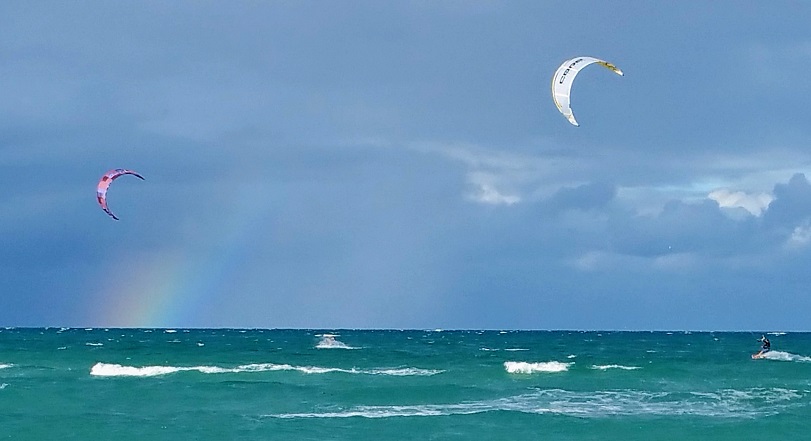
The storm has passed. The sky is bright. A rainbow rises from the sea. It’s stopped by clouds eventually, but in the sky’s a sail that’s white. We’re thankful for this gift of light. Our gratitude pours out as praise that we were given all these days to listen, hear with renewed hearts, forsaking all deceptive arts, performing service that obeys.
Ronovan Hester offers the rhyme word “bright” to be use in an A rhyme of a décima having rhyme pattern ABBAACCDDC for this week’s challenge.
Needing words that rhyme with ‘sunny’ some demons would cooperate. Between them they regurgitate, “Death is dark and lava runny. Funny how it sticks like honey.” That made no sense! They’re on the run. I do prefer a sunny sun with demons nowhere to be seen, with blue skies blue and green grass green and demons knowing they are done.
Ronovan Hester offers the rhyme word “sunny” to be used in an A line of a décima having rhyme pattern ABBAACCDDC for this week’s challenge.
It’s hard to dream up something new when morning sunlight’s cloudless, bright. I should have written more last night, but that was then. What should I do? Deceit tries hard to block what’s true, but goodness stands against its dread. I’ve only two lines in my head, “The weather’s fine but Mister Pitt decided he’d have none of it.” For now I’ll leave the rest unsaid.
Ronovan Hester offers the rhyme word “pitt” to be used in a D line of a décima having rhyme patter ABBAACCDDC for this week’s challenge.
We’re persevering. Let me send a blessing on what you may do that it be right and it be true. At last I know you as a friend to look for when we reach the end. We’ve seen the way the devil groups despair with his deceitful troops, because he wants to hold his ground. Deep time is short. We’re homeward bound. He’ll trip and fall, his final oops.
Ronovan Hester offers the rhyme word “oops” to be used in the C line of a décima having rhyme pattern ABBAACCDDC for this week’s challenge.
This prairie’s thick with butterflies. From bloom to bloom they make a trip as summer’s winds through flowers slip at home with life and cloudy skies.
These butterflies distract my eyes like yellow leaves that float and fall. They calmly work though very small. While on this journey patiently, though home seems far away from me, I’ll walk and pray, obey the call.
Ronovan Hester offers the rhyme word “trip” to be used in a B line of a décima having rhyme pattern ABBAACCDDC for this week’s challenge. And Eugenia offers “journey” for her prompt this week.
What we learn from experience depends on the kind of philosophy we bring to experience.
C.S. Lewis, Miracles: A Preliminary Study, Page 11.
In Miracles C.S. Lewis wants to convince his readers that miracles, especially the grand miracle of the Incarnation where God became Man in Jesus, are possible and fitting. He does this by challenging views of nature, both theistic and atheistic, that reject the supernatural as a source for miracles.
Naturalism claims that supernatural reality does not exist implying that there could be no miracles. Lewis takes from Naturalism that nature is orderly, impersonal cause and effect processes. He then shows that our reasoning ability would not be the result of such processes. Whenever we reason we thereby demonstrate reality that Naturalism cannot explain without something else outside it.
Hence, given Naturalism’s presuppositions about nature, nature cannot be the whole show. Alvin Plantinga carried this idea further in his Evolutionary Argument Against Naturalism.
Combine Naturalism with some field of consciousness (to avoid the supernatural) and one gets Pantheism, an ancient but ever-popular form of spirituality. Lewis writes (pages 99-100), “The popular ‘religion’ excludes miracles because it excludes the ‘living God’ of Christianity and believes instead in a kind of God who obviously would not do miracles, or indeed anything else.”
Although that characterization of Pantheism makes sense, it seems limited. These nature religions also have an ominous underbelly of demonic activity that Ephesians 6 warns us about. Miracles are wonders to our eyes. God is not the only source of them.
Furthermore, I see Platonism as a rationalization of these popular religions that Lewis objects to. However, and this is where my problems start, Lewis views Christianity as having “incorporated both” Platonism and Judaism (page 101). After reading his appendix on special providences I lost the ‘living God’ in all that philosophy.
There is much in Miracles of value especially when Lewis uses the presuppositions of Naturalism to argue for the supernatural, however, I suspect that Lewis accepted without adequate questioning many of the presuppositions of Naturalism such as impersonal natural laws and my own worldview inclines me to trust the Jewish scriptures over Plato.
Next Sunday I will look at miracles as presented by Greg Bahnsen.
The audio below is a reading of a shorter essay by Lewis on the topic of miracles.
He was a craft-less, cranky crook who stole the money from some kid. He ran and laughed at what he did then found a darkened, dreary nook, unwrapped the bills to have a look, and counted dollars, one by one. Just five? All singles? That’s no fun. He wanted more. There were no more. Complaining life was such a bore the rats approached. This tale is done.
Ronovan Hester offers the rhyme work “crook” to be used in an A line of a décima having rhyme pattern ABBAACCDDC for this week’s challenge.