After worrying whether he should or not, Tom called his father telling him that he saw the ghostlike presence of Aunt Janet after his classes that afternoon.
“She said she was sorry, but she didn’t say what for,” Tom added.
“What did you say?”
“I told her it was OK and then she vanished.”
Tom didn’t believe in ghosts, nor did his father, but he felt obligated to pass on this message not understanding what actually alienated his father from Aunt Janet over a decade ago. He was relieved when he heard his father say, “I’m glad you told her that.”
It is not merely that I can know them by the way they express, or don’t, the fruits of the Holy Spirit, but I can know myself by the way I express those fruits as well.
These fruits do not come from consuming therapies, taking drugs or following self-help programs to not behave badly. They are not my fruits, but the fruits of the Spirit, the Holy Spirit.
There is nothing easier than expressing them in stillness. There is nothing harder than giving up the addiction to my own spoiled fruits since faithlessness suggests that’s all there is.
Weekly Bible Readings:Genesis (Audio: King James Version read by Alexander Scourby) Commentary: David Pawson, Genesis Part 3 of 7 and Part 4 of 7, Unlocking the Bible
Saul consented to the stoning of Stephen outside of Jerusalem. Little did he realize that years later he himself would be stoned in Lystra, stoned to death so his enemies thought. And perhaps it was to death, but after being dragged out of town and left for dead by men who supposedly knew what they were doing, he would stand up.
On his way to Damascus, Saul once again was up to no good. This time the Lord Himself knocked him down, or rather, he fell down unaccustomed to the blinding light. When his blindness left, so too did his powerful delusion.
Denise offers the prompt word “powerful” for this week’s Six Sentence Stories. The story is a recounting of some events from Acts 6-9,14.
I used to find Plotinus, a 3rd century Platonist, interesting. His idea of the One suggested a kind of naturalistic or pantheistic spirituality. To the extent I understood any of this, the One was like a force field having the attributes philosophers might assign to a deity.
Little of this is attractive to me today, but that earlier exposure has kept me wary of Platonic or even Aristotelian influences. When I hear discussions of God that do not lead to repentance, salvation or a personal relationship with Jesus grounded in the special revelation of the Bible I wonder if there aren’t hidden presuppositions underlying the arguments that might be coming from ancient Greek, rather than Jewish or Christian, sources.
I’ve noticed these hidden ideas within various Christian traditions going back to Augustine or earlier. Some of them are fine, but it’s easy to forget that even the acceptable ones are cultural additions. So, I try to distinguish what is in the Bible from what is outside trying to get in. Then I put scripture over tradition should a conflict arise between the Word of God and that other stuff.
For those who wish more information on this especially as it pertains to questionable Greek cultural influence, see David Pawson’s lecture on “de-Greecing” the church:
Weekly Bible Readings:Genesis (Audio: King James Version read by Alexander Scourby) Commentary: David Pawson, Genesis Part 1 of 7 and Part 2 of 7, Unlocking the Bible
Bernard’s confidence returned as he began drinking the last can of his six-pack. He was ready to point out every nit that needed picking from the members of a social networking community he frequented.
In righteous rivalry he led his own charge condemning the “freaks, flakes and morons” to fiery hells that he himself didn’t believe in. They knew he was drunk.
Eventually his demons, unforgiving accusers themselves, led tired Bernard to bed one last time. As a reward for his long service, they prepared terrifying dreams.
I learned from Michael Wilson’s blog that the San Francisco Archbishop Salvatore Cordileone had called on the Catholic Church to deny Communion to prominent pro-abortion Catholics.
I agree with Archbishop Cordileone, but would add a twist to his call making it relevant even for non-Catholics: All Christians should advisethose who are pro-abortion to refrain from Communion until they have repented.
Does that sound harsh?
What would be harsh would be Satan’s accusations full of finger-pointing and despair with no hope of forgiveness on the other side. However, this call is different. It is a call to the discomfort of repentance and the liberation of change where pardon replaces that crash into the brick wall.
Although Rebekah told Isaac of the prophecy she received that Jacob, the second-born of her twins and her favorite, was to receive the blessing, as the boys matured Esau, the first-born and Isaac’s favorite, seemed to Isaac better able to carry any burdens his blessing might require.
In his old age with failing eyesight, Isaac decided to give the blessing to Esau rather than Jacob without telling Rebekah, but she overheard his plan and improvised one of her own. She prepared the meal Isaac requested from Esau, covered Jacob’s arms with fur to imitate Esau’s hairy skin and dressed him in Esau’s clothing to deceive her husband. Not even Jacob, willing though he was to go along with it, thought her plan would work, but it did.
After realizing he had been fooled, Isaac reluctantly remembered the prophecy and remained faithful to it reaffirming the blessing he unwittingly gave to Jacob. Esau, however, wanted revenge and so Rebekah convinced Isaac to send Jacob off on the pretext of finding a suitable wife, not one like Esau found among the locals, knowing that she would likely never see Jacob again.
Denise offers the prompt “improvise” for this week’s Six Sentence Story.
A more complete and accurate description of what happened to Isaac, Rebekah, Esau and Jacob begins at Genesis 25:19. The insight that Rebekah did not see Jacob again came from Pastor Colin Smith’s sermon last Sunday.
Rafael walked home with his daughter, Celia, to bring her back to her mother. Celia told him about Derek, and she wondered how he knew so much about him? Rafael didn’t think he knew much at all.
They climbed the stairs to the second story apartment wondering what Celia’s mother would say or do when she saw her daughter again after two years. The silence of their searching eyes overcame the hardened words and deeds from their memories. Then tears restored their lost connection.
If one has a closed natural system where nothing can enter to support it from the outside, the system will run down. Any order will become disorder in a finite amount of time. Entropy is a measure of disorder.
In naturalistic or materialistic worldviews the universe we live in is supposed to be such a closed system. There is nothing outside it. Or, if there is, that supernatural stuff can’t break through the boundaries of the closed system to offer support.
In the Christian worldview not only is there an outside to the universe but that outside is powerful, willing and intelligent enough to both create the universe and make an ongoing difference to it. The material universe is not closed in this worldview although it could be hypothetically viewed as closed to study what would happen to it assuming the outside did not intervene.
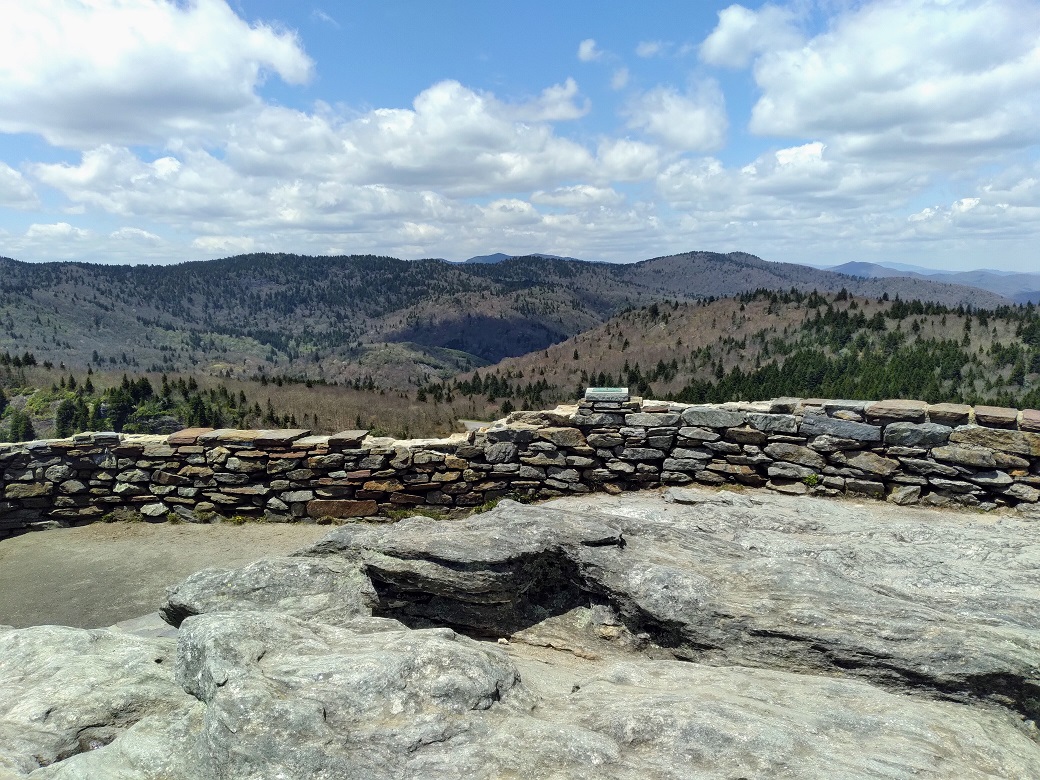
For example, if we assumed nothing would stop erosion, weathering and traffic from the outside, we could ask how long the hypothetically closed system of the rock formations in the photo above would remain intact? No one doubts that there is intelligence outside this system of rock formations. Just by studying the system we are that intelligence outside it. After a study is made other people powerful and willing enough could use the findings to implement policies to preserve the formations. All of that study and preservation comes from outside this system of rock formations intervening to alter what would happen to it if those formations were left alone.
If we supposed that our universe were closed with no outside support, the main mystery would be how our universe came to be. With entropy we cannot claim that our universe had always been here to avoid addressing its origin. If our universe were infinitely old, it would have run down by now. Furthermore, any popping of ordered reality out of nothing or even out of less ordered stuff would require an explanation how that popping could increase orderliness without the assistance of some outside intelligence.
In the past it was believed that random mutations filtered through natural selection could serve as the mechanism allowing living organisms within a closed universe to evolve into ever more complex organisms without help from the outside. The change coming from random mutations would be mindlessly directed by natural selection to achieve this. R. A. Fisher even offered a mathematical proof that it would work.
However, with further study of mutation-selection the opposite is now known to happen. This perpetual motion mechanism is not what we thought it was. Even Fisher’s Theorem has been flipped by William F. Basener and John C. Sanford. The following podcast with John Sanford puts this in perspective.
Rather than describing a means by which evolution could occur mutation-selection describes the mechanism behind genetic entropy. Without outside help, living species in a closed system not only do not evolve into super-species, they run down just like everything else does. At some point in their genome degeneration they go extinct.
















 Poetry, Short Prose and Walking