Lachish was a Canaanite city. Douglas Petrovich presents five significant archeological finds at Lachish in the process of giving you a history of this important biblical city.
The following map from Bible Mapper shows Lachish in relation to other cities during the time when it fell to the Assyrian Sennacherib.
Douglas Petrovich is active on Academia.edu where you can find many of his papers. He is also the author of The World’s Oldest Alphabet, Origins of the Hebrews and Nimrod the Empire Builder.
Once upon a time there was a lad who noticed how highly the town folk honored those who warned the town of the big bad wolf. Wanting some of that honor for himself, he cried, “Wolf! Wolf!”, even though there was no wolf to be seen.
He did get the desired attention and admiration and so the next day and the next and the next, he did it again and again and again. After the tenth day of this even gullible folk could read the mark on the lad’s forehead saying, Don’t believe anything this kid has to say.
One day the real big bad wolf reappeared and the lad cried, “Wolf! Wolf!” None of the town folk came to chase the wolf away, figuring it was imaginary, and everyone, except for the lad who became the main course of the wolf’s dinner, lived happily ever after – that is, until the wolf got hungry again, but that’s another tale.
______
Denise offers the prompt word “mark” to be used in this week’s Six Sentence Stories.
They are close to where we are currently staying, but not where we normally live.
______
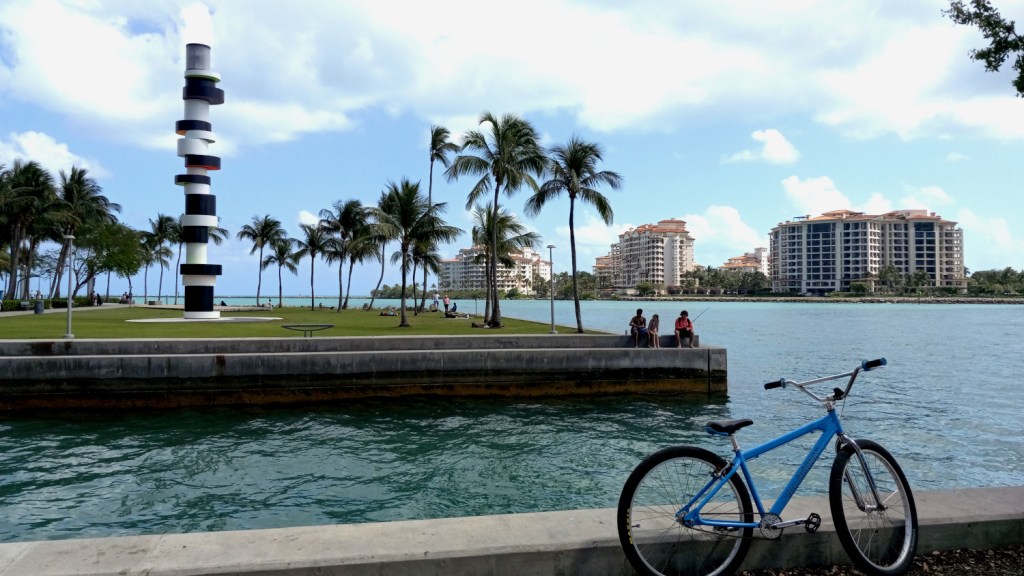
People live in buildings like those in the distance. There is one still being constructed as well.Other places where people live especially if they have boatsIn the distance are condos if you look past the bicycle, the people, the palm trees and the whatever-it-is art
______
Some of my poetry was recently published in The Short of It. I am grateful to the editor for accepting them.
There were five cities mentioned in Deuteronomy 29:23 and Genesis 19 that were subject to destruction: Sodom, Gomorrah, Admah, Zeboiim and Zoar. Although Zoar was in the middle of those five cities it was not destroyed, because Lot fled there.
Joel P. Kramer shows the sulfur that destroyed the cities and provides evidence that these were the actual cities mentioned in the Bible. He also shows why other sites which some have claimed to be Sodom, such as Hammam, could not have been.
Genesis 19:17-22 KJV – 17 And it came to pass, when they had brought them forth abroad, that he said, Escape for thy life; look not behind thee, neither stay thou in all the plain; escape to the mountain, lest thou be consumed. 18 And Lot said unto them, Oh, not so, my Lord: 19 Behold now, thy servant hath found grace in thy sight, and thou hast magnified thy mercy, which thou hast shewed unto me in saving my life; and I cannot escape to the mountain, lest some evil take me, and I die: 20 Behold now, this city is near to flee unto, and it is a little one: Oh, let me escape thither, (is it not a little one?) and my soul shall live. 21 And he said unto him, See, I have accepted thee concerning this thing also, that I will not overthrow this city, for the which thou hast spoken. 22 Haste thee, escape thither; for I cannot do any thing till thou be come thither. Therefore the name of the city was called Zoar.
The following is a review of a book I received as an early reviewer. Normally, I post such reviews on Amazon and Library Thing where I received the book. Since I was puzzled enough by Matthew 16:181 to write a story about it, I am posting my review here as an alternate way of looking at that verse.
______
This is a powerful book on many levels. It makes an argument for universal salvation of all human beings in the past, present and future. Since God wills all to be saved (1 Timothy 2:42), there are biblical grounds for this position.
This is the first volume of a proposed trilogy. It addresses the concept of the “harrowing of hell”. This harrowing occurred after the death of Jesus when He descended into hell and it was completed before He rose. This was when the gates of hell fell from the inside. They could no longer prevail against the church (Matthew 16:18) to keep the church captive. The church now included everyone on both sides of the gulf which separated Lazarus from the rich man (Luke 16:19-313). Everyone, every captive, left. Christ is the Victor, the hero of this event.
The author makes his argument by first discussing the meanings of “Sheol” or “Hades” as the place where the spirits of the dead waited for salvation, “Gehenna” as an actual garbage dump and “Tartarus” as a place for angels. He then describes the divide within Sheol mentioned in the parable of Lazarus and the rich man. Paul revealed that the Gospel was also for the gentiles, the people with the rich man on other side of the divide.
The victory over Hades from (Matthew 16:18) is next explained as a Trojan horse kind of attack on hell from within. He provides an early church confirmation of his position and especially noted the vision of Perpetua from 208 AD which referenced crushing of the head of the serpent.
With the above argumentation in place, the author provides a three part imaginative narrative of what happened during this harrowing. The story is powerful and brings the argument to life. You will encounter Adam and Eve, Moses and Elijah, the thief on the cross along with even Jesus’ betrayer Judas.
The last chapter goes through a history of church teaching on the harrowing of hell from the early church which took it for granted to the modern church which viewed it as allegory if at all. Indeed, I don’t recall hearing the term before. A week before reading this book, I was trying to make sense of Matthew 16:18. Was the church the rock catapulted against the gates of hell from the outside to bring those gates down? Was this an event we were still to prepare for? Those were the kinds of thoughts going through my head. I understand better now what happened after reading this book.
______
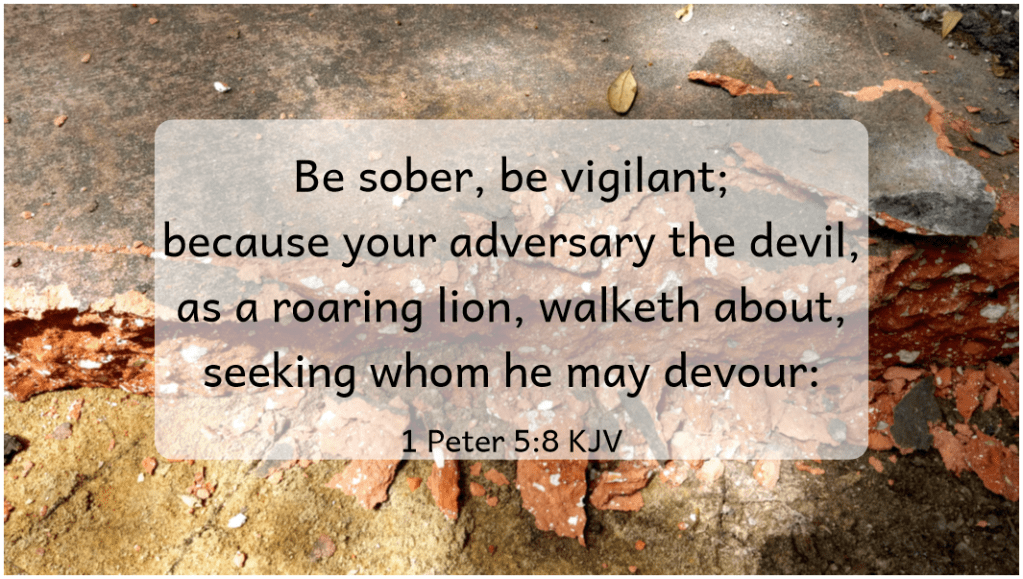
Matthew 16:18 KJV – And I say also unto thee, That thou art Peter, and upon this rock I will build my church; and the gates of hell shall not prevail against it.↩︎
1 Timothy 2:4 KJV – Who will have all men to be saved, and to come unto the knowledge of the truth. ↩︎
Luke 16:19-31 KJV – 19 There was a certain rich man, which was clothed in purple and fine linen, and fared sumptuously every day: 20 And there was a certain beggar named Lazarus, which was laid at his gate, full of sores, 21 And desiring to be fed with the crumbs which fell from the rich man’s table: moreover the dogs came and licked his sores. 22 And it came to pass, that the beggar died, and was carried by the angels into Abraham’s bosom: the rich man also died, and was buried; 23 And in hell he lift up his eyes, being in torments, and seeth Abraham afar off, and Lazarus in his bosom. 24 And he cried and said, Father Abraham, have mercy on me, and send Lazarus, that he may dip the tip of his finger in water, and cool my tongue; for I am tormented in this flame. 25 But Abraham said, Son, remember that thou in thy lifetime receivedst thy good things, and likewise Lazarus evil things: but now he is comforted, and thou art tormented. 26 And beside all this, between us and you there is a great gulf fixed: so that they which would pass from hence to you cannot; neither can they pass to us, that would come from thence. 27 Then he said, I pray thee therefore, father, that thou wouldest send him to my father’s house: 28 For I have five brethren; that he may testify unto them, lest they also come into this place of torment. 29 Abraham saith unto him, They have Moses and the prophets; let them hear them. 30 And he said, Nay, father Abraham: but if one went unto them from the dead, they will repent. 31 And he said unto him, If they hear not Moses and the prophets, neither will they be persuaded, though one rose from the dead.↩︎
With the sounds of battle coming from the enemy’s gates the sergeant told Philippe, “Write down every miracle.”
Philippe told him that he couldn’t think of a single one.
The sergeant responded, “Then open your eyes.”
Philippe told him that his eyes were open, but there were no miracles to be seen.
The sergeant knew Philippe wasn’t ready to be launched like a rock against the gates of hell, but with the battle raging the sergeant had time only for a brief deliverance or mini exorcism – words of command given to the demonic mountain to move – before he turned to the next soldier.
But that was all Philippe needed for the grays to wash clean with brand new bright light.
______
Denise offers the prompt word “brand” to be used in this week’s Six Sentence Stories.
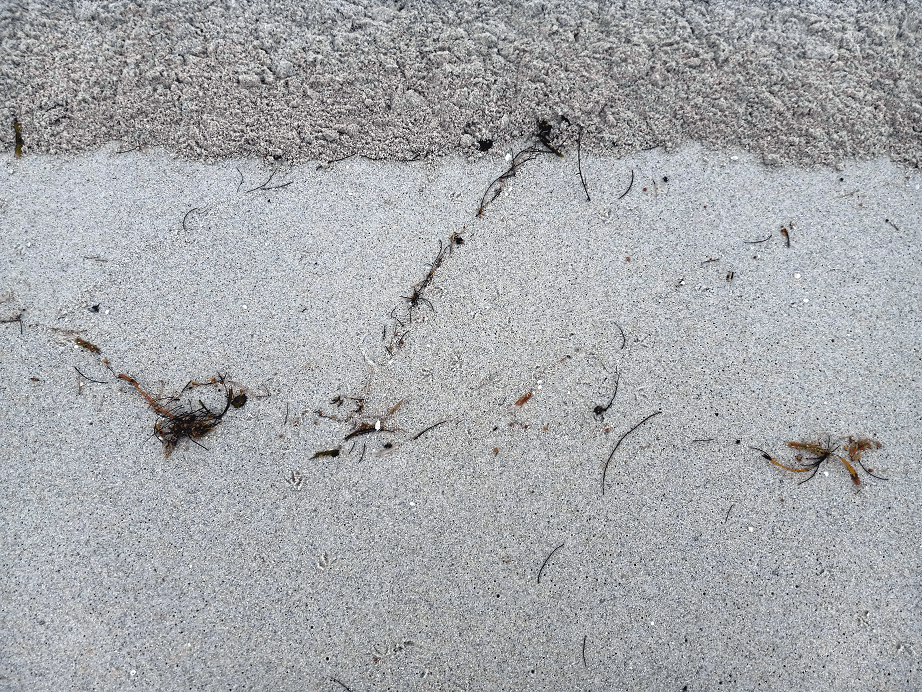
Some of these may be more cluttered than a true minimalist would find acceptable.
Except perhaps for the last one.
______
The beach with a minimal amount of stuff washed to shore. At the top is sand pushed aside by a plow smoothing the beach.So minimal, not even the sun is in the photoThis one is so minimal I almost called it “White On White” except it is gray, the gray sand left as the waves retreated.








 Poetry, Short Prose and Walking