Dale offers the prompt “inversions” for this week’s Cosmic Photo Challenge.
I used an “Invert” option on the Color dropdown menu in digiKam to make these. The first is the image before I applied the option. The second is the image after applying it.

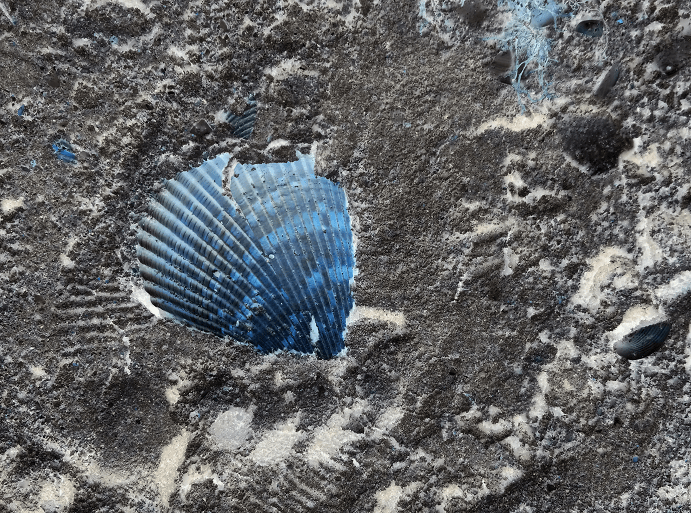



Dale offers the prompt “inversions” for this week’s Cosmic Photo Challenge.
I used an “Invert” option on the Color dropdown menu in digiKam to make these. The first is the image before I applied the option. The second is the image after applying it.
My hope is built on nothing less
than Jesus’ blood and righteousness.
You think the world is in a mess?
No longer: He is risen!
______
Ronovan Hester offers the inspiration “hope” for this week’s Ovi Poetry Challenge.
The first two lines were written by Edward Mote (1797-1874) as the first two lines of his well-known hymn.
______
May you have a blessed Resurrection Day with an overflow of blessings to others.
In Logic: A God-Centered Approach to the Foundation of Western Thought Vern Poythress attempted to write a textbook on western logic from a Christian perspective. Although he discussed other logics, his main focus was on justifying first order logic with identity (FOL=) as a platonic reflection of “God’s logic” and, because of that, personal and loving.
This reflection bridges the Creator-creature distinction. However, when he sets up this reflection between FOL= and “God’s logic” he assumes that FOL= is not just another example of man’s desire for autonomy from God. This is where he makes a mistake.
To see why this characterization of FOL= is problematic, consider that Poythress would not want to describe the Tower of Babel as a reflection of “God’s tower”. Because the Tower of Babel is an example of man’s desire for autonomy from God, it should not reflect anything from God.
Poythress knows that almost no one, Christian and non-Christian alike, thinks FOL= is personal in any way. To counter this anticipated objection, he accuses those who might reject his argument as being “massively guilty” of “idolatry”. For example, consider this comment about guilt and idolatry on page 84:
Christians too have become massively guilty by being captive to the idolatry in which logic is regarded as impersonal. Within this captivity we take for granted the benefits and beauties of rationality for which we should be filled with gratitude and praise to God.
By committing to FOL= Poythress blinds himself to seeing it as another attempt by man to gain autonomy from God. Given that commitment, perhaps better described as compromise, he now has to defend FOL= even when it attacks the Trinity. We will see how that attack goes next.
FOL= is Non-Trinitarian
If I assume the Trinity in FOL=, I can derive a contradiction using rules for manipulating equality. Here is how such a proof might look:
(1) Assume the Father is God.
(2) Assume the Son is God.
(3) Assume the Father is not the Son.
(4) Derive from (2) that God is the Son using symmetry.
(5) Derive from (1) and (4) that the Father is the Son using transitivity.
(6) Derive a contradiction from (3) and (5).
Note that the above is a presuppositional argument that could be used by an atheist to undermine belief in the Trinitarian God. The atheist assumes the Trinity since it would be my admitted presupposition. Then he uses FOL= to derive a contradiction. Finally, the atheist insists that I reject my belief because it is irrational.
Since FOL= forces me to reject the Trinity (or else reject parts of FOL= itself), I can characterize any mathematical formalization of this logic as non-Trinitarian. A non-Trinitarian logic does not “reflect” the Trinitarian God.
Poythress is aware of the contradiction, but he tries to get around it by invoking “mystery”. He writes on page 67:
The Bible also teaches that God is one God, in three persons. How do we understand how these things can be? Do these mysteries violate the laws of logic? Though there is mystery here for us as creatures, there is no mystery for God the Creator. If logic is ultimately an aspect of God’s mind; what for us is a mystery is in full harmony with the logic that is in God.
Call it what you like, a “mystery” is nothing more than a contradiction in FOL=. In the context of FOL=, the laws of logic are the laws of derivation in FOL=. Accepting a contradiction as true would violate the laws of FOL=, hence the laws of logic.
How does one get around this? Easy. Don’t take FOL= so seriously. Don’t commit yourself to it the way Poythress does. Don’t think it is neutral ground upon which you can safely compromise. Recall that FOL= is a work of man. It is not a work of God. It can change just as any other man-made philosophy or scientific theory can change when there is something wrong with it.
And, besides, as I will point out next, theologians seeking to rationalize the Trinity are not the only ones who have problems with FOL=.
There Are Alternatives to FOL=
CONSTRUCTIVIST LOGICS
Although FOL= cannot derive the Trinity it can derive the existence of sets whose cardinalities represent ever increasing transfinite numbers. The logical rules used to derive these sets are the same as those used to reject the Trinity: (1) assume the contrary to what you want to show, (2) derive a contradiction, and (3) given that contradiction, reject the unwelcome assumption as false.
Poythress approves of these set theoretic proofs in part E2. They derive a “ladder” or sequence of sets with each set having a strictly greater infinite cardinality than the one below it. He remarks on page 630,
The ladders reflect the glory of God, who is transcendent. They reflect the original imaging and creativity in the Father eternally begetting the Son.
Rather than seeing these sets as representing an “imitative transcendence” (page 630), Poythress should have warned the reader that such derivations can also be viewed as a red flag that something is wrong with FOL= especially given that FOL= rejects the Trinity.
Constructivists are mathematicians who want nothing to do with these ladders. They see the red flags waving. One of the logics they have created is intuitionistic logic. This logic modifies FOL= to prevent the derivation of such infinite sets.
Although constructivist logics won’t help us rationalize the Trinity they do demonstrate that FOL= is not the only game in town.
QUANTUM LOGICS
FOL= doesn’t handle quantum particles any better than it handles the Trinity. Absolute identity in FOL= requires that we can tell the difference between individual members of a domain, the set of elements which FOL= will range over.
Absolute identity is defined as A = B if and only if all properties of A are also properties of B and all properties of B are also properties of A. A and B are identical because they are indiscernible based on checking all of their properties. Such discernment can’t be done with quantum particles. To get around that some have proposed quantum logics as a modification of FOL=.
Although the statistical solutions quantum logics provide don’t help rationalize the Trinity they do point to absolute identity as the problem with FOL= that those attempting to rationalize the Trinity have to face. They also help us see that rationalizing physical reality in FOL= is as problematic as rationalizing the Trinity.
RELATIVE IDENTITY LOGICS
P.T. Geach offered relative identity as an alternative to absolute identity to correct the problem of the falsification of the Trinity in FOL=.
Daniel Molto, who continues Geach’s work in support of the consistency of the doctrine of the Trinity, drew the following conclusion in “Relativizing identity” (page 9):
Most actual languages can express no universally reflexive relation that satisfies the Indiscernibility of Identity without contradiction.
We now have the possibility of a logic that can rationalize the Trinity. This blocks the atheist’s objection to Christianity.
Taking FOL= Too Seriously
One of the dangers of taking FOL= too seriously is that it leads people to think it holds the essence of intelligence. Proof assistants mechanize the search for and validation of FOL= derivations. If we can mechanize the derivations of proofs and intelligence can be reduced to FOL=, then we should be able to mechanize intelligence. But if we were able to do that (which we are not), that would reduce us, who have been made in the image of God, to machines.
The use of the term “artificial intelligence” exposes the real “idolatry” with regard to logic that Poythress warned about. He thinks this idolatry has to do with us not seeing FOL= as personal and loving. Just the opposite is the case.
FOL= is an impersonal, even unintelligent, tool that can be mechanized. It gives the atheist hope that he can reduce men and women, made in the image of God, to machines. It also gives the atheist a means of expressing his autonomy from God.
Why Bother Rationalizing the Trinity?
The benefit of rationalizing the Trinity is not to learn anything about God. We already know God is Trinitarian from Scripture. The benefit comes from deflecting presuppositional arguments coming from atheists that Trinitarian theism is irrational because one can derive a contradiction from it in FOL=.
It also helps us see the difference that a logic offers, even one that can rationalize the Trinity, from what we have as born-again Christians. The indwelling of the Holy Spirit makes truth very personal for the Christian. Logic by itself does not. As John 14:6 reveals, Jesus is the way, the truth and the life. Christians after Pentecost follow a truth-filled way of life by obeying the Holy Spirit who dwells within us.
Conclusion
Since FOL= has decided against the Trinity, I am faced with a choice: Do I accept the Trinity or do I accept FOL= which rejects the Trinity? Let me make sure my decision is clear:
I choose the Trinity over FOL=.
Choosing the Trinity means I will not attempt to view FOL= as reflecting the Trinitarian God. It also means I need to be aware of the limitations of FOL= so I am not deceived by any presuppositional argument coming from atheists.
Because I do not want to encourage fantasies that we can be reduced to machines, I will also not characterize FOL= as loving or personal. I will not create an idol out of it. Atheists have done enough damage already with their promotion of “artificial intelligence”.

If you are a born again Christian, remind anyone who speaks massive guilt over you that you have been redeemed by the blood of Jesus.
George picked up the couple near the entrance to the interstate knowing there would not likely be many cars going north at this hour of the evening. Clearly, the woman was pregnant, but when he found out they needed to go a hundred miles out of his way, George hesitated, but it was getting darker and she was pregnant.
Over two hours later George dropped them off at their apartment in a small town in the timberlands of Maine. As George started his truck to leave noting the fuel gauge with confidence that he had enough gas to return and getting ready to slide back into his normal routine that had been going nowhere, the man offered him the only thing he had besides his thanks: “May the Lord bless you.”
Decades later when George and his wife were hosting an Easter dinner with their children’s families and their children’s children’s families including their new great granddaughter, he remembered that young couple and told all of them the story.
When George said, “Their child would be more than sixty years old by now,” he realized, with the love of his family all around him, that, indeed, he had received over all those years blessing upon blessing with overflows of blessings to share.
______
Denise offers the prompt word “slide” to be used in this week’s Six Sentence Stories.
Matthew 25:40
And the King shall answer and say unto them, Verily I say unto you, Inasmuch as ye have done it unto one of the least of these my brethren, ye have done it unto me.

Dale offers the prompt “the arrival of spring” for this week’s Cosmic Photo Challenge.
We are in Florida. I don’t know what these plants are, but they look like signs of Spring.



Hebrews 8:10-12
10 For this is the covenant that I will make with the house of Israel after those days, saith the Lord; I will put my laws into their mind, and write them in their hearts: and I will be to them a God, and they shall be to me a people:
11 And they shall not teach every man his neighbour, and every man his brother, saying, Know the Lord: for all shall know me, from the least to the greatest.
12 For I will be merciful to their unrighteousness, and their sins and their iniquities will I remember no more.
For those in His new covenant, the Lord remembers our sins and our iniquities no more.
The important questions are Whom do we know? Has His laws been written in our hearts? Are they in our minds? Are we in His new covenant?

To walk on water take His hand.
Forget the beach, its shells and sand.
Forget wet water as you stand
on Love’s deep rush of joy.
Don’t worry if you can not swim.
Your love’s forever born of Him.
When words betray the world as grim,
you’re now its salt and light.
______
Ronovan Hester offers the inspiration “tragedy” to be used in this week’s Ovi Poetry Challenge. Also posted on Poet’s Corner.
Matthew 5:13-14
Ye are the salt of the earth…Ye are the light of the world…
1 John 4:7-8
7 Beloved, let us love one another: for love is of God; and every one that loveth is born of God, and knoweth God.
8 He that loveth not knoweth not God; for God is love.

Anticipating the eventual manifestation of his healing Sam began singing a happy song which he made up as he went along mainly repeating the words, “Hallelujah”, “Thank you, Jesus” and “I am healed” over and over and over again.
Sensing an opportunity to get a word in edgewise and expecting Sam to know the difference between the play money of an “eventual manifestation of healing” and an actual testimony one could take to the bank, the devil said, “You’re not.”
When Sam’s wife heard him suddenly stop singing, she asked, “Did the devil say you weren’t healed?”
“Yes.”
“That devil’s a doofus.”
HA ha ha ha—HA ha ha—HA ha ha ha—HA ha ha—which offended their high maintenance devil so much that it threatened to leave and when it finally did even the bankers recognized Sam’s testimony as golden.
______
Denise offers the prompt word “bank” to be used in this week’s Six Sentence Stories.



 Poetry, Short Prose and Walking