Linda G. Hill’s One Liner Wednesday.

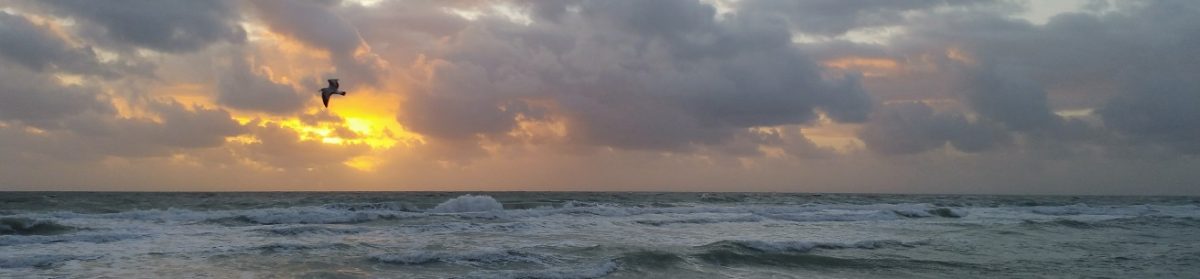
Dale offers the prompt “low elevation” for this week’s Cosmic Photo Challenge.
I took these many years ago when I tried to see the world the way a pigeon might walking on the street.
I probably looked silly taking these photos.


Over the past year I put together a book, Stars and Stories, using LaTeX (MiKTeX) as the typesetting software for both book and cover and Audacity for the audio. I just completed that project and I am now offering the pdf from this page.
The book is a selection of short tales. All of them except for one, Afterwards, were originally written for either Denise Farley’s Six Sentence Stories or for Sammi Cox’s Whispers and Echoes. Some of these stories were revised from their original versions.
Here is the cover, front and back:
The print book is made and distributed by Lulu. It is pocketbook size (think, small) with heavier paper to better show the color illustrations. Because of that it is more expensive to print.
I used Amazon’s Kindle Create to make a replica of the print book as an ebook for Kindle readers. It looks much like the pdf file. As a “print replica” ebook, the text does not reflow. This preserves the illustrations in their original positions on the pages.
Now that I know how to do this, my next projects will be to make a larger, color book of photographs and poems and to create a Volume 2 of Stars and Stories.
You may read and download the book below as well as listen to the audio files. If you would like to review the book you are most welcome to do so. You may consider this pdf file as a review copy.
They left what’s wrong to darkened night
to rise and follow living light.
The way was narrow, true, but right.
That’s how they made it home.
Forsaking gods of mountains, trees,
of roiling, windy, mindless seas,
they listened through the silent breeze
and served the living LORD.
______
Ronovan Hester offers the word “right” as inspiration for this week’s Ovi Poetry Challenge. Also posted at Poet’s Corner.
Joshua 24:15 (KJV)
And if it seem evil unto you to serve the LORD, choose you this day whom ye will serve; whether the gods which your fathers served that were on the other side of the flood, or the gods of the Amorites, in whose land ye dwell: but as for me and my house, we will serve the LORD.

Barry painted light-hearted, popular abstract art. The more light-hearted his compositions were the more popular they became and the more popular they became the more computer scientists thought they could simulate them to prove that machines were just as light-hearted as people.
Although their computer generated art looked like Barry’s, the collecting public were able to pick out an authentic Barry original with little difficulty. It had that je ne sais quoi that only Barry could bring to the canvas.
In a quote published by the gallery representing him, Barry acknowledged the predicament his imitators were in saying, “Should computers ever talk to their programmers, and programmers opened their ears to listen, they would tell them that no one in his right mind would waste time putting anything on a canvas.”
Waste of time or not Barry’s spirit didn’t mind filling canvas after canvas each of which put his soul in such a good mood that his body bubbled over with love and laughter.
______
Denise offers the prompt word “abstract” to be used in this week’s Six Sentence Stories.
1 Thessalonians 5:23 (KJV)
And the very God of peace sanctify you wholly; and I pray God your whole spirit and soul and body be preserved blameless unto the coming of our Lord Jesus Christ.
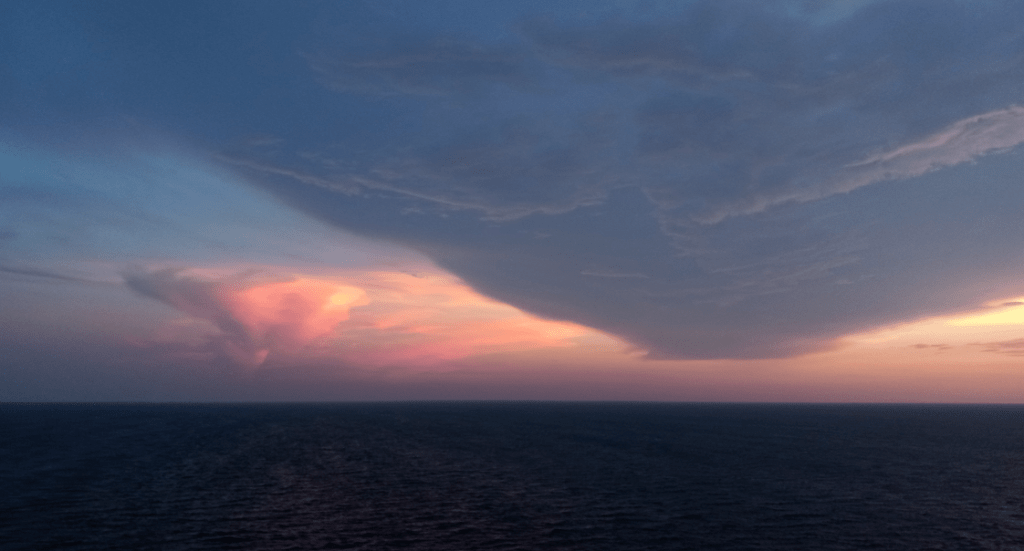
Dale offers the prompt “the sky’s the limit” for this week’s Cosmic Photo Challenge.
These were taken over the Atlantic Ocean.
I thought the first photo had a great sunset with the swirling yellow light. Then the wind blew some clouds in turning that sunset into an even greater one below it.


While fretting over loveless things
instead of what the Spirit brings,
I stifled joy. The church bell rings.
There’s sadness in the wind.
His way is true. His burden light.
He found me through the dark of night.
I once was bound to wrong, not right,
but that was long ago.
______
Ronovan Hester offers “choice” as inspiration for this week’s Ovi Poetry Challenge.
In a few seconds Timothy scribbled a poem in his notebook while standing on the beach waiting for the sunrise. When he got home he read it and wondered where that came from as if he had found an exotic seashell or spotted a seal in the water.
Accepting the gift he cleaned it up and posted it on his favorite sites. Although no one “liked” it nor left a comment he kept reading it over and over wondering: Where did that come from?
At the end of the day Timothy was grateful for everything: birds, clouds, beach, water and just being there. In a week he’d forget the poem because there would be another one and the days of rejoicing and wonder would start all over again.
______
Denise offers the word “seal” to be used in this week’s Six Sentence Stories.
I am on vacation this week without access to the internet. Hopefully I will be back by Saturday in time to post this to the Six Sentence Story group before the deadline, but if not, I have scheduled it in advance for Wednesday evening.

Linda G. Hill’s One Liner Wednesday.


 Poetry, Short Prose and Walking