
If one compares the chronologies of Genesis 5 and 11 as they appear in the Masoretic Text (MT) – which is what most of our bibles use for these dates – with those in the Septuagint (LXX), one finds roughly a 1500 year discrepancy.
The LXX (or Alexandrian) Inflation Hypothesis explains this discrepancy by saying that the Greek translators of the lost Hebrew text of Genesis of their time (called the Vorlage) inflated the dates in the 3rd century BC to better agree with Egyptian history. The Rabbinic Deflation Hypothesis explains this discrepancy by saying that the rabbis in the 2nd century AD deflated the numbers to discredit Jesus as the Messiah.
In the following interview Henry B. Smith Jr of the Associates for Biblical Research (ABR) argues for the Rabbinic Deflation Hypothesis. It is long, so I have commented on it section by section with links to each part.
The correct dates are important for both archeology and apologetics.
The Christian archeologist has to know what the original Genesis text said about the events following the flood. Apologists who accept the Bible as an historical document also need to be clear about what that history actually is. Attacks against any Christianity that has not been watered down to a new age belief system come from those who want to discredit the Bible as reliable history.
- 0:00 Michael Filipek’s introduction
- 6:20 Henry B. Smith Jr’s introduction. He notes that there are no chronological gaps in these genealogies. He also asserts that the biblical text has higher authority over external evidence.
- 16:05 There are three textual traditions with differences in the genealogies: the MT, the LXX, and the Samaritan Pentateuch (SP). The correct dates are needed for archeological research and for apologetics. Smith Jr focuses on Genesis 11 because these dates come after the flood where archeological evidence has to be located and there the internal evidence is greatest for the Rabbinic Deflation Hypothesis.
- 25:02 Smith Jr contrasts the total number of years in these chronologies. For the MT it is 2008 years. For the SP it is 2249 years. For the LXX it is 3394 years. Although creation science explores the entire chronology beginning with creation, archeologists would only have evidence for the time after the flood.
- 33:15 Smith Jr analyzes the dates for Peleg as an example.
- 35:00 Smith Jr analyzes the dates for Kainan as another example. Kainan is mentioned in Luke 3:36 and the LXX, but not in the MT nor the SP.
- 40:37 Smith Jr offers a warning about critical scholarship: although there might be treasures hidden there many of these scholars support the Documentary Hypothesis which entirely discredits the historical value of these chronologies. He also comments that preservation of Scripture does not require that it be preserved in Hebrew manuscripts. It could be preserved in other languages, such as, Greek.
- 44:51 Whoever made the deliberate changes to the text would need a high enough motivation to overcome the command in Deuteronomy 4:2 not to change the text. They would also need the means to disseminate the changes and the opportunity to do so.
- 54:30 There are external witnesses before the second century AD to the LXX reading of Genesis 5 and 11: Liber Antiquitatum Biblicarum (LAB), Josephus, Eupolemus, and Demetrius of Alexandria as early as 220 BC. However, there are no external witnesses before the second century AD to the MT reading.
- 1:24:00 Smith Jr returns to Peleg as an example of a methodology on how to approach these texts.
- 1:28:54 Smith Jr points out the internal evidence in the MT that there is not enough time from the flood to the Babel dispersion for the population to reach the state that Genesis 10 describes it to be in. He notes that some people may find it hard to believe that the rabbis would have deflated their own texts and some may also have a long-term commitment to Ussher’s chronology which is based on the MT.
- 1:43:45 Smith Jr introduces the Rabbinic Deflation Hypothesis. Chrono-messianism used 1000-year blocks and the Daniel 9 prophecies to predict the coming of the Messiah. The Seder ‘Olam Rabbah became a new chronology in the second century AD. The rabbis wanted to put Jesus outside of biblical prophecies.
- 1:59:21 Ancient support for the Rabbinic Deflation Hypothesis comes from Eusebius, Julian of Toledo, Jacob of Edessa and Bar Hebraeus.
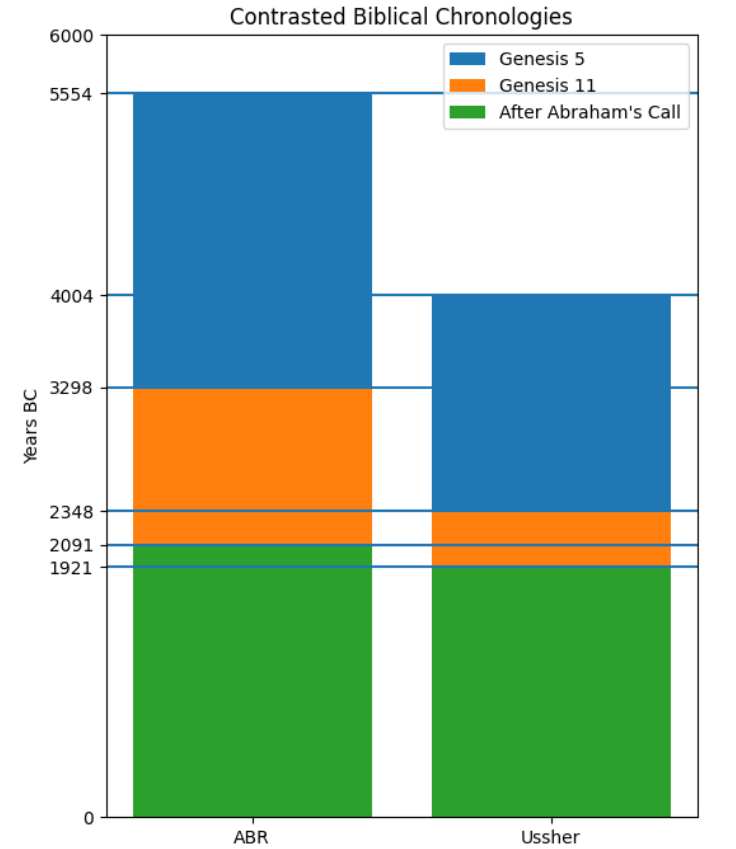
The following diagram compares the ABR chronology1 which prefers the LXX dates because it accepts the Rabbinic Deflation Hypothesis with James Ussher’s chronology2 which prefers the MT because it accepts the LXX Inflation Hypothesis.
______
- Henry B.. Smith Jr, The Case for the Septuagint’s Chronology in Genesis 5 and 11, International Conference on Creationism, 2018 for the Creation and Flood date and the chart at the bottom of the Genesis 5 and 11 Project page for the Call of Abraham date: Creation 5554 BC, Flood 3298 BC, Calling of Abraham 2091 BC ↩︎
- James Ussher, The Annals of the World, 1650: Creation 4004 BC, Flood 2348 BC, Calling of Abraham 1921 BC ↩︎
 Poetry, Short Prose and Walking