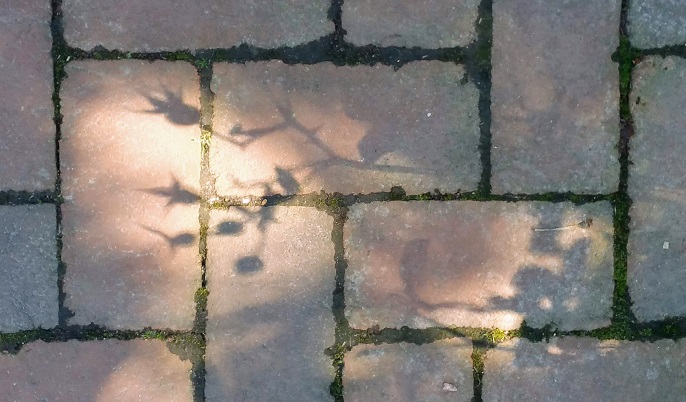
Dale offers the prompt “silhouettes and shadows” for this week’s Comic Photo Challenge. These are shadows on walkways.
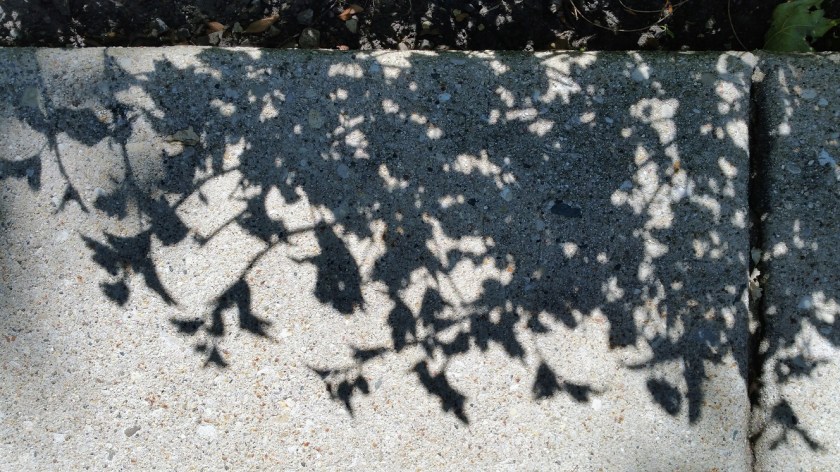

Dale offers the prompt “silhouettes and shadows” for this week’s Comic Photo Challenge. These are shadows on walkways.
I have been studying Biblical Hebrew primarily using the YouTube videos from the Aleph With Beth channel by Andrew and Bethany Case. The Bible Society in Israel offers the Hebrew Bible with a dramatized audio reading and dictionary. They have also translated the Greek New Testament into Modern Hebrew and made this available with an audio reading. One can add a column to compare two versions of the text. As an alternative, I have also used the Step Hebrew Interlinear Bible.
I recommend all of these resources if you are interested in learning Biblical Hebrew. If you have other resources you are using that you find helpful, let me know. I still have a long way to go.
My goal is to be able to read the Masoretic text found in the Biblia Hebraica Stuttgartensia without needing a dictionary. I am not there yet. Here is a song by Miqedem on Psalm 23 that I am trying to understand by hearing it sung without following along with the Hebrew-English text.
The Old Testament was written in Biblical Hebrew. Douglas Petrovich provided evidence that the Israelites possessed an alphabet centuries before Moses. If that’s true there is no longer a compelling reason to follow theories like the JEDP/Documentary Hypothesis which claimed that Moses could not himself have written the first five books in the Bible because he did not have the means to do so. Moses had what he needed to write those books and the Israelites were able to read them.
I used to think that Aramaic was the language Jesus spoke. However, Jeff A. Benner provided evidence that most of the New Testament was originally written in Hebrew which was also the language spoken by Jesus and his early followers. If that’s true then what we have today are translations of the Hebrew originals into Greek from which English translations were later made.
Some early form of Biblical Hebrew may have been the original “one language” (Genesis 11:1 KJV) spoken until the time of the Tower of Babel. For arguments for and against this, including Isaac Mozeson’s Edenics, see Bodie Hodge’s discussion of language before the time of Moses. Mozeson notes that many Jewish commentators see this one language as Biblical Hebrew. For further information on his view see A Garden of Edenics 2021.
Weekly Bible Reading: Daniel (Audio), Hosea (Audio)
24 Cheshvan, 5782, Chayei Sarah: Parashat Genesis 23:1-25:18; Haftarat 1 Kings 1:1-1:31
Commentaries:
David Pawson, Daniel, Part 46, Hosea, Part 47, Unlocking the Bible
Bible Project, Daniel and Hosea

Jim jumps about with wayward Jack.
They think they know the way to go,
but tend to graze where demons grow
who’ll watch them fatten then attack.
The Lord makes sure Joe doesn’t lack.
He’s led to pastures green and pure.
Through evil valleys he’ll endure
when led on paths of righteousness.
With oil anointed, fed, and, yes,
through length of days he’ll dwell secure.
Ronovan Hester offers the rhyme word “jack” to be used in an A line of a décima having rhyme pattern ABBAACCDDC for this week’s challenge. I am thinking of Psalm 23.


Joe tossed the letter into the box not as a keepsake but as one of those things he didn’t have time to sort through at the moment. More than two decades later while cleaning the basement he noticed the box and went through its contents. He found his father’s letter at the bottom. Reading it for the first time he realized his father was not scolding him in spite of their disagreements but rather offering him assistance should he need anything during that tense period when he decided to move away from the family home.
Having a rebellious son now of his own Joe understood what must have been going through his father’s mind. Although he and his family reconciled shortly after his move, it wasn’t until he read his father’s letter that he began wondering just how much of his past was lived under misconceptions of what was actually going on.
Denise offers the prompt word “keepsake” to be used in this week’s Six Sentence Stories.

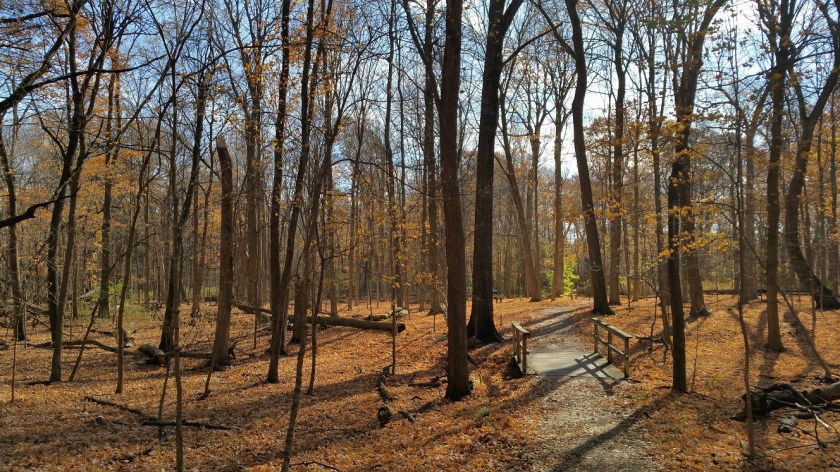
Dale offers the prompt “Autumnal Landscapes” for this week’s Cosmic Photo Challenge. These are scenes from last November at Allison Woods if I remember correctly.
And God said, Let there be lights in the firmament of the heaven to divide the day from the night; and let them be for signs, and for seasons, and for days, and years:
Genesis 1:14, King James Bible 1769
John Sanford and Christopher Rupe provide evidence that our galaxy is near the center of the universe in a paper at LogosRA. They write, “Astronomical data shows that the universe displays a striking pattern in its arrangement. Not only that, the universe may have a central position and it appears that our galaxy is at or very near it—far from what we would expect from a random, cosmic accident.“
Here is a summary of the evidence offered for that view.
On the fourth day of creation God created lights in the firmament for signs. Sanford and Rupe suggest: The universe’s countless galaxies may be designed for no other purpose than to be seen by us in these last days – so that it might be clear to all humanity that “The heavens declare the Glory of God…” (Psalms 19:1)
Weekly Bible Reading: Ezekiel (Audio), Daniel (Audio)
17 Cheshvan, 5782, Vayeira: Parashat Genesis 18:1-22:24; Haftarat 2 Kings 4:1-4:37
Commentaries:
David Pawson, Ezekiel, Part 44, Daniel, Part 45, Unlocking the Bible
Bible Project, Ezekiel (34-48) and Daniel
Reject deception. Walk in light.
Have fellowship and know what’s true.
Let’s show it in the things we do.
Don’t stumble through the dark of night.
Confess: we haven’t done what’s right.
We’ve stained ourselves repeatedly.
They ate the fruit. In turn are we
blocked from entering the garden.
Blood brings righteousness and pardon.
It cleanses. Jesus cleanses me.
Ronovan Hester offers the rhyme word “garden” to be used in a D line of a décima having rhyme pattern ABBAACCDDC for this week’s challenge. I am thinking of 1 John 1.

Tom could not see how to get from where he was to where he wanted to be. Nor did anyone have a suggestion outside of praying that he get well soon.
In desperation he resigned himself to whatever would happen hoping he could get his house in order before it did.
While sitting outside in the warm summer air Tom’s appetite returned and his death influenced fantasies left him. Within an hour and without any evident treatment to credit with the change he suddenly found himself where he didn’t think it was any longer possible for him to be. He got better.
Denise offers the prompt word “treatment” to be used in this week’s Six Sentence Stories.

Dale offers the theme “dusk” for this week’s Cosmic Photo Challenge. Here are two sunset views over the pond at Techny Prairie Park and Fields in Illinois.

We are in the year 5782 in the Jewish calendar. It represents the number of years since the creation based on the ages of people in the Bible. This would put creation in 3761 BC (that is, 5782-2021). However, others using various biblical texts calculated this differently. For Luther the creation occurred in 3961 BC. For Kepler it was 3993 BC. For Josephus it was 5555 BC.
Robert Carter gives reasons for these discrepancies in his Origins interview. At about 23:00 in the video he offers as an estimate 4220 BC as the year of Creation using the Masoretic text. This estimated date has a range from 3822 BC to 4339 BC. If that estimated date is correct, the earth would be about 6241 years old within a range from 5843 to 6360 years old.
Chris Hardy and Robert Carter present this in more detail in their article The biblical minimum and maximum age of the earth.
Given these estimates of the age of the Earth we can construct more detailed chronologies of when things happened. Those with competing chronologies can do the same with their estimates. The problem with having a very old estimated age of the Earth is that we also know rates of erosion or entropy. The older the estimated age, the more likely it will be falsified by some rate of decay. For example, a fossil cannot be older than the time it would take for erosion to wash the fossil away.
The Biblical account also provides the means by which the Earth (and universe) began. God was responsible through creation meaning there was an all-powerful intelligence right at the beginning.
Those who reject such a starting point need to come up with some plausible way for the universe that we see today to even be here. They need to provide a coherent explanation of a starting point and identify mechanisms for any evolutionary steps taking us from that starting point to our current state before entropy of some sort washes it all away.
Weekly Bible Reading: Ezekiel (Audio)
10 Cheshvan, 5782, Lech-Lecha: Parashat Genesis 12:1-17:27; Haftarat Isaiah 40:27-41:16
Commentaries:
David Pawson, Ezekiel, Part 42 and Part 43, Unlocking the Bible
Bible Project, Ezekiel (1-33)