Armed agents secured the area. The recovery team searched the abandoned store on the old road up the mountain range both inside and out.
Someone noticed the large, white graffiti-painted letters PHERE above the entrance, threw out the P, and asked for a ladder. What they were looking for was spread thinly beneath the paint. They carefully replaced the items with fakes.
I’d like to say these were the good guys, but if they were, why were they up there? Anyway I doubt they realized that they weren’t the first to find the stuff I hid there.
Barry had a handful of chickens on his tiny homestead in the woods which were a handful too many for his dog, Fred. Things might have turned out differently for the birds if they had not taunted Fred while he was chained to his dog house. They knew just how far his chain would reach and teased him until he lunged at them only to be snapped back by the chain.
Things also might have turned out differently, or at least gone on precariously, were it not for Barry taking Fred on walks far down the forest trail and then letting him off his chain to freely romp about in the trees.
Early one morning before the sparkling dewdrops vanished Fred dragged Barry further down the forest trail than usual. Barry’s hypnotic dreaming of what he would do if only he had a homestead as big as this beautiful woodland area popped like a forest faery fantasy when he watched Fred run back to take care of those pesky chickens.
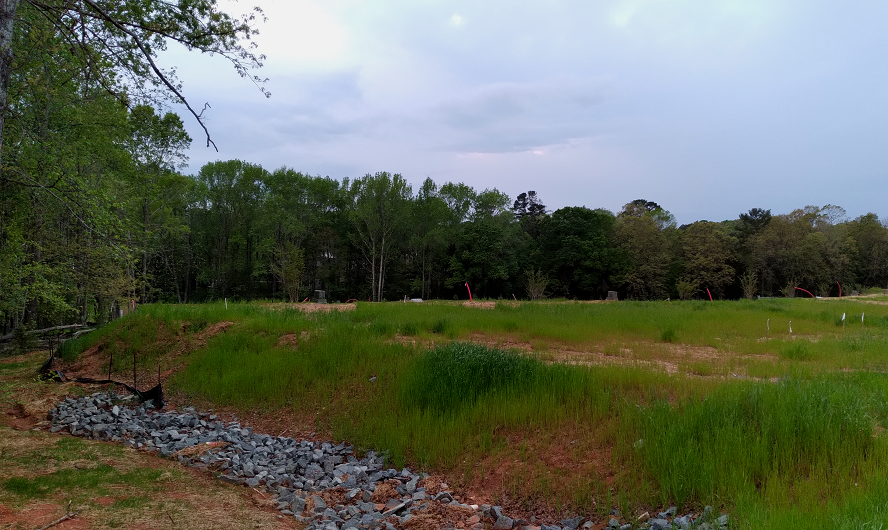
This is a spot where the sunset was very beautiful a week or so ago. However, tonight it was overcast.
The first view shows a residential construction area. The land is raised higher and some of the drainage system is in place. The second view is a bit to the right of it. The third view is to the left and shows the edge of a fenced in dog recreation area.
I am grateful to Chel Owens for selecting my free verse poem as the winner of the most recent Terrible Poetry Contest. The award winning poem and my attempt to explain it are below.
I told my shrink that the cops brought me here because of my bad driving and he said I had no record of ever driving a car in my life and I told him, not car, spaceship, S-P-A-C-E-S-H-I-P, and he said I had no spaceship and wasn’t an alien because my DNA test, D-N-A, showed I’m human enough and I told him, well, then why am I in that padded cell and he said I wasn’t in any cell and I asked him if he was trying to drive me crazy and if he was he wasn’t doing a good job of it and then he said I was brought in because I was scaring the neighborhood kids and the judge assigned me to him and I told him that I had a lot of fun turning my head 360 degrees like an owl and he said I couldn’t do stuff like that and I asked him whether he ever saw me and he said no and so I asked him if he wanted to see me turn my head 360 degrees and he said, “Sure, Marvin, go ahead turn your head 360 degrees like an owl, go on show me” and so I turned my head 360 degrees like an owl and he called the exorcist.
This poem is in imitation of Gerald Stern’s American Sonnets. These “sonnets” have no rhyme nor meter (and often no sense that I could detect). They are mostly one sentence long allowing the reader to put in line breaks or not. I would call them terrible American sonnets, but he won some award for them and they are occasionally entertaining.
This is a long post. It is more a set of notes to myself. You might want to skip it. If not, let’s go down the rabbit hole.
This is how I currently see the chronology of events represented by the traditions of Good Friday and Easter Sunday. You are welcome to set me straight in the comment section.
Yeshua (Jesus) fulfilled the sign of Jonah. He was in the tomb three days and three nights. (Matthew 12:38-41) That was the length of time Jonah was in the great fish. (Jonah 1:17) Hence we have a length of 72 hours, no more, no less. Clearly one cannot fit three days and three nights between Friday afternoon and Sunday morning. What we have are two full nights, one full day and two partial days.
Yeshua died on an afternoon and He was in the tomb before sunset on the Day of Preparation before the first day of Unleavened Bread, a special Sabbath. (Matthew 27:45-65, Mark 15:33-44, Luke: 23:50-56)
The women went to the tomb on the first day of the week, Sunday, and an angel rolled back the stone showing them that the tomb was empty. (Matthew 28:1-8) I used to think Yeshua rose with the rising sun on Easter Sunday. What I understand now is Yeshua rose on the late Sabbath before sunset, 72 hours after His burial, prior to the morning of the first day of the week when the women looked for him but found the tomb empty.
In summary, Yeshua could not have been crucified on a Friday. He was crucified on the fourth day of the week (Wednesday) in the afternoon as the Passover lambs were being sacrificed. His Resurrection occurred three days and three nights later on the Shabbat (Saturday) afternoon before sunset. Celebrations of Resurrection Day should focus on the setting sun, not the morning sunrise.
The Church of God, one Christian group that seems willing to give the Bible priority over Church tradition, produced a detailed Timeline from Passover (the 14th of Abib (Nisan)) to the Wave Sheaf Offering on the first day after the weekly Shabbat. The chart shows the parallel between what happened in Exodus with what happened in the Gospels. The only part of their timeline I suspect may not be correct is the year of the Crucifixion and Resurrection. They claimed it occurred in 31 AD. I am more convinced by Navah’s view that it occurred in 28 AD.
Why does this matter?
The neglect of biblical feasts and the rejection of the Shabbat suggests a cultural anti-Judaism that goes back before the time of Constantine when it became institutionalized Church tradition justified by attacking Judaizers.
However, the use of an alternate pagan calendar also suggests a drift into idolatry through compromise. People attacking this compromise sometimes point out that there is no need to rename Yeshua to something that sounds like JeZeus except to indirectly focus on the Greek deity Zeus.
To see the idolatry connection, Michael Rood gave an account of where Easter came from in his teaching on the Book of Esther (“Easter”, as he called her) (about 34:00 to 38:00). He talked about the tale of Nimrod who became the sun god upon death and Semiramis, his wife, who was impregnated by that sun god to give birth to Tammuz on December 25th where the Julian calendar put the winter solstice. He included the reincarnation of Semiramis as Easter from an egg landing in the Euphrates along with rabbits and a reference to Playboy since this is all about pagan fertility worship.
For more details on this, mostly in agreement with Rood but from a Church of God perspective, see Christopher Eames’ article, Easter – In the Hebrew Bible?
When I wonder how the Israelites could have fallen into idolatry, I think about the deviation of the Christian liturgical calendar from the agricultural calendar presented in the Torah. I am equally puzzled how that could have happened. The Israelites had to obey their judges or kings, but when prophets came to correct them, I suspect many figured what they were doing was close enough in their own eyes to be acceptable to YeHoVaH (God). That’s probably what I would have thought were I one of them.
Today I ask myself something similar: Are Easter and Good Friday close enough to the Passover, the sign of Jonah and the Wave Sheaf Offering to be acceptable to Yeshua even though we lose the significance of the events evident to early Messianic believers and risk participating witlessly in pagan ritual practices?
Not everyone agrees with the above. For example, Jonathan Sarfati of Creation Ministries International presented a detailed opposing view. He asserted that Easter is not of pagan origin and tried to fit three days and three nights between Friday afternoon and Sunday morning by counting partial days as full days.
Some want to promote an even further compromise of Christianity with paganism. For example, Rudolf Steiner, an Austrian occultist, presented a description of Good Friday and Easter from a pagan perspective. Here Christianity is just another religion in a cyclic calendar going from springtime rebirth at Easter to autumn anticipation of death on All Saints Day (after Halloween). This sentiment seems typical of what C.S. Lewis called Pantheism in the “Christianity and ‘Religion’” chapter of Miracles.
The reason to present the occult views of Steiner is to see how the pagan cyclic calendar contrasts with the biblical calendar of Leviticus 23 that reveals a direction to history. The biblical calendar identifies the appointed times of YeHoVaH (מוֹעֲדֵ֣י יְהוָ֔ה). These appointed times are more than annual holidays. YeHoVaH gave them to us to remember what He had already done to move history according to His will. For example, on Passover we remember the Exodus and now also Yeshua’s redemptive sacrifice in the Crucifixion. YeHoVaH also gave them to us to prepare for future events such as the Second Coming and the Messianic Kingdom with the Feast of Trumpets, Yom Kippur and Succoth.
Having an annual calendar with a divinely revealed direction through the years and not just a birth-death-rebirth annual cycle of nature makes the Messianic story unique and something far beyond the imagination of pagan religions.
What about the Passover Seder?
I am grateful to Geri Ungurean, a Jewish Christian, for mentioning the video below on her blog. The Last Supper as recorded in the Gospels and reenacted by the early Messianic believers may be the origin for the Passover Seder. Such a ritual would be needed after the destruction of the temple. Those at the table in the video were discussing such a view from Israel Jacob Yuval in his paper, “The Haggadah of Passover and Easter“. For those who want to know more about Haggadah see chabad.org, a Jewish site.
As I see it the Last Supper occurred at the beginning of the 14th of Abib, the day of Passover after sunset. After the meal they went to the garden where Yeshua was arrested. Before the end of the day with the coming sunset, Yeshua died and was buried. Yeshua fulfilled the Passover by becoming the sacrificial lamb.
At the moment I am concerned with reconciling Matthew 26:17 withJohn 13:1. Did the Last Supper occur after Passover on the first day of Unleavened Bread (Matthew) or at the beginning of Passover (John), the day before that? Justin J. van Rensburg translates Matthew 26:17 asAnd a former day of Pesach[Passover], the talmidim came and said to him, “In what place do you want that we prepare the Pesach?” which would resolve my concern if the Hebrew manuscript he was using from the Vatican Library is an authentic copy of the original Hebrew autograph.
Weekly Parashah Readings Parashah: Passover Day 8, 22 Nissan, 5782 – April 23, 2022 Torah:Exodus 12:21-51; Numbers 28:16-25 Haftarah:Joshua 3:5-7; Joshua 5:2 – 6:1; Joshua 6:27 Brit Chadashah:Luke 22:7-20; John 1:29-31; 1 Cor 15:20-28 Resources:Chabad, Hebrew4Christians,Weekly Torah Readings, Calendar
The snow kept piling on and on. The piles made by the snow plows went higher and higher. We thought we’d be buried in a glacier until uncovered by shocked archaeologists refusing to believe it as the evidence falsified everything they held dear.
That’s when spring came. That’s when we could credibly whine about global warming again. That’s when the snow melted.
As it did things we couldn’t find reappeared. All of this uncovered evidence falsified explanations we cherished about what happened to that missing stuff only a fool would have left outside.
Rochelle Wisoff-Fields offers the photo below by Dale Rogerson as the prompt for this week’s Friday Fictioneers.
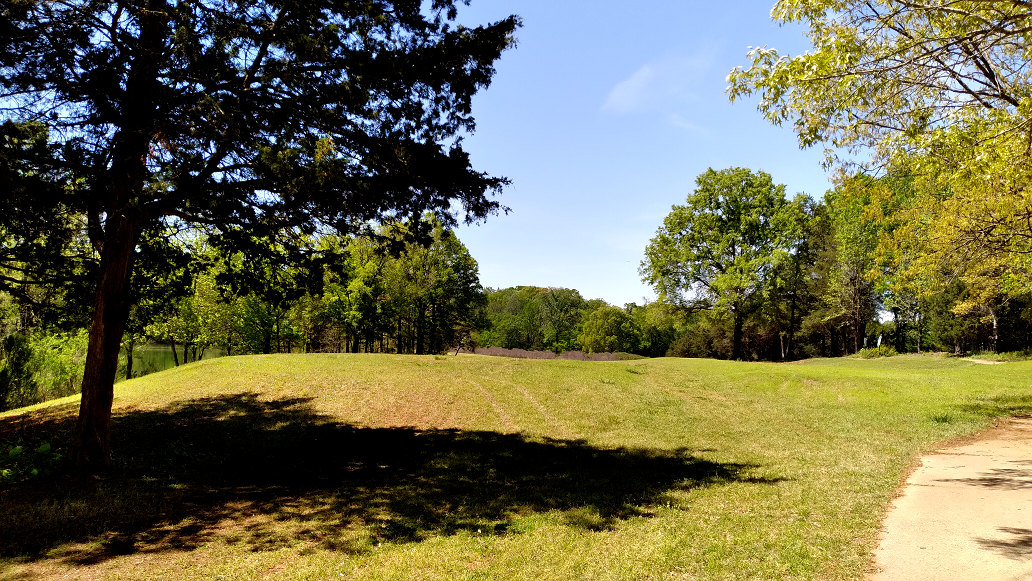
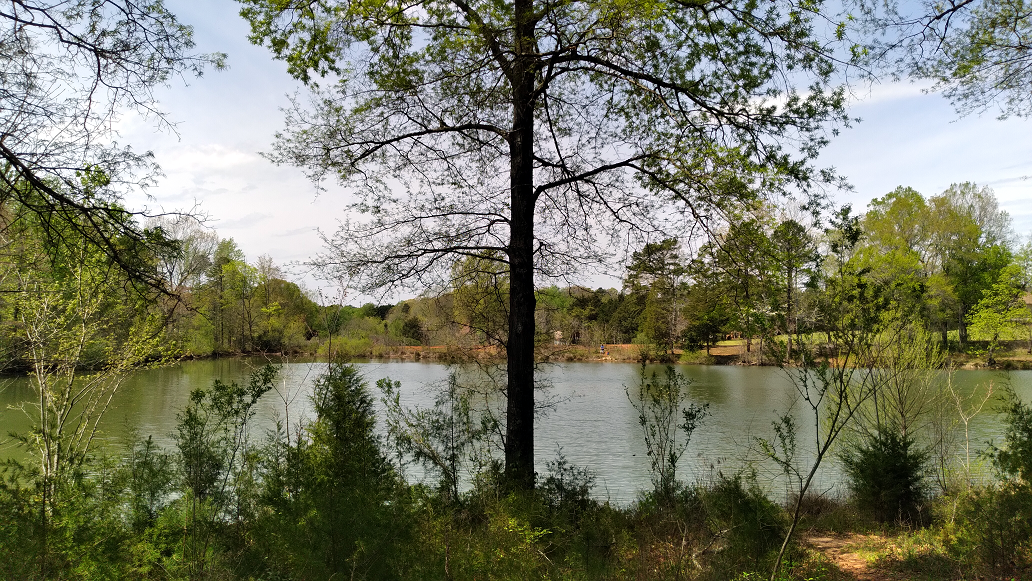
Jim waited for the gentle sounds of birds before getting out of bed. Later he walked through a park with tall trees and grassy slopes. Today he paused where the stream had been dammed to form a pond before crossing the bridge made out of wooden boards.
He knew this wasn’t yet heaven, but rather the beginning of eternity starting afresh each morning if he chose to persevere. Since he knew he had been healed he breathed freely in spite of the lingering manifestations of disease tempting him with doubt.
Jim indeed persevered crossing the narrow bridge of wooden boards powered by the gratitude of his praise.
In the photo above are three royal terns (plus the legs of two others) minding their own business on the shore and wondering if I would mind mine.
In the photo below there are two birds (perhaps seagulls) watching the sunrise. There is actually a third tiny bird (sandpiper?) to the left on the shore.
Both of these were taken in southern Florida some years ago using my phone.
If faith without works is dead, what are works without faith? Answers that come to mind are magic or manipulation. Rather than pitting faith against works perhaps we should aim to avoid both faith without works and works without faith.
That makes me wonder what the Greek word ἔργων or the Hebrew word מעשים might mean besides “works”, “deeds” or “actions”? Could one understand this as “faith without practice is dead” or “faith without exercising it is dead”?
Regardless, Audrey Mack compares faith to muscles. We all have muscles, but some of us are weaker than others. Muscles become stronger as we exercise them. So does faith.









 Poetry, Short Prose and Walking