With freeze and thaw of wintry woes some fear the still-life’s gonna die. Why spin the news so fast that I can see the lies beneath fresh snows?
There is the Lamb that heaven shows, the One who can unseal the book. The losing side will try to hook the world with sorrows. Persevere. The sea of glass and fire comes here with victory and praising. Look!
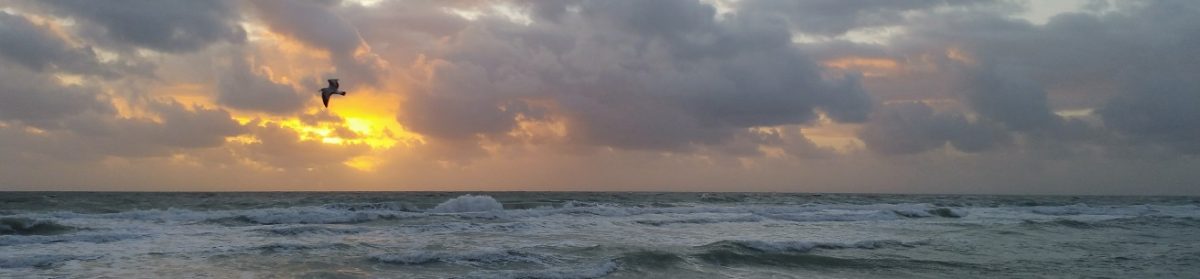
Stanley didn’t like to swim but living near the ocean he didn’t mind, should the Spirit lead him, to take a sunrise stroll along the water’s edge.
The huge quantity of water brought Noah to mind. “That’s where all the water went,” he told himself. Then he provided the explanation that mountains rose while deep sea basins formed to collect the runoff which carved canyons along the way.
When Stanley told others the story of the water no one believed him (except those who did). Perhaps to taunt him for telling the tale of its failure to drown the remnant in that boat, or perhaps to merely remind him what it could still do, the water lapped its waves upon the sandy shore licking off any trace of Stanley’s footprints.
We moved during the past year from Northbrook, IL, making a new start in Fort Mill, SC. These photos are from a month or so ago at the nearby Anne Spring Close Greenway.
Our entire last year was a blessing for which we are grateful. May each day be a blessing for all of you filled with gratitude and praise.
A tiny trinket out of jade deceptively was smoothly made. I bought it. Why? I do not know. My dreaming mind said let it go. I wonder now how much I paid.
It didn’t require a visa to get where Pete went only a willingness that none of us had to go through that unpromising hole-in-the-wall. Perhaps some of us should have gone with him to point the way back, but we didn’t care that much what happened to him so long as whatever it was didn’t happen to us.
Today decades later and buried in memories our delightful destinations reached their dead-ends. Admittedly we knew this would happen, but we didn’t think it would happen in next to no time.
Pete told us to come along, but were we still welcome in spite of demonic reminders that we were not? Was the breath that coughed its way through our lungs evidence that there was still a bit of mercy left even for the likes of us?
In an attempt to make conversation, or perhaps scare away snakes that might be sunning themselves on the trail, Stephen said to Dale, “What makes deception work is all that true enough sky-is-blue stuff that serves as the delivery vehicle for the poison we don’t know we’re being fed.” He then added the next thing that popped into his head, “Of course, we only think others can be fooled so we happily open our mouths.”
Unwilling to follow just any non-sequitur where it leads, but also unwilling to remain unsociably silent, Dale countered, “Things haven’t changed much since that snake messed with Eve.”
Meeting the challenge Stephen observed, “You can tell by the cautious way the snake phrased its words that it was worried Eve was going to bite its head off if it made a wrong move.”
While pointing out the direction where the trail forked Dale noted, “She did want that lame excuse to eat forbidden fruit.”
Since this was Stephen’s first time on this twisted trail he only added by way of conclusion, “But after they took those bites—surprise!—they and that snake had plenty of other things to worry about.”
______
Denise offers the prompt word “Surprise” to be used in this week’s Six Sentence Stories. Associated with these prompts is a YouTube Channel, Two Guys and a Girlie, discussing the writing of these stories featuring Clark, Nick and Denise streaming live on Sundays at 2:30 PM EST.
If you want to read the brief dialogue between Eve and the serpent to see how far I’ve gone off the trail see Genesis 3:
Scrooge, the knot tier, saw threads come apart and got busy. Unfortunately the threads didn’t like the way he thought best to tie them together so they slipped through even the toughest knot Scrooge knew how to tie.
Meanwhile a prophet passed by and told Scrooge that he wasn’t anointed to tie knots. Frustrated with the threads this further bit of abuse pushed Scrooge over the edge triggering him to ask the prophet what exactly did anointed mean and what exactly does this prophet think Scrooge was supposed to be doing anyway instead of his own job tying knots?
Considering the unraveling state of the world prophets are very busy nowadays. He had no time to waste giving Scrooge any further word than “Merry Christmas!”
______
Denise offers the prompt word “knot” to be used in this week’s Six Sentence Stories. Associated with these prompts is a YouTube Channel, Two Guys and a Girlie, discussing the writing of these stories featuring Clark, Nick and Denise streaming live on Sundays at 2:30 PM EST. The next episode will be on January 1st, 2023.