When George saw his simple-minded companion, Bart, go through the narrow entrance way showing George how to squeeze in if he bowed down a bit (actually quite a bit) George realized he wouldn’t fit, at least not with all the baggage he had. After yelling at Bart to come back, calling him an idiot for going through that hole in the wall, and seeing its door close George gave up on his companion as lost.
Later in the evening George saw Bart through a bright window at the very wedding feast they were both originally planning to attend. He went back and found the door banging on it after he, George, of all good and worthy people, was refused admission by the doorkeeper.
His complaints turned into weepy indignation which George alternated with teeth gnashing, a futile rebellion at this point. The fire burning inside him synchronized with the growing darkness as he uttered ineffective curses against those at the wedding feast, a feast he declared he wouldn’t attend now if they paid him.
Denise offers the prompt word “lost” to be used in this week’s Six Sentence Stories. I was thinking of Luke 13.
The geologist Michael J. Oard is writing a multivolume account of the Earth under a biblical creationist perspective. The chapters of his first volumes are freely available on Flood/Ice Age Research for download. The one I have been reading is Earth’s Surface Shaped By Genesis Flood Runoff. This volume gave me an introduction to geology and the philosophical presuppositions surrounding the science.
In the 18th century the narrative of the catastrophic global flood in Genesis 6-9 was replaced by a narrative presuming that uniformitarian processes visible today along with local catastrophes operating over deep time shaped the Earth into what we now see. The problems are these uniformitarian processes are low-energy while the permitted, non-global-flood-like catastrophes are not large enough. All they are able to do is erode away how the Earth is currently shaped.
Does it look like a catastrophic, global flood formed the present geological structures?
Yes, it does. For example, given wide and high plains (planation surfaces) all over the globe with hard, rounded gravels like quartzite transported hundreds of miles on top, the global flood would provide the high energy water force over a large area needed to accomplish that. See Chapter 27. Rivers or local floods do not have the power or width to deposit these gravels or smooth that surface.
Could this have happened only a few thousand years ago?
Yes, it could have. For example, given current measured erosion rates, the formations we now see can not be very old. See “erosional remnants” in Chapter 9. These are structures like Devils Tower in Wyoming or Ayers Rock in Australia. They were once buried in sediment. How long ago could that have been? Given current erosion rates, in 10 to at most 50 million years the entire continent would be flattened to sea-level from typical erosion one sees today. So these structures could not be older than that. But one can reduce that age further. Based on the debris at the base of Devils Tower, the events exposing the formation should have completed less than 10,000 years ago. If someone should claim it is older, where is the debris that would have fallen over that period of time? Why is Devils Tower still standing?
Should one find a fossil allegedly hundreds of millions of years old all that means, given present erosion rates, is that there is something wrong with whatever dating method was used. Those deep time dates are not consistent with present erosion rates. See Chapter 35.
Once we reject the uniformitarian detour taken in the 18th century we can start asking the right questions about why the Earth is shaped the way it is.
Weekly Bible Reading:Micah and Nahum Commentaries: David Pawson, Micah, Part 52, and Nahum, Part 53, Unlocking the Bible Bible Project, Micah and Nahum Weekly Torah Readings 16 Kislev, 5782, Vayishlach: ParashatGenesis 32:4-36:43; HaftaratHosea 11:7-12:12
Through cold gray clouds the sun still beams on soundless white and frequent fear. That was a wintry time of year when what was bad went to extremes.
Till Judgment comes demonic schemes of wickedness rehearse their coup, but there’s still time. May hearts renew, return, repent, refrain and learn to let the Spirit help discern the flaws in stuff we thought was true.
Ronovan Hester offers the rhyme word “learn” to be used in a D-line of a décima having rhyme pattern ABBAACCDDC for this week’s challenge.
Greg told his three friends sitting with him in a booth for lunch that he had peeked out from under a cultural blanket of deception, a demonic snow job, that had covered him for decades. They listened politely amused by the stuff he came up with knowing he’d be over with his revelations shortly.
It’s not that he had been right often before. Generally he got things wrong especially when he offered health tips for losing weight. But he seemed pretty sure about what he had seen.
That they thought he was nuts only confirmed Greg’s suspicions, which he tactically kept to himself for the moment, that the cultural deception he experienced had disarmed them as well.
Denise offers the prompt word “blanket” to be used in this week’s Six Sentence Stories.
These are old photos. I wonder why I keep using them. In the photo above, the detailed textures of the footprints remind me that, being made in the image of God (Genesis 1:27), we are a distinct and separate creation from anything else that God created. For example, we are very proficient at speaking and understanding words. We are not silent and our words express moral power through blessings or curses.
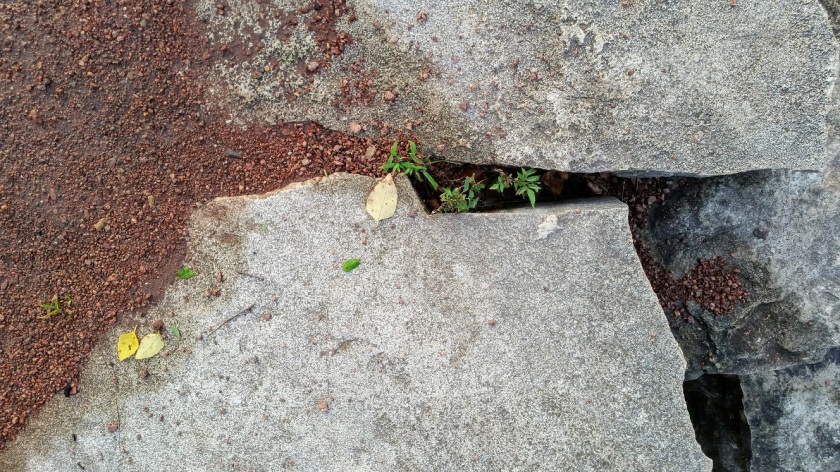
In the photo below the textures of the white stone, red gravel, dark cavities, green vegetation and fallen leaves presented together seem to have enchanted me. I’m glad Eugenia offered the word “enchanted” for her Thursday Prompt which gives me an excuse to describe them in that way.
Being enchanted, however, suggests to me on the negative side being “manipulated”, “deluded”, or “under a spell of words”. Having been under many I am wary of enchantments. I wonder: Why am I so fond of these photos? To avert any harm, if they seem enchanting to you, may they also be blessings.
Although I mainly remember that Jonah was in a great fish (whale as I heard it told) for three days, David Pawson noted that there were eight miracles recorded in the book. He further claimed that if you believed any one of them you might as well believe the other seven.
Although I find the story of Jonah to be rather humorous, I realize that the prophet Jonah son of Amittai was an historical figure mentioned in 2 Kings 14:25 and the events were not recorded to make fun of him. The only sign Jesus said He would give was the “sign of Jonah” (Matthew 12:38-41), that is, His Resurrection after being dead for three days.
Here are the eight miracles that Pawson listed.
God sent a wind when Jonah fled in the boat. (Jonah 1:4)
The sailors cast lots to find who was responsible and God made the lot fall to Jonah. (Jonah 1:7)
After they threw Jonah overboard, God calmed the sea. (Jonah 1:15)
God sent a fish to swallow Jonah. (Jonah 1:17)
At God’s command the fish vomited Jonah alive onto dry land. (Jonah 2:10)
God provided a plant to shade Jonah in one day. (Jonah 4:6)
God told a worm to eat the plant the next day. (Jonah 4:7)
God sent an east wind with a hot sun to torment Jonah. (Jonah 4:8)
What makes all of these events miracles is that each event explicitly involved an action by God. God sent that wind. God told a worm and a fish what to do. It was not that the wind blew by chance. It was not that the worm just happened to be nearby and hungry. Explaining the miracles with naturalistic explanations that do not involve God’s action would not be explaining them as they were told in the book.
Since the naturalist, and likely the deist as well, rejects God as a cause, the naturalist would have to reject all eight of these miracles. I would expect the naturalist to dismiss the entire book as myth.
Others who do accept, say, the east wind blowing since God sent it might as well accept the part about the fish that God sent, because ultimately they would be expected to believe the truthfulness of the “sign of Jonah” that Jesus referred to: Jonah died and three days later came back to life.
Rebelliousness will find its fall. Self-righteousness will show the way deceived deceivers go astray. They think they’ve won, but lost it all.
On wayward paths some hear His call and follow giving up their pride. The faithless seek a place to hide. The leaves descend upon the land and snowy winter takes a stand. The warmth’s for those who went inside.
Ronovan Hester offers the rhyme word “pride” to be used in a C line of a decima having rhyme pattern ABBAACCDDC for this week’s challenge.
Jeff knew from personal experience that he was not only up against human beings although they were the evident ones attacking in the field so much as their demonic manipulators. It was still possible for those human adversaries to flip and become allies, but no chance at all for the demons to do so.
The manipulated, however, didn’t believe in demons and pursued Jeff with extreme prejudice.
If it were as easy as taking a red pill Jeff would have taken one himself when he was under their influence. Today if someone offered him such a pill he’d wonder whether it contained the very witchcraft that caused the war in the first place. As he put on his armour that morning, his last morning as it turned out, he was grateful that he was still found useful in spite of all he had done wrong.
Denise offers the prompt word “armour” to be used in this week’s Six Sentence Stories. I was thinking of Ephesians 6, but you are welcome to imagine these manipulators as zombies, aliens, rogue robots, or some other symbol of the demonic.

















 Poetry, Short Prose and Walking