Not having made a meme before Richard searched the internet for tools that would make one for him. Finding a few he sniffed his nose at he decided to do it the hard way and write his own code.
That exercise kept him merrily preoccupied for weeks. Once he figured out which package to use and which options to apply he realized how smooth as silk easy it was to put words and images together.
With all that procrastination out of the way Richard ran up against a problem even an internet search couldn’t answer. He couldn’t think of anything snarky enough to give him a wicked giggle that wouldn’t eventually make him regret he posted the meme in the first place.
______
Denise offers the prompt word “silk” to be used in this week’s Six Sentence Stories.
The first photo was taken along a rural road in northwestern Indiana near the farm where I grew up. This is an agriculturally productive land out in the country where corn, soybeans and hay are raised on nearly fat fields.
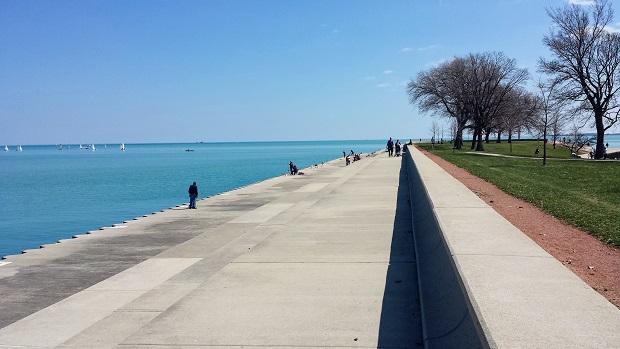
The second photo is from a park in Colorado Springs providing a view of the mountains. In the distance is Pikes Peak. In the middle of the photo, if you know what you’re looking for, you can see the upright sedimentary rock formations known as “Garden of the Gods”. This is country also, but more mountainous than that in Indiana.
Spring Storm, Northwestern IndianaPikes Peak from Colorado Springs
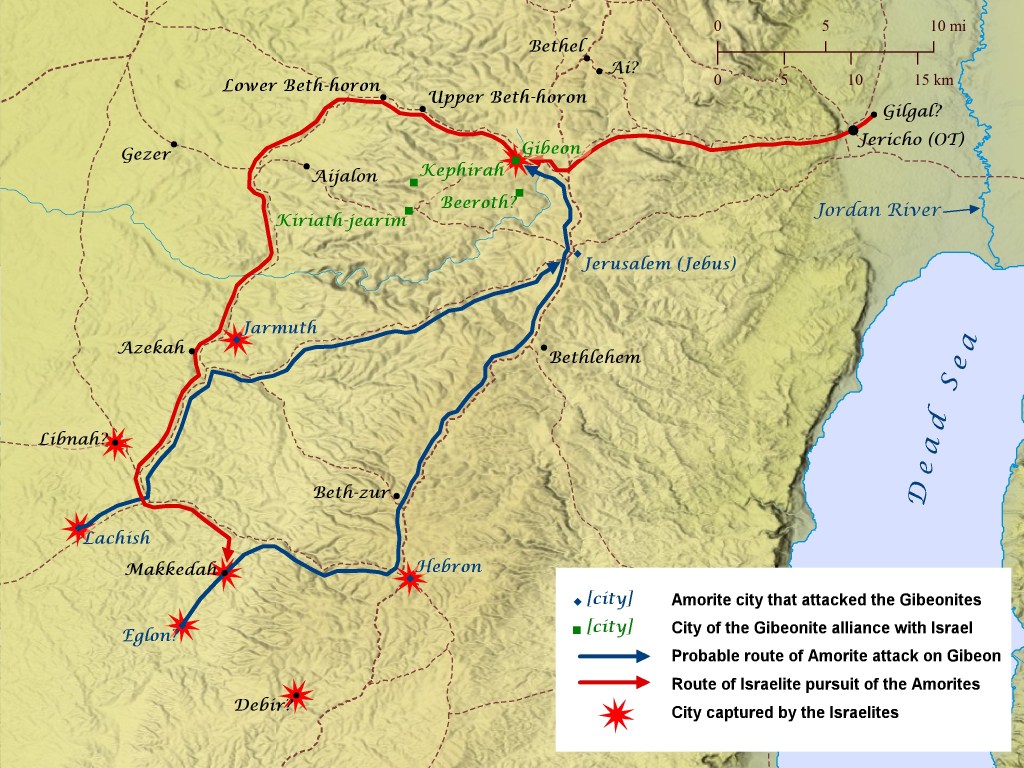
9 Joshua therefore came unto them suddenly, and went up from Gilgal all night. 10 And the Lord discomfited them before Israel, and slew them with a great slaughter at Gibeon, and chased them along the way that goeth up to Bethhoron, and smote them to Azekah, and unto Makkedah. 11 And it came to pass, as they fled from before Israel, and were in the going down to Bethhoron, that the Lord cast down great stones from heaven upon them unto Azekah, and they died: they were more which died with hailstones than they whom the children of Israel slew with the sword. 12 Then spake Joshua to the Lord in the day when the Lord delivered up the Amorites before the children of Israel, and he said in the sight of Israel, Sun, stand thou still upon Gibeon; and thou, Moon, in the valley of Ajalon. 13 And the sun stood still, and the moon stayed, until the people had avenged themselves upon their enemies. Is not this written in the book of Jasher? So the sun stood still in the midst of heaven, and hasted not to go down about a whole day. 14 And there was no day like that before it or after it, that the Lord hearkened unto the voice of a man: for the Lord fought for Israel. Joshua 10:9-14 (KJV)
There are two kinds of explanation of what happened at the conclusion of this battle that I don’t find satisfying: (1) claims that the miracle involved the sun ceasing to move across the sky, and (2) claims that the avenging process could have occurred naturally. I am looking for a miraculous explanation that is relevant to what Joshua likely wanted to accomplish.
When people today say the sun moves across the sky they mean the earth rotates. The sun only appears to move from the perspective of our activity on earth. Because the sun appears to move at a regular rate, we can use it as a clock to estimate how long something took.
Bernard Ramm described various explanations for the sun appearing to stand still in The Christian View of Science and Scripture, 1954, pp 156-161. He found three that he was willing to accept preferring the third.
Poetic: “The cry of Joshua was then a cry for help and strength. His cry was answered with renewed vigor in his soldiers who then fought so valiantly and were so refreshed that they did a day’s work in half a day, and it seemed to them that the day had actually been lengthened.” (page 157)
Mirage: An unusual atmospheric refraction made it seem as if there were an extended amount of light.
Overcast Sky: Believing that what Joshua really asked for was darkness not a longer day, the hailstorm, mentioned in Joshua 10:11, that had already killed many Amorites while they fled from Beth-horon to Azekah continued to cool off the Israelites from the day’s heat helping them fight more effectively.
John Walton approached the problem as a misunderstanding of an ancient text. His view is that Joshua’s intent was merely that the Amorites be psychologically disadvantaged in seeing the positions of the sun and moon as a bad omen. Although I am suspicious of this theory, it does make a good point: Whatever Joshua asked for he likely wanted it to benefit the Israelites and harm the Amorites.
One doesn’t get such selective treatment that favors only the Israelites by asking for a change in the environment. Environmental changes such as a mirage of light to lengthen the day or clouds to shelter one from the heat would also aid the Amorites. They, too, would cool off. They would have more time to escape to walled cities. So these environmental explanations should be put aside including views that the earth or even the sun actually stopped moving.
If that’s correct about Joshua’s intent, and we choose to take a traditional reading of the text rather than Walton’s, then only Ramm’s poetic option remains. However, this explanation, as Ramm expressed it, suggests that Joshua somehow motivated his men to overtake the Amorites before they reached safety. While that might help, it would not give us a day such that “there was no day like that before it or after it, that the Lord hearkened unto the voice of a man: for the Lord fought for Israel” (Joshua 10:14).
The good thing about the poetic explanation is that it shows a way for the sun to appear to stand still. If we felt the Lord overwhelm us to the extent that we moved faster than we knew we could have moved on our own, we might be inclined to think that the sun stood still while all that happened. The sun would be a confirmation that something miraculous had happened within us.
For this to be satisfying as an explanation, I need to clarify what such a miraculous overwhelming by the Lord might look like.
Before I describe what I think happened, especially since I could be wrong, we should keep in mind the advice from the Got Questions site: “While we may not fully understand how this “long day” occurred, a miracle does not have to be scientifically proven—just accepted.”
______
The Holy Spirit Explanation
After the Amorites fled and suffered losses from hailstones all the way to Azekah the sun appeared to stand still only for the Israelites. They alone were overwhelmed by the Holy Spirit. This gave them the power to avenge Israel against the Amorites. For a brief period of time as measured by the sun, but a whole day as measured by the normal bodily movement of the Israelites, the Lord as Holy Spirit filled them allowing them to rapidly overtake and avenge themselves on the fleeing Amorites.
______
UPDATE October 5, 2023
Although they are not described in terms of the sun standing still there are other passages in Scripture where the Lord assists people to perform tasks much faster than others could have done them. Here are two:
Eileen, troubled as many of us are, was seeking never to be the same again as she watched dozens of people, some very old and some very, very young, fall and laugh overwhelmed by the Holy Spirit during the revival meeting. She knew this would not happen to all attendees since some understandably felt no zest to embarrass themselves in public in front of video cameras, but she wondered if it might happen to her in spite of her sitting in the middle of a row far in the back of the auditorium and in spite of her troubles.
The revival leader said he was looking only for those the Spirit showed him were ready as he walked the aisles. When he called her she nervously edged her way past the lukewarm spectators sitting next to her to get to the aisle knowing that—yes!—she, too, was going to fall and—yes!—she, too, was finally going to laugh.
Eileen raised her hands in praise, unnaturally fell backwards fearlessly into the arms of a catcher and laughed without restraint on the floor. Although decades later she would have proof, while lying there full of joy she already knew she would never be the same again.
At first I wondered if my cheap phone could take such photos. So I focused in on the traffic in the street and moved the phone while clicking the photo button. After a few tries I got something like the first photo.
That gave me encouragement. So I took a bunch more.
The second photo contains Venus and Jupiter, top right, in the early evening sky. They show up better when they’re blurry. The building and traffic in the first photo is down on the bottom left of the photo.
Steve looked at the sunrise letting his mind wrap his preconceptions around what he saw. He was no longer a pagan rationalizing this burning ball of hydrogen as a pantheistic spiritual entity. Nor was he ever an atheist seeing naturalistic stellar evolution in play rather than the greater light created by God to rule the day.
Taking Einstein’s relativity seriously he stipulated that the one-way speed of light from the sun to him was instantaneous. This forced the one-way speed back to the sun to be half the speed some might want it to be who preferred their own preconceptions to help them get lost in the addiction of deep time.
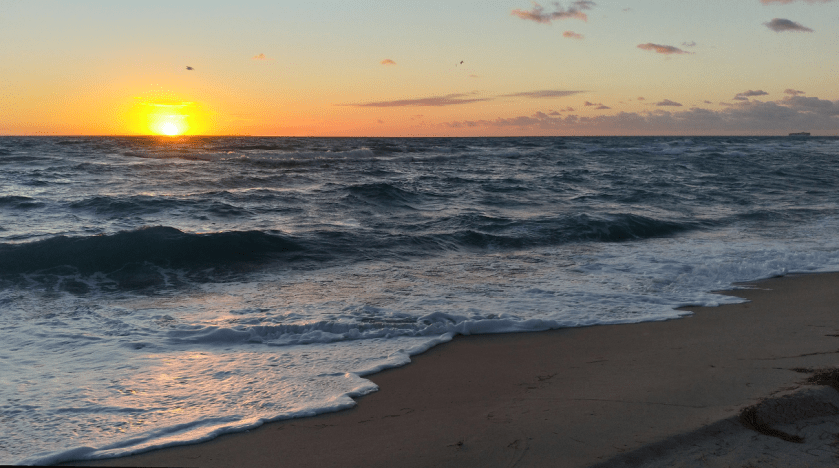
With that taken care of Steve watched the birds originally created on the fifth day watch the sun rise over the catastrophic flood waters that drained off over five millennia ago to become the Atlantic Ocean.
______
Denise offers the prompt word “wrap” to be used in this week’s Six Sentence Stories.
If the story makes no sense, I’ve been reading Jason Lisle’s 2010 presentation of the anisotropic synchrony convention and a 2018 modification of it by Tenev, et al.
After their last doctor visits Jeremy and his wife, Felicity, planned a series of trips across the country. They went from their children’s homes to those of other family members to friends making sure to mark the date so they would not forget to attend Sunday Mass wherever they were. They saw baby alligators lie on mama alligators’ backs in the Everglades, fancy roosters wander the streets of Key West, cold Alaskan glaciers, deep Arizona canyons, Rocky and Blue Ridge mountains and wide expanses of oceans with turtles, birds and seashells.
Some noticed the medications they were taking while others wondered about their talk of checking off items on their bucket lists. Regardless, they could be counted on to visit when there were births or weddings and to offer consolation at funerals leaving those they visited overwhelmed with peace.
In spite of the medications and bucket lists Jeremy and Felicity beep bopped around the country for another thirty years and the Lord visited them every day putting at the top of their list those who most needed to see them next.
______
Denise offers the prompt word “date” to be used in this week’s Six Sentence Stories.
Romans 10:13 – “For whosoever shall call upon the name of the Lord shall be saved.” (KJV)