The easiest temptations to resist are those you have trained not to arise.
Linked to Linda G. Hill’s One-Liner Wednesday.

Short prose
The easiest temptations to resist are those you have trained not to arise.
Linked to Linda G. Hill’s One-Liner Wednesday.
Even a thick, stone wall can have an opening letting light through like a window with a rock-hard frame. Outside our window two cars stopped. The front car was undamaged. The front bumper of the rear car, however, hung almost to the ground which made the accident look worse than it was.
Standing on the grass a sixteen-year-old girl watched an older woman, the driver of the front car, examine the damages. Her brother stood by her side ready to act if there was anything he needed to do, but there wasn’t much he could do.
A third car arrived. A second woman stepped out and the two adults talked. The second woman gave the first her insurance information and then she walked to her daughter. One could sense the daughter’s tears hiding behind her eyes and deepening frown. I imagine she wanted to know what was so wrong with her that she could have unintentionally and unexpectedly damaged her family.
Her mother’s arms opened and wrapped themselves around her daughter. Now we all have these openings, if we want to use them, but sometimes, perhaps because the fairy tales we tell ourselves aren’t real, we do not think we do. Anyway, without demanding an explanation, the mother emptied the tears hiding in her daughter’s heart through the opening of her own.
Linked to Sue Vincent’s #writephoto Sight. She provided the photo for the prompt.

Smiling turns the brain right-side up.
Linked to Linda G. Hill’s One-Liner Wednesday.
Big stuff can’t exist without small stuff. Don’t get stepped on.
Linked to Linda G. Hill’s One-Liner Wednesday.
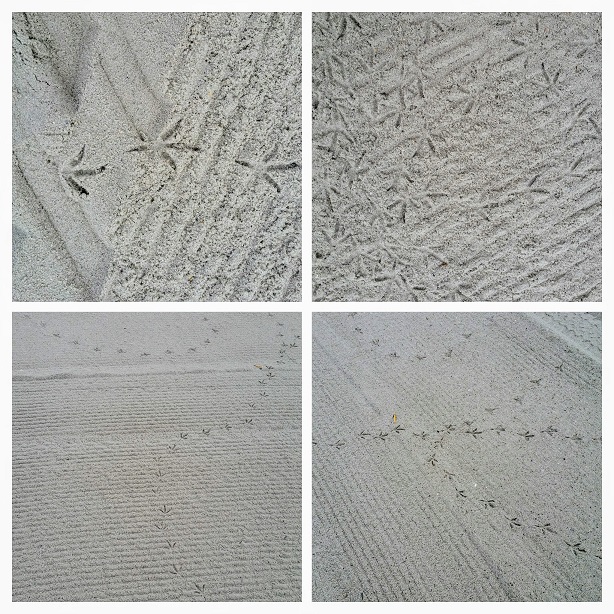
Birds line up near the water’s edge to watch the sunrise on the beach. So do a few people although not in such nice lines. Workers collect garbage from trash containers. Others drive tractors smoothing the sand roughed from yesterday’s play. Unintentionally they make raked Japanese Zen gardens, but without the stones. They are so perfect they need delicate footsteps. So much order also wants to be beautiful.
BIRDS OBSERVE THE SUN
ROUGH WAVES SOOTH THE WINTER SHORE
WALK THROUGH FRESH RAKED SAND
Linked to dVerse Haibun Monday. Victoria C. Slotto is hosting with the theme Wabi-Sabi, the art of imperfection.
Photos: “Sunrise Watching” above and the collage “Bird Tracks on the Beach” below both by the author. These are linked to K’lee and Dale’s Cosmic Photo Challenge with the theme “Birds and Bees”.
Come join us with your photos and haibun!
When harsh winds blow some whine, “How the wicked wind oppresses me!” Others wonder how they could make money off that wind by grinding grain or generating electricity. One turns it into poetry. The other turns a profit.
The Little People dwelt in the windmill. Like everyone they loved good stories. The Big People owned the mill. They tolerated the Little People because they bravely fought the Hungry Mice who wanted the grain as much as they did. “Get your own grain!” the Little People shouted. As a reward the Big People let the Little People have enough for their needs and internet connections.
Everything trended nicely, but the problem with trends is people forget once something goes one way long enough that it could go the other way. So most everyone confidently predicted everything would stay the same and every time it stayed the same their predictions came true. True, there were some who feared the end was always near, but that’s how their minds trended and they were usually wrong.
One day Wicked Wind joined Raging Fire and burnt whatever was dry including the windmill. The Big People were no longer big. They looked little and the Little People had no home. Even the mice were unhappy.
Illnesses popped up out of nowhere. The mice were blamed. The homeless Little People were blamed. The formerly Big People were blamed. The poetry and stories went dark and conflict trended.
The mice, who could not access the windmill, quickly recovered. Meanwhile the wind stirred the People mixing the big with the small as their generations sailed through birth and death until they rewrote their stories and survived.
Linked to Sue Vincent’s #writephoto Sails.
Photo provided by Sue Vincent.
While looking back at Jilly’s 28 Days of Unreason, I think this post fits Day Six about the “violent wind”.
Keep tossing deep thoughts into the well. Eventually one will sink.
Linked to Linda G. Hill’s One Liner Wednesday.
I don’t think the brain wants coffee as much as coconut oil. I put a large tablespoon of it in my coffee each morning. I know that sounds gross, but milk is just as gross, if you pause briefly to think about it, and don’t get me started on what coffee shops do with whipped cream. I prefer coffee strong and black in a real mug, but the brain doesn’t only need coffee to see straight.
Truly true stories don’t have bad guys. There aren’t as many out there anyway who want to feast on us like we feast on whatever we can. It’s not that there aren’t bad guys, people who, even with the gates open, even with there being no gates, even with there being no outside, feel unworthy to enter paradise. It’s more like we need some coconut oil in our coffee to see them better.
I take for granted that the Sun will rise in the morning. Is that because the Sun or the Earth loves us? We don’t like to think so, but what we like to think doesn’t matter when it comes to reality. Besides, we will abandon them before they abandon us. If I were the Sun, or the Earth, I would love to indiscriminately scatter crumbs to whomever was out there, good or bad, like an offering.
Some people drink coffee out of the skin of an avocado–or so I’ve heard. That drink must be hard to hold. All they’re lacking to make a really bad mess is whipped cream.
Linked to Jill Lyman’s Day Two post in the series 28 Days of Unreason based on reading Jim Harrison’s Songs of Unreason. The theme is about the Sun forgetting to rise.
Photo: “Rising Sun” by the author
Bernard lived with his aunt, a widow without children, for the spring semester of the third grade. He was familiar with his aunt’s home where she held Christmas Eve parties late after Midnight Mass. His parents enrolled him in the nearby parish school.
His aunt would send him on errands to the grocer. On his first errand he brought back a loaf of bread, among other items as requested, and his aunt frowned. “See how you’ve pressed this loaf? It is ruined. How can I toast it? You think my money grows on trees! You’re selfish!” On future errands he paid special attention to the bread.
Realizing Bernard didn’t have a rosary, his aunt gave him one. She pointed out the five sets of ten beads for the Hail Marys separated by a bead for the Our Father. She explained the three sets of five mysteries that one had to think about when reciting the prayers. Although eager to learn and fascinated with the beads’ magic, Bernard was confused. He had more questions than his aunt had time for. One night he walked into her bedroom holding the rosary. “I don’t know if I skipped one. My fingers slipped. Does it count? Do I have to start over?” She told him to go back to bed and not bother her. The next day he was sent to the rectory after school.
In the rectory Bernard was told that his aunt wanted the priest to talk to him about “scruples”. Bernard was embarrassed and he didn’t remember what the priest said, but this was his first realization that the magic was very deep. Over the decades he came to understand that it was not just Catholic or Buddhist rosaries or Hindu mantras. The magic included every single word humans said or even thought to each other. He looked back on that five-minute visit with a parish priest as a life-changing miracle.
After that semester, his parents took him back to his old school. The parties at his aunt’s stopped. In a few years, his aunt moved to a drier climate for her health. He did not see her again, except unexpectedly once many years later when Bernard rented a house with five other graduate students.
As Bernard was heading toward the kitchen, he saw the top half of his aunt appear about ten feet in front of him. She was walking away as she turned to him. Her words appeared in his mind: “I’m sorry.” What could she be sorry for? Bernard remembered the deformed bread. He mentally thought, “It’s OK.” She vanished.
Three days after seeing his aunt, his mother called him. She told him his aunt died a few days ago. They were just informed. His aunt did not want his father to drive the distance to the funeral and what little she had she left to the church.
Bernard told his mother that his aunt appeared to him. He didn’t tell her about his aunt’s message. He never told his parents about that damaged loaf of bread and he didn’t want them to think badly of her now. Simply saying he saw a ghost would be enough of a shock and maybe worth a joke the next time they met. He didn’t mind. He was too old to be sent to the priest.
I met Bernard when he was retired living in a high-rise condo. Looking out the window at a party, we saw two pigeons playing like children over the tops of houses as the sun set deepening the shadows. They reminded him of his father and his aunt, now both deceased. He found it hard to imagine either of them as children although now he had no problem imagining them as birds. It occurred to Bernard that maybe his aunt’s message wasn’t for him but for his father, her brother, and he failed in his task that day to pick up the phone and tell his dad that he should give his sister a call.
After hearing this story from Bernard, I teased him. “Hey! Did all this really happen?” He thought for a while and said, “I suppose this story is a mixture of truth and fiction. The part I can’t forget, and the part you probably found unbelievable, is the part that actually happened. The rest, the parts you probably found believable enough, are the parts I can’t remember so well. It is as close to the truth as I know but telling the full truth about anything is thankfully impossible and unnecessary.”
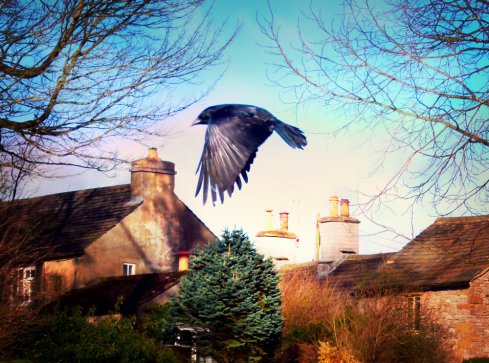
Linked to Sue Vincent’s Flight #writephoto.
Photo provided by Sue Vincent for the prompt.





 Poetry, Short Prose and Walking